
Watercolor Portrait Collage
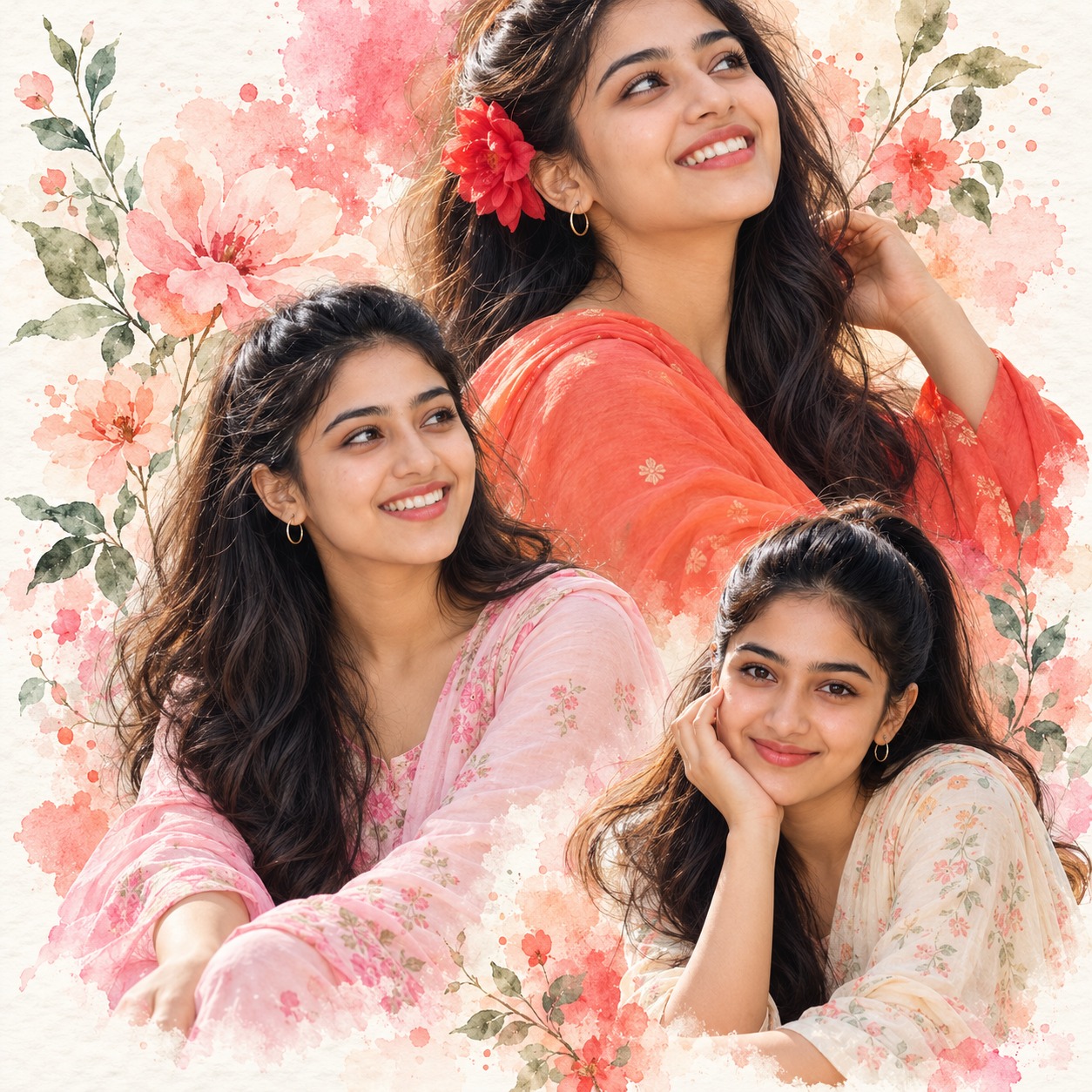
The Watercolor Portrait Collage concept combines realistic portrait photography with the delicate appearance of watercolor painting. It brings together three photographs of the same woman, each showing a different outfit, pose, and expression. Rather than placing the photographs in a rigid grid, the composition uses overlapping layers and softly fading edges to create an artistic arrangement that feels personal, expressive, and visually balanced.
The square canvas provides a compact space for the three portraits and their decorative background. A pale cream-white surface acts as the foundation, giving the composition a bright and airy appearance. The largest portrait occupies the upper-central and upper-right areas, while two smaller portraits overlap near the bottom. This arrangement creates a natural sense of depth and directs attention toward the colorful clothing, expressive faces, and soft watercolor details.
The upper portrait is the most visually prominent element. The woman wears a rich coral-orange traditional Indian outfit with a naturally draped silhouette and gentle fabric folds. Her head tilts backward and turns upward toward the side, creating a graceful pose that differs from the more direct expressions in the lower portraits. One hand rises near her hair as though she is gently touching or arranging it. A vivid red flower tucked beside her dark hair introduces a strong decorative accent.
The upper photograph is intentionally cropped by the top edge of the composition. This creates an editorial feeling, as though the portrait extends beyond the visible paper. The crop also gives the upper section a more spontaneous character instead of making it resemble a conventional framed photograph. The visible portions of the face, hair, and clothing remain the main points of interest, while the coral outfit provides a rich area of color behind the lower portraits.
Her dark hair is thick, long, and loosely wavy. It falls around her shoulders and extends down her back, creating a soft silhouette against the light background. Natural strand separation and subtle highlights contribute to the realistic photographic appearance. The red flower stands out against the darker hair, creating a vivid accent that complements the coral clothing without overwhelming the overall pastel palette.
The lower-left portrait provides a warmer and more openly expressive moment. The woman wears a pale blush-pink traditional outfit with delicate decorative details and soft fabric. Her body is positioned comfortably, and her head turns gently toward the right side of the composition. Her eyes follow the same direction, while her broad, tooth-visible smile creates a joyful and approachable expression.
Long, voluminous dark hair falls over both shoulders, with additional fullness along the left side of her body. This gives the lower-left portrait a balanced silhouette and adds contrast against the light background. Soft frontal illumination helps reveal natural facial features, individual hair strands, and the subtle texture of the outfit. The warm-neutral skin tones contribute to the gentle and romantic mood.
The smaller lower-right portrait introduces a quieter expression. The woman wears a cream or pale-peach traditional outfit with understated printed or embroidered details. She leans forward slightly, resting one hand against her cheek or chin. Her head inclines naturally toward the supporting hand, and her gaze meets the viewer with a gentle smile.
This relaxed pose adds variety to the composition. While the upper portrait feels expressive and upward-looking, and the lower-left photograph communicates joy, the lower-right portrait creates a softer and more intimate moment. The differences between these expressions make the three photographs feel like separate personal memories brought together in one artwork.
The arrangement of the portraits is central to the design. The large upper photograph sits behind the two smaller photographs, allowing their overlapping edges to establish depth. The medium lower-left portrait occupies a substantial portion of the bottom area, while the compact lower-right portrait balances the opposite side. This asymmetrical layout feels more natural than a symmetrical arrangement and creates an editorial quality.
The watercolor background provides the visual connection between all three photographs. Pale ivory and cream tones keep the composition bright, while translucent washes of coral, peach, dusty rose, and blush pink echo the clothing colors. Loose botanical shapes and soft floral illustrations appear around the left edge and upper-right region. Muted sage-green leaves introduce a natural accent that balances the warmer colors.
The flowers are intended to feel loosely painted rather than arranged as a formal border. Petals, small blossoms, delicate branches, and irregular brush marks contribute to the handmade appearance. Some pigment areas spread softly into the paper, while others retain more defined watercolor edges. This variation gives the background a sense of movement without creating unnecessary visual clutter.
One of the most distinctive features is the transition between photographic realism and watercolor illustration. The faces, eyes, smiles, hair, and clothing remain detailed and lifelike. The outer edges of the portraits, however, gradually blend into translucent pigment washes and irregular brush-shaped forms. Selected hair edges and fabric boundaries soften into the background, making the photographs appear integrated with the surrounding artwork.
This blending requires a careful balance. If the watercolor texture spreads too heavily across the faces, important facial details can become unclear. If the photographs retain hard rectangular borders, the mixed-media effect becomes less convincing. The concept therefore emphasizes soft feathering, gradual transitions, and organic edges while keeping the main facial features crisp and recognizable.
Lighting is soft, diffused, and natural throughout the composition. Gentle highlights reveal the contours of the face, the texture of the hair, and the folds of the traditional outfits. Shadows remain subtle, avoiding the dramatic contrast associated with darker cinematic portraits. This high-key treatment supports the pale background and helps the coral, blush-pink, and cream garments retain their individual colors.
The overall color palette combines coral orange, red, blush pink, dusty rose, ivory, muted sage, and dark brown. The coral outfit provides the strongest color area, while the red flower offers a smaller, more concentrated accent. The blush-pink and cream outfits soften the lower section, and the dark hair adds definition against the pale background.
Subtle paper grain and watercolor pigment textures contribute to the fine-art appearance. Organic splashes, translucent washes, and loose brush marks provide visual interest around the portraits. These details should remain secondary to the people, ensuring that the composition feels artistic without becoming crowded or overly decorative.
The concept is suitable for personalized portrait artwork, traditional fashion collages, social media posts, decorative prints, digital greeting designs, and fine-art photography presentations. Its square format is convenient for profile-oriented layouts and compact digital displays. The combination of several outfits and expressions also makes it useful for presenting different photographic moments in one unified composition.
For users who appreciate traditional Indian clothing and romantic artwork, this design offers a distinctive alternative to a standard photo collage. The realistic portraits provide personality and emotional connection, while the watercolor background introduces softness, color, and artistic character. The overlapping layers create depth, and the floral elements give the composition a gentle, natural atmosphere.
The main creative strength of this concept is its balance between detail and delicacy. The photographs remain the emotional center of the artwork, while the watercolor textures soften the surrounding space. Each outfit contributes a different color, each pose introduces a different mood, and the botanical elements unite the composition into one coherent visual presentation.
Watercolor Portrait Collage styling is especially appealing when the photographs retain their natural expressions and realistic details. The soft background, warm pastel colors, and irregular edges create an elegant fine-art effect without taking attention away from the subject. Together, these features establish a romantic, expressive, and visually harmonious portrait concept.
[[[
A. REFERENCE ANALYSIS
- Style: Photorealistic portrait collage blended with watercolor illustration and mixed-media fine art.
- Composition: Square 1:1 canvas, three overlapping portraits, asymmetrical arrangement.
- Top portrait: Large cropped portrait in a coral-orange traditional outfit, head tilted upward, one hand near the hair, vivid red flower accessory.
- Lower-left portrait: Medium seated portrait in a blush-pink traditional outfit, long wavy hair, head turned slightly right, broad natural smile.
- Lower-right portrait: Smaller leaning portrait in a cream or pale-peach outfit, one hand supporting the cheek, gentle smile toward the camera.
- Background: Pale cream-white paper with watercolor flowers, loose botanical shapes and peach-pink pigment washes.
- Lighting: Soft, diffused illumination with warm-neutral skin tones and gentle shadows.
- Color palette: Coral, peach, blush pink, ivory, muted sage and dark brown.
- Texture: Loose watercolor brushwork, translucent washes, soft pigment bleeding, organic splashes and feathered photo edges.
B. MASTER PROMPT
Photorealistic Portrait Photography + Mixed-Media Watercolor Portrait Illustration + Romantic Indian Ethnic Fashion Editorial + Three-Portrait Photographic Collage + Fine-Art Digital Watercolor Composition + Square 1:1 Aspect Ratio + Layered Multi-Scale Portrait Montage + Asymmetrical Editorial Layout + Large Cropped Upper Portrait + Medium Lower-Left Portrait + Smaller Lower-Right Portrait + Overlapping Photographic Layers + Soft Feathered Image Masking + Organic Watercolor Edges + Airy White Negative Space + Elegant Feminine Aesthetic + Warm Pastel Color Palette + High-Resolution Facial Details.
OVERALL COMPOSITION: Create a square artistic portrait collage featuring three photographs of the same woman, arranged in overlapping layers against a pale cream-white background. Combine realistically rendered photographic faces and hair with delicate watercolor flowers, translucent pigment washes, organic paint splashes and soft botanical illustrations. Place the largest portrait across the upper-central and upper-right portions, partially extending beyond the top crop. Position a medium portrait in the lower-left quadrant and a smaller portrait in the lower-right quadrant. Keep the upper portrait behind both lower portraits. Preserve the asymmetrical balance, airy negative space and soft, irregular transitions between photographs and watercolor elements.
LARGE UPPER PORTRAIT: Show the woman wearing a rich coral-orange traditional Indian outfit with soft fabric folds and a naturally draped silhouette. Her upper torso faces slightly sideways, her head tilts backward and turns upward toward the side, and one hand rises near her long dark hair as though gently touching or arranging it. A vivid red flower is tucked beside her hair. Her voluminous, dark,
loosely wavy hair cascades around her shoulders and down her back, with natural strand separation and subtle highlights. Crop the portrait dramatically so part of the upper face extends beyond the top edge; do not artificially reveal facial details hidden by the crop. Preserve the warm coral fabric, the red flower and the graceful upward-facing pose. Use warm, diffused illumination with soft highlights on visible skin and hair.
LOWER-LEFT PORTRAIT: Place a medium-sized photographic portrait in the lower-left quadrant, overlapping the lower portion of the large upper portrait. The woman wears a pale blush-pink traditional Indian outfit with delicate floral or ornamental details and soft, lightweight fabric. She sits or leans comfortably with relaxed shoulders and a natural, slightly three-quarter body orientation.
Her head turns gently toward the right side of the frame, and her eyes look off-camera in the same direction. Give her a joyful, open, tooth-visible smile. Her long, voluminous, dark wavy hair falls over both shoulders, with more pronounced volume along the left side of her body. Preserve natural facial proportions, realistic skin texture, expressive dark eyes and fine individual hair strands. Use soft frontal daylight, gentle shadows and a natural warm-neutral skin tone.
LOWER-RIGHT PORTRAIT: Position a smaller portrait in the lower-right quadrant, partially overlapping the lower-left portrait and surrounding watercolor background. Show the woman wearing a light cream or pale-peach traditional outfit with understated printed or embroidered details. She leans slightly forward, with one elbow supported below the crop and one hand gently resting against her cheek or chin. Her head inclines toward the supporting hand, her gaze is directed toward the camera, and her expression is a soft, relaxed smile. Her long dark hair falls naturally over her shoulders. Maintain plausible hand-to-face contact, realistic finger anatomy and a relaxed posture. Use evenly diffused light and soft facial shadows.
WATERCOLOR BACKGROUND AND FLORAL ELEMENTS: Build a mostly white and pale-ivory paper background with subtle watercolor paper grain. Surround the portraits with translucent washes of dusty rose, blush pink, peach, coral and warm cream. Add loose watercolor blossoms, delicate petals, soft botanical branches and muted sage-green leaves around the left edge and upper-right region. Use expressive but restrained pigment splashes, wet-on-wet color diffusion, delicate brush marks and naturally bleeding watercolor edges. Keep the florals irregular, airy and integrated with the photographs rather than arranged as a rigid border. Allow small floral washes to extend behind and around the portraits without obscuring faces.
PHOTO-TO-WATERCOLOR BLENDING: Preserve realistic photographic rendering in the faces, eyes, smiles, hair and clothing while blending the outer edges into painterly watercolor textures. Use soft white feathering, translucent pigment overlays, irregular brush-shaped masks and gradual color transitions. Let selected hair edges and garment boundaries dissolve naturally into pale watercolor washes. Avoid making the facial features themselves painterly or indistinct. Maintain a clear distinction between detailed photographic subjects and the softer illustrated background.
LIGHTING AND COLOR: Soft, high-key diffused natural light across all three portraits, with warm-neutral skin tones, subtle peach highlights and delicate shadow transitions. Keep the overall contrast gentle, while dark hair provides definition against the light background. Use a coordinated pastel palette of coral orange, blush pink, dusty rose, cream, ivory, muted sage green and dark brown. Let the upper coral outfit and red flower provide the strongest color accents. Preserve the pale, luminous background without washing out the clothing or facial features. Apply restrained pastel color grading, smooth tonal transitions and natural color variation.
TEXTURE AND FINISH: Fine hair strand detail, expressive dark eyes, natural skin texture, delicate traditional fabric folds, understated embroidery, soft photographic focus, translucent watercolor pigment layers, loose botanical brushwork, subtle paper texture and organic pigment granulation. Apply selective sharpness to the faces, with softer focus and painterly edges around the background and decorative flowers. Avoid artificial plastic skin, excessive smoothing, exaggerated saturation, heavy grain, harsh shadows and strong digital sharpening.
FINAL RESULT: An elegant square three-portrait collage combining lifelike South Indian traditional portraits with romantic watercolor florals. Preserve the large cropped coral-orange portrait above, the smiling blush-pink portrait at lower left, the smaller cream-colored leaning portrait at lower right, and the pale watercolor background with pink and coral botanical accents. Keep the arrangement layered, airy, softly blended and visually balanced, with realistic faces and hair against a delicate mixed-media artistic finish.
C. EDITABLE VARIABLES
| Variable | Current value |
|---|---|
| [USER IDENTITY] | Same woman across all three portraits |
| [CAMERA ANGLE] | Eye-level for lower portraits; upward-facing head in upper portrait |
| [POSE & BODY GEOMETRY] | Upper hand near hair; lower-left seated; lower-right cheek supported by hand |
| [FACE DIRECTION & EXPRESSION] | Upper face tilted upward; lower-left smiling sideways; lower-right soft smile toward camera |
| [OUTFIT & ACCESSORIES] | Coral-orange, blush-pink and cream traditional outfits; red hair flower |
| [LIGHTING & SHADOWS] | Soft, diffused, high-key natural illumination |
| [COLOR & MOOD] | Warm pastel palette, romantic and airy |
| [TEXTURE & EFFECTS] | Watercolor washes, organic splashes, feathered photo edges |
| [BACKGROUND & OBJECTS] | Ivory-white background, watercolor flowers and botanical accents |
| [ASPECT RATIO] | Square 1:1 |
| [AUTHORIZED CHANGES] | None specified; preserve the reference composition |
D. NEGATIVE PROMPT
Wrong identity, inconsistent facial identity, duplicated faces within a single portrait, extra portraits, missing portraits, incorrect three-portrait arrangement, frontal pose replacing the upward-facing upper portrait, incorrect head direction, altered hand positions, malformed fingers, unnatural hand-to-cheek contact, distorted anatomy, invented visible body parts, incorrect crop, zoomed-out upper portrait, fully revealed upper face, altered outfit colors, missing red hair flower, extra jewellery, invented accessories, excessive embroidery, straight hair replacing wavy hair, artificial hair texture, plastic skin, excessive skin smoothing,
beauty filters, distorted eyes, unnatural smiles, painterly faces, cartoon faces, anime style, 3D render, harsh outlines, hard rectangular photo borders, jagged masking, excessive watercolor bleeding over faces, overly dense floral decoration, cluttered background, dark background, oversaturated colors, neon pink, excessive orange grading, muddy skin tones, harsh shadows, blown highlights, excessive glow, heavy film grain, excessive sharpening, lost facial detail, missing negative space, typography, text, logos, watermarks, unnecessary borders, unrequested changes.
E. RECONSTRUCTION BLUEPRINT
Create a square fine-art portrait collage on a pale cream-white background, featuring three overlapping photographs of the same woman in traditional Indian clothing. A large coral-orange portrait fills the upper-central and upper-right areas, with the woman tilting her head upward, one hand near her dark wavy hair and a vivid red flower tucked beside it. Part of her face is cropped by the top edge. A medium portrait overlaps the lower-left, showing her in a blush-pink outfit, seated comfortably with voluminous dark hair, looking toward the right and smiling broadly. A smaller portrait overlaps the lower-right,
showing her in a cream or pale-peach outfit, leaning forward with one hand against her cheek and a gentle gaze toward the viewer. Blend the photographs into the background with soft white feathering and irregular watercolor edges. Add loose coral, peach, blush-pink and cream watercolor blossoms, muted sage leaves and translucent pigment splashes along the left edge and upper-right region. Use soft natural light, realistic faces and hair, delicate fabric details, subtle paper texture and an airy pastel palette. Maintain the three distinct poses, original clothing colors, asymmetric layering and gentle romantic atmosphere.
F. LIMITATIONS
- The upper portrait is cropped, so its full facial expression and exact gaze cannot be reliably reconstructed.
- Fine jewellery and garment embroidery are indistinct; avoid inventing elaborate details.
- The watercolor decorations appear digitally composited or illustrated; the exact original technique is uncertain.
- For consistent identity across all three portraits, use an identity reference alongside this prompt where image-conditioning tools are available. Text alone cannot guarantee exact facial identity or pixel-perfect reproduction.
]]]