
Vintage Saree Collage
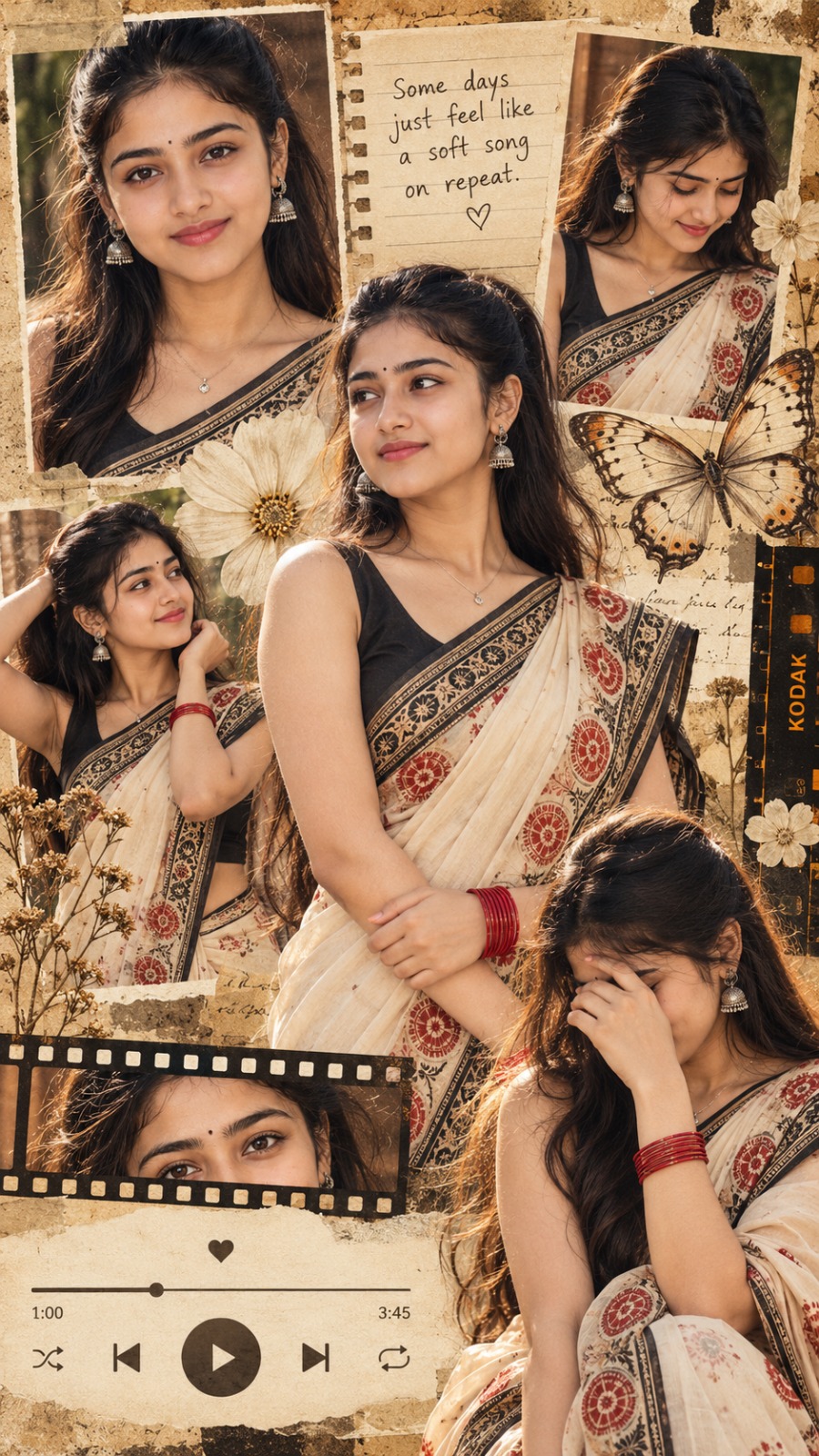
The Vintage Saree Collage concept combines traditional Indian fashion photography with the nostalgic charm of analog film, aged paper, and retro music-player graphics. The overall design resembles a personal scrapbook or vintage music album cover, bringing together several portraits of the same woman in one carefully layered composition. Warm colors, detailed textile patterns, botanical decorations, and handwritten notes create a visual story that feels intimate, expressive, and timeless.
The main subject is a South Indian woman wearing an ivory cotton saree with a distinctive dark border. The saree features repeated rust-red circular motifs, cream ornamental patterns, and intricate black detailing. A black sleeveless blouse provides a strong contrast against the lighter fabric. This combination creates a recognizable traditional look while allowing the saree’s decorative border to become one of the most important visual elements.
The central portrait is the main focal point. The woman stands with her torso facing mostly forward while her head turns toward the left. Her eyes look beyond the frame, and her gently closed lips create a thoughtful, composed expression. One forearm bends across her waist, with the hand resting naturally near the opposite side of her abdomen. Her relaxed posture gives the photograph an understated elegance rather than a formal or rigid appearance.
Her long, dark hair falls naturally around her shoulders and down her back. Individual strands and subtle highlights contribute to the realistic photographic finish. Traditional silver-toned jhumka earrings frame her face, while a small black bindi adds a recognizable detail to her styling. A delicate pendant necklace introduces another subtle accent, and red glass bangles bring a touch of color to the wrist.
The surrounding portraits show different expressions and gestures while maintaining the same clothing style. An upper-left close-up presents the woman facing almost directly toward the camera, with a calm expression and softly arranged hair. This portrait establishes a clear facial focal point and balances the more directional gaze of the central figure.
The upper-right photograph captures a quieter moment. Her head tilts downward, and her gaze falls toward her clothing or hands. The dark hair frames her face, while the ivory saree’s patterned border crosses diagonally across her torso. This pose adds an introspective quality and creates variety within the collage.
The middle-left portrait introduces a more active gesture. One arm rises toward the side or back of her head, while the other hand rests near her jaw or neck. Her head turns to the left, and loose hair strands contribute to a natural, candid appearance. The repeated saree pattern links this photograph visually to the central portrait, helping the multiple images feel like parts of one photographic series.
The lower-right portrait provides a more dramatic contrast. The woman lowers her head and raises one hand across her face, partially covering her eyes and nose. Her long hair falls forward, and red bangles remain visible near the raised wrist. This gesture introduces mystery and movement, balancing the calm expressions in the other photographs.
A narrow filmstrip portrait adds another visual layer near the lower section. It focuses on the woman’s eyes and upper face within a horizontal frame bordered by small rectangular film perforations. This detail references traditional analog photography and creates a strong visual connection between the portraits and the vintage scrapbook theme.
The background is built from aged beige paper, notebook pages, weathered photographic fragments, and handwritten-looking marks. Paper fibers, worn edges, and overlapping layers give the composition a tactile appearance. Rather than using a clean, modern backdrop, the design creates the impression of personal photographs collected over time and arranged into an artistic memory board.
One notebook page contains the handwritten sentence, “Some days just feel like a soft song on repeat.” The informal lettering and small heart beneath it contribute to the reflective mood. The sentence connects the visual theme with music and memories, making the composition feel like a personal album cover rather than a conventional fashion poster.
Botanical decorations soften the darker photographic elements. A pale cream flower sits behind the central figure, while dried stems and delicate seed heads extend along the lower-left area. A smaller floral detail appears within a narrow decorative panel on the right. These natural elements complement the aged paper and add a gentle contrast to the strong geometric shapes of the filmstrip.
A large illustrated butterfly occupies the upper-right and central-right region. Its cream and warm-brown wings feature delicate markings and fine outlines, giving it the appearance of a vintage natural-history illustration. The butterfly adds visual interest while supporting the nostalgic, collected-paper aesthetic.
The narrow vertical film graphic along the right edge introduces another retro design element. Dark film-like sections, small numeric markings, and warm orange lettering evoke traditional photographic film packaging. Its narrow placement makes it a supporting detail rather than a competing focal point.
The retro music-player panel anchors the bottom of the composition. Its cream-beige surface contains a horizontal progress line, a circular progress marker, timestamps, and recognizable playback symbols. Shuffle, previous-track, play, next-track, and repeat controls create the appearance of a vintage audio interface. A small heart above the controls reinforces the connection between music, personal memories, and emotion.
Lighting plays an important role in unifying the photographs. Warm directional illumination creates gentle highlights on the face, hair, hands, and saree fabric. Soft shadows preserve facial dimension and reveal the natural folds of the cotton material. Amber highlights contrast with olive-brown shadows, creating a cinematic appearance without relying on excessively bright colors.
The color palette combines creamy ivory, aged beige, sepia brown, black, rust red, muted burgundy, and subtle olive tones. The light saree remains visible against the darker photographic layers, while the red motifs and bangles provide concentrated color accents. Warm paper tones connect the portraits, flowers, butterfly, and music-player panel into one cohesive design.
Analog film grain, subtle vignetting, soft background defocusing, and matte textures reinforce the vintage finish. These effects are restrained so that the faces, textile details, and handwritten sentence remain recognizable. The composition depends on the balance between photographic realism and decorative collage elements rather than heavy visual effects.
This style is suitable for traditional fashion editorials, nostalgic social media posters, personal portrait collections, music-inspired artwork, scrapbook designs, and creative fashion moodboards. Its vertical format works well for portrait-oriented digital displays, while the layered arrangement provides a distinctive alternative to a simple single-photo design.
The greatest strength of the concept is its storytelling. Each portrait reveals a different expression or gesture, while the saree, jewelry, and color grading maintain continuity. The notebook sentence adds a reflective message, the flowers and butterfly introduce softness, and the retro music controls connect the design with a nostalgic listening experience.
For users who appreciate Indian ethnic fashion and vintage-inspired visuals, this concept offers a sophisticated combination of traditional styling and analog-film aesthetics. Its warm palette, layered photographs, and textured paper create a memorable visual identity that feels personal, artistic, and emotionally expressive.
Rank Math Ready Post Content:
Vintage Saree Collage styling combines traditional Indian fashion, cinematic portrait photography, and nostalgic scrapbook design in one visually rich composition. The concept features a woman wearing an ivory cotton saree with a dark ornamental border, rust-red motifs, silver earrings, and red bangles. Layered portraits, aged notebook paper, botanical details, and retro music-player graphics create a memorable vintage atmosphere.
The vertical composition brings together several photographs of the same woman, each showing a different pose and expression. Warm sepia grading unifies the images, while the detailed saree pattern provides a recognizable visual connection throughout the collage.
Vintage Saree Collage Design and Visual Appeal
A Vintage Saree Collage combines realistic portrait photography with the tactile appearance of old photographs, paper fragments, and analog film. Its layered arrangement creates depth and makes the composition resemble a personal scrapbook or nostalgic music album cover.
The central portrait remains the main focal point. The woman stands with her torso facing forward and her head turned toward the left, creating a thoughtful expression. Her relaxed posture and natural facial features give the photograph an understated elegance.
Supporting portraits surround the central figure, showing different expressions and gestures. These photographs add variety while maintaining consistent clothing, accessories, and warm color grading.
Vintage Saree Collage With Traditional Indian Fashion
The ivory cotton saree provides the foundation of the visual design. Its broad black-brown border features rust-red circular motifs, cream ornamental shapes, and fine decorative details. A black sleeveless blouse creates contrast against the lighter fabric.
Silver-toned jhumka earrings, a small black bindi, a delicate pendant necklace, and red glass bangles complete the styling. These accessories add traditional character without distracting from the saree’s distinctive pattern.
A Vintage Saree Collage benefits from this balance between light fabric and dark ornamental detailing. The contrasting colors remain recognizable across the different photographs, helping the composition feel unified.
Cinematic Lighting and Warm Colors
Soft directional lighting creates gentle highlights across the face, hair, hands, and saree. Subtle shadows preserve natural facial contours and reveal the cotton fabric’s folds.
The color palette includes creamy ivory, aged beige, sepia brown, black, rust red, muted burgundy, and olive-brown shadows. Warm highlights create a nostalgic mood, while restrained saturation keeps the photographs realistic.
This Vintage Saree Collage approach works particularly well when the faces remain naturally textured and the textile details retain their clarity. Subtle film grain and a matte finish reinforce the analog aesthetic without making the images appear excessively aged.
Vintage Scrapbook Background and Decorations
The background uses layered notebook pages, weathered paper fragments, old photographic textures, and handwritten-looking marks. A notebook page carries the sentence, “Some days just feel like a soft song on repeat.” Its informal lettering and small heart add a reflective, personal touch.
Pale flowers and dried botanical stems soften the arrangement. A large illustrated butterfly introduces a delicate decorative focal point, while a narrow vertical film graphic adds a retro photographic reference.
A Vintage Saree Collage feels most balanced when these details support the portraits rather than competing with them. The aged paper creates texture, but the woman’s face and traditional outfit remain the most important visual elements.
Retro Music-Player Interface
The cream-colored music-player panel anchors the lower portion of the poster. It includes a progress bar, timestamps, a circular progress marker, and shuffle, previous-track, play, next-track, and repeat symbols.
The interface gives the collage the appearance of a nostalgic music-themed editorial. Its simple lines and muted brown controls complement the surrounding paper textures and warm color palette.
The narrow filmstrip portrait adds another layer of analog photography inspiration. Small rectangular perforations along the strip distinguish it from the surrounding paper and provide a clear visual divider.
Creative Uses for Vintage Portrait Artwork
A Vintage Saree Collage is suitable for social media posters, traditional fashion editorials, personal portrait collections, music-inspired artwork, and scrapbook-themed designs. Its vertical format is well suited to portrait-oriented digital displays.
The layered photographs provide more visual storytelling than a single portrait. Different expressions create a sense of personality, while the repeated saree pattern connects each image into one coherent presentation.
For a polished composition, maintain the central portrait’s visual prominence, preserve the traditional textile details, and keep the handwritten sentence readable. Decorative flowers, the butterfly, and the music-player interface should remain supporting elements.
Why Choose a Vintage Saree Collage?
The appeal of a Vintage Saree Collage lies in the combination of traditional clothing, cinematic lighting, and nostalgic design details. The ivory saree introduces elegance, the red motifs add color, and the layered portraits create visual depth.
The notebook writing adds emotional context, while the flowers and butterfly soften the composition. Retro film graphics and music-player controls connect the design with analog photography and personal listening memories.
This style suits people who appreciate traditional Indian fashion presented through an artistic vintage aesthetic. It offers a distinctive alternative to clean modern layouts by combining natural expressions, aged textures, and thoughtful decorative details.
For the strongest visual balance, preserve the different portrait poses, keep the warm colors controlled, and ensure the central face remains the primary focal point. Allow the paper textures and music-player graphics to complement the photographs without overwhelming them.
Vintage Saree Collage artwork ultimately combines fashion, photography, and nostalgia in a layered visual story. Its traditional styling, warm sepia tones, botanical accents, and retro audio interface create a sophisticated concept for memorable portrait presentations.
[[[
A. REFERENCE ANALYSIS
- Style: Photorealistic Indian ethnic fashion photography + vintage analog-film scrapbook collage + retro music-player editorial design.
- Format: Vertical 9:16 poster with dense, overlapping photographs.
- Main portrait: Large central three-quarter portrait, torso facing forward, head turned left, eyes gazing off-frame, calm and thoughtful expression.
- Supporting portraits: Upper-left frontal close-up, upper-right downward gaze, middle-left hair-adjusting pose, lower-right face partially covered by a hand, plus a narrow cropped portrait in the lower filmstrip.
- Outfit: Ivory cotton saree with a broad black-brown border, repeating rust-red circular motifs and cream ornamental patterns; black sleeveless blouse.
- Accessories: Silver-toned jhumka earrings, small black bindi, delicate pendant necklace and red glass bangles.
- Background: Aged beige paper, handwritten notebook text, pale flower, dried botanical stems, butterfly illustration and vintage film graphics.
- Lighting: Warm directional light, soft facial highlights, gentle shadows and muted sepia grading.
- Special design element: Cream-colored retro music-player panel with playback controls, timestamps and progress bar.
B. MASTER PROMPT
Photorealistic Indian Ethnic Fashion Photography + Cinematic Editorial Portraiture + Vintage Analog Film Aesthetic + Nostalgic Scrapbook Collage + Multi-Frame Portrait Montage + Layered Photographic Composition + Vertical 9:16 Poster Layout + Warm Sepia Color Grading + Amber-Toned Color Palette + Muted Earth-Tone Aesthetic + Creamy Beige Highlights + Burnt Orange Accents + Deep Burgundy Details + Olive-Brown Shadows + Natural Skin Texture + Detailed Facial Features + Traditional Handloom Saree Styling + Vintage Analog Photography Moodboard.
CANVAS AND COMPOSITION: Create a vertical 9:16 poster composed of five photographic portrait crops of the same woman, layered with vintage paper, botanical decorations, filmstrip overlays and a retro music-player interface. Use an asymmetrical editorial arrangement with overlapping photographs, uneven collage boundaries, tactile aged-paper textures and a warm nostalgic atmosphere. The central standing portrait must be the dominant focal point, with the upper-left close-up, upper-right downward-looking portrait, middle-left hair-adjusting portrait, lower-right face-covering portrait and narrow lower filmstrip portrait surrounding it.
MAIN CENTRAL PORTRAIT: Place a large three-quarter portrait in the center, extending from the upper-middle region to the lower-middle of the composition. Show a South Indian woman standing upright, torso facing mostly forward, shoulders relaxed, head rotated toward the left side of the frame and eyes looking farther toward the same side. Her chin remains approximately neutral, lips gently closed, and expression thoughtful and composed. One forearm bends inward across her waist, with her hand resting naturally near the opposite side of her abdomen.
Several red glass bangles encircle the visible wrist. Her long dark hair falls naturally around her shoulders and down her back. She wears an ivory or cream cotton saree with a wide dark brown and black border decorated with repeated rust-red circular motifs, cream ornamental shapes and intricate fine black detailing. A black sleeveless blouse is clearly visible beneath the drape. Add traditional silver-toned dangling jhumka earrings and a small dark bindi centered on the forehead. Use warm, directional frontal-to-side illumination, realistic facial contours and natural skin texture.
UPPER-LEFT CLOSE-UP: Position a large close-up portrait in the top-left corner, framed from the upper chest to just above the head. The woman faces almost directly toward the camera, shoulders subtly angled, head nearly upright, eyes directed toward the viewer, lips closed and expression calm and neutral. Long dark hair is loosely arranged, with fine strands framing both sides of the face. Preserve the small dark bindi, silver-toned dangling earrings and delicate necklace with a small pendant. The ivory saree border crosses diagonally near the chest over a black sleeveless blouse. Use warm, soft frontal lighting and a muted beige background. Keep the face detailed, naturally proportioned and softly illuminated.
UPPER-RIGHT PORTRAIT: Place a smaller vertical photograph in the upper-right corner. The woman’s torso angles slightly away from the camera, her head tilts forward and her gaze falls downward toward her clothing or hands. Her lips remain gently closed, creating a quiet, introspective expression. Long dark hair falls forward around her face. The ivory saree drapes diagonally across the upper torso, displaying the same bold black, cream and rust-red folk-art border. Include traditional earrings and soft warm light. Preserve the smaller photograph’s independent framing and layer it behind the central portrait.
MIDDLE-LEFT HAIR-ADJUSTING PORTRAIT: Place a smaller standing portrait along the left side, partially behind the central figure. Her torso turns partly sideways. One arm is raised, with the hand near the side or back of her head, while the opposite hand rests near her jaw or neck. Both elbows bend naturally. Her head and gaze turn toward the left side of the frame. Her long dark hair is arranged loosely, with natural flyaway strands. Preserve the same ivory patterned saree, black blouse and silver-toned earrings. Use soft directional light with warm highlights on her face and arms.
LOWER-RIGHT FACE-COVERING PORTRAIT: Position a large three-quarter-body portrait in the lower-right corner, overlapping the bottom of the central figure and part of the music-player area. The woman turns her torso slightly sideways and dips her head forward. One hand rises across her face, obscuring the eyes and part of the nose. The elbow bends naturally in front of her torso.
Long dark hair falls forward and down her back, covering a substantial portion of the saree. Keep the broad ornamental border visible over the shoulder and body, with rust-red circular motifs, cream decorative shapes and black detailing. Red bangles remain visible near the raised wrist. Use directional amber light to illuminate selected sections of the hair, hand and fabric while preserving soft shadows.
LOWER FILMSTRIP PORTRAIT: Include a narrow horizontal crop of the woman’s eyes and upper face near the lower-left-to-center region, positioned within or directly beneath a horizontal vintage filmstrip. Show only the visible portion of the face that fits naturally within the narrow frame. Keep the small bindi, dark eyes and surrounding hair consistent with the other portraits. Add repeated small cream-white rectangular film perforations along the top and bottom edges of the strip. Preserve the filmstrip as a clear compositional divider.
BACKGROUND AND PAPER TEXTURES: Construct the background from layered beige notebook paper, aged parchment, worn printed ephemera, warm brown photographic fragments and subtle paper fibers. Near the upper-center, include a beige ruled notebook page with visible spiral-binding holes along one edge. Render the exact handwritten sentence: “Some days just feel like a soft song on repeat.” Use informal dark-brown handwritten lettering arranged over several short lines, with a small outlined heart underneath. Keep the writing integrated into the collage and do not allow the main portrait to obscure its essential wording.
BOTANICAL DECORATIONS: Add a large pale cream-white flower behind the central subject, slightly left of the torso, with softly shaded petals and a subtle warm center. Place delicate dried botanical stems and seed heads along the lower-left side, overlapping the aged paper and photograph edges. Add a smaller pale flower within the narrow decorative image along the right edge. Botanical elements should resemble pressed flowers and vintage natural-history illustrations, with subdued brown, ivory and beige tones.
BUTTERFLY OVERLAY: Place a large illustrated butterfly across the upper-right and central-right region, partially overlapping the downward-looking portrait and nearby paper. Use translucent cream and warm brown wings, dark fine outlines, symmetrical wing markings and subtle vintage illustration texture. Keep the butterfly distinct from the woman’s clothing and facial features.
RIGHT-SIDE FILM GRAPHIC: Along the far-right edge, place a narrow vertical photographic or graphic panel featuring pale flowers and a dark film-related strip. Include partially visible vertical orange lettering and small numeric markings to suggest vintage photographic film packaging. Preserve the narrow crop, dark strip and warm orange lettering without introducing additional prominent text.
RETRO MUSIC-PLAYER INTERFACE: Reserve the bottom-left and bottom-center region for a cream-beige retro music-player panel. Include a thin horizontal playback progress line with a small circular progress marker, timestamp “1:00” at the left and “3:45” at the right. Beneath the progress line, arrange muted-brown shuffle, previous-track, large circular play, next-track and repeat symbols in a balanced horizontal row. Add a small muted-brown heart icon above the player controls. Use minimalist, recognizable icons, thin lines and a nostalgic vintage audio-interface aesthetic. Keep the panel partially overlapped by the lower-right portrait, preserving the collage’s layered depth.
LIGHTING AND COLOR GRADING: Warm tungsten-like ambient light, soft directional window illumination, gentle golden highlights on faces and hair, subtle warm rim lighting, deep olive-brown shadows and realistic skin-tone variation. Use an amber, sepia and creamy-beige palette with black fabric accents, rust-red motifs and burgundy details. Preserve moderate contrast, detailed shadows and soft highlight transitions. Avoid excessive orange saturation, artificial skin smoothing or overly bright exposure.
TEXTURE AND FINISH: Fine hair strands, realistic skin pores and facial detail, visible cotton weave, intricate folk-art textile patterns, delicate silver jewellery reflections, aged notebook fibers, faded paper edges, analog film grain, subtle vignette and soft background defocusing. Apply selective sharpness to the central face and primary textile details. Preserve a tactile scrapbook appearance, authentic photographic rendering and subtle matte finish.
FINAL HIERARCHY: The central standing portrait is the primary focal point. The upper-left close-up is the secondary facial focal point. The upper-right and middle-left portraits support the narrative. The lower-right face-covering portrait adds movement and contrast. The narrow filmstrip portrait, notebook writing, butterfly, botanical decorations and retro music-player controls provide supporting design details. Maintain the original relative placements, layering, outfit consistency, muted color grading and nostalgic music-album-cover atmosphere.
C. EDITABLE VARIABLES
| Variable | Current value |
|---|---|
| [CAMERA ANGLE] | Eye-level across most portraits |
| [POSE & BODY GEOMETRY] | Central standing pose; supporting candid poses |
| [FACE DIRECTION & EXPRESSION] | Central gaze left; close-up frontal; upper-right downward |
| [OUTFIT & ACCESSORIES] | Ivory patterned saree, black blouse, silver jhumkas, red bangles |
| [LIGHTING & SHADOWS] | Warm directional light, soft shadows |
| [COLOR & MOOD] | Sepia, amber, cream, rust red, dark brown |
| [TEXTURE & EFFECTS] | Analog film grain, aged paper, filmstrip overlay |
| [BACKGROUND & OBJECTS] | Notebook, butterfly, pale flower, dried stems, music-player panel |
| [TEXT] | “Some days just feel like a soft song on repeat.” |
| [ASPECT RATIO] | Vertical 9:16 |
| [AUTHORIZED CHANGES] | None specified; preserve the reference design |
D. NEGATIVE PROMPT
Wrong identity, inconsistent faces, mixed identities, duplicate facial features, missing portraits, incorrect number of portrait panels, wrong collage order, central portrait missing, altered central head direction, smiling central portrait, incorrect downward gaze, incorrect hair-adjusting pose, missing face-covering hand, malformed hands, extra fingers, unnatural joints, incorrect body proportions, changed saree design,
missing rust-red motifs, altered border colors, wrong blouse, missing bindi, missing silver earrings, missing red bangles, invented jewellery, unrealistic fabric texture, plastic skin, excessive smoothing, beauty filters, distorted eyes, overly sharp skin, harsh flash, cold blue lighting, excessive orange grading, oversaturated reds, flat lighting, crushed shadows, blown highlights, heavy glow, extreme blur, cartoon rendering, anime,
3D illustration, clean modern background, missing notebook text, misspelled handwriting, extra prominent text, missing butterfly, oversized butterfly covering the face, missing flower, excessive floral decoration, missing filmstrip, missing music-player interface, incorrect timestamps, illegible playback icons, misplaced music-player panel, straight uniform grid layout, hard cutout edges, cluttered overlapping faces, extra people, watermarks, logos, unrequested modifications.
E. RECONSTRUCTION BLUEPRINT
Create a vertical 9:16 nostalgic Indian fashion collage with five photographs of the same woman wearing an ivory saree with a wide black-brown border, rust-red circular motifs and cream folk-art patterns, paired with a black sleeveless blouse. Place a large frontal close-up in the upper-left, a small downward-looking portrait in the upper-right, the dominant standing portrait in the center with her head turned left and one forearm resting across her waist,
a hair-adjusting portrait at middle-left and a larger portrait at lower-right with one hand covering part of her face. Include a narrow cropped eye portrait inside a horizontal filmstrip near the lower section. Surround the photographs with aged beige notebook paper, handwritten text reading “Some days just feel like a soft song on repeat.”,
a pale flower, dried botanical stems and a large cream-and-brown butterfly. Add a narrow vertical film graphic along the right edge and a cream-colored retro music-player panel at the bottom with timestamps, progress bar, heart, shuffle, previous, play, next and repeat controls. Use warm sepia and amber grading, natural skin texture, soft directional lighting, subtle analog film grain, vintage paper textures and layered photographic depth. Preserve the distinct poses, traditional accessories, text placement, film elements and nostalgic music-album-cover design.
F. LIMITATIONS
- The precise identity of the person cannot be determined from the collage alone; use a separate identity reference if exact likeness is required.
- Small printed film lettering and decorative background details may not reproduce accurately in text-to-image generation.
- The handwritten sentence and playback interface may need to be added afterward in a graphics editor for exact spelling and clean controls.
- Camera specifications and exact physical locations are not identifiable from the reference; the lighting and perspective descriptions are visual estimates.
]]]