
Teal Saree Portrait
Understanding the Teal Saree Portrait Concept
The Teal Saree Portrait concept combines traditional Indian couture with sophisticated fashion photography and vintage editorial design. It brings together realistic portraits, intricate embroidery, traditional jewelry, botanical illustrations, and aged-paper textures to create a luxurious visual presentation. The overall aesthetic draws inspiration from heritage fashion magazines, fine-art portraiture, and carefully composed couture campaigns.
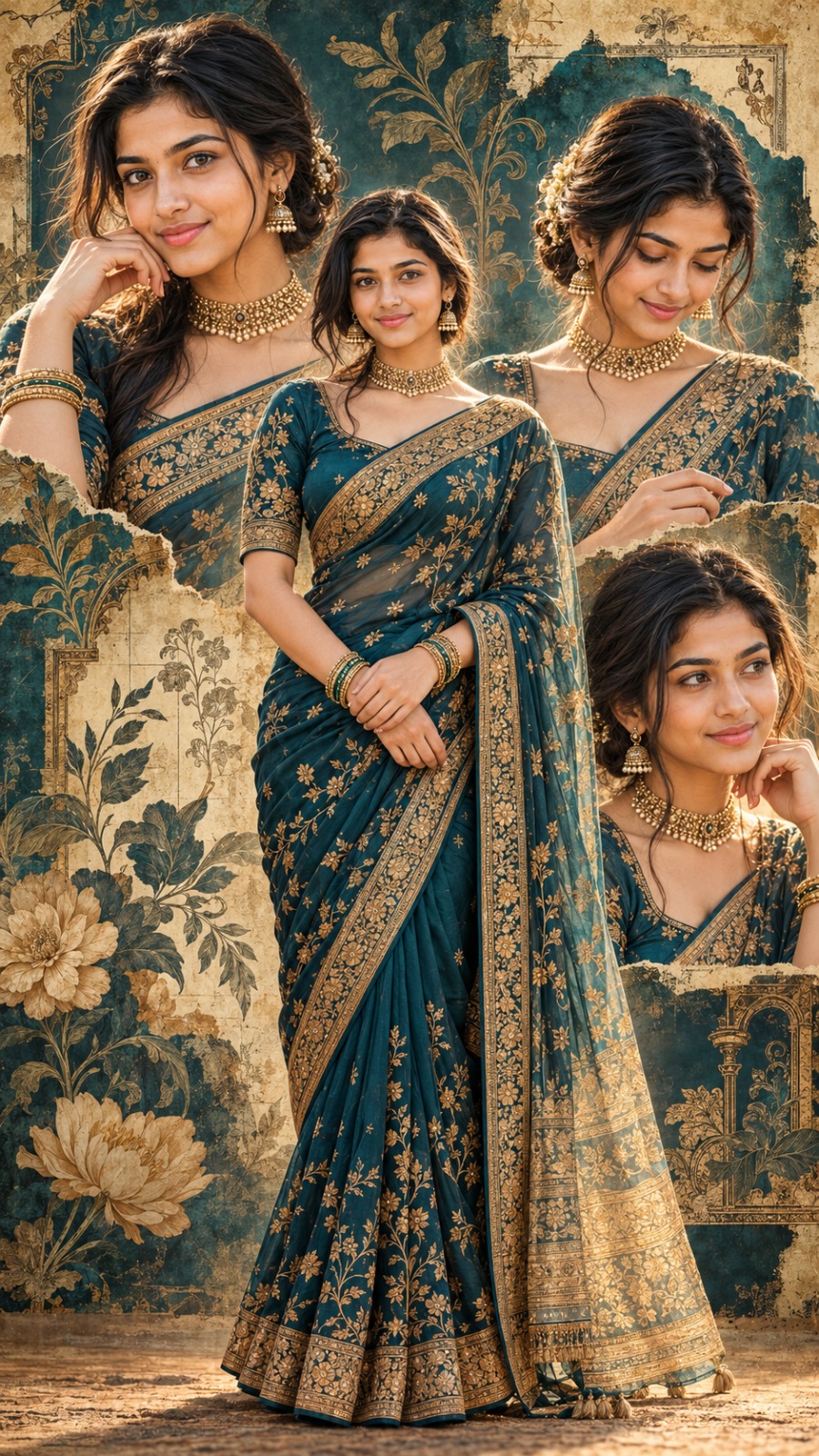
The central idea is to showcase the same adult Indian woman through four coordinated portraits arranged within a single vertical composition. Each portrait contributes a different expression, pose, and viewing angle while maintaining a consistent appearance. Together, the photographs communicate elegance, confidence, and cultural richness without relying on excessive decorative elements.
The Teal Saree Portrait style is distinctive because of its combination of rich fabric colors and antique-inspired surroundings. Deep teal and midnight blue create a sophisticated foundation, while gold embroidery introduces intricate detail and warm reflections. Muted olive, brown, and parchment beige soften the composition, giving it the character of an old fashion publication.
Main Subject and Personal Appearance
The main subject is an adult Indian woman dressed in traditional ethnic couture. Her appearance is defined by natural facial features, expressive dark eyes, carefully styled hair, and coordinated gold accessories. The overall presentation is elegant and composed, with an emphasis on authentic-looking skin texture and realistic facial proportions.
Her dark hair is styled into a neat low bun, with a few loose tendrils framing the face. This hairstyle complements the traditional clothing while keeping the neckline, earrings, and necklace visible. Fine individual strands and subtle highlights add realism without making the hairstyle appear overly polished or artificial.
The face is an important focal point throughout the composition. Naturally defined eyebrows, detailed eyelashes, balanced facial contours, and softly shaded skin contribute to the photographic quality. Restrained retouching preserves the natural appearance of the subject, allowing the expression and lighting to provide the main visual impact.
Consistency is essential because the woman appears in four different portraits. Her facial features, skin tone, hairstyle, jewelry, and clothing remain coordinated, creating the impression of a unified fashion editorial rather than a collection of unrelated photographs.
The Central Full-Body Portrait
The central portrait acts as the anchor of the entire design. The woman stands gracefully with relaxed shoulders, her torso facing mostly forward and her head turned slightly to one side. Her hands are gently clasped around waist level, creating a balanced and natural pose.
This posture communicates quiet confidence rather than exaggerated glamour. The relaxed positioning of the arms allows the saree’s draping, embroidered border, and jewelry to remain visible. Natural proportions and believable hand placement contribute to the refined photographic character.
The full-body view also reveals the relationship between the blouse, pleats, pallu, and decorative borders. The deep teal fabric creates a continuous color field, while the antique-gold embroidery introduces intricate patterns across selected areas. The central figure extends through much of the poster’s height, giving the composition a clear visual foundation.
The Teal Saree Portrait concept uses this central placement to establish hierarchy. The viewer notices the full-length figure first, then explores the surrounding close-ups and smaller details.
Three Supporting Portraits
Three additional portraits surround the central figure, creating a layered editorial collage. The upper-left photograph presents a closer view, cropped around the chest or waist. The woman’s head is gently tilted, and one hand rests near her chin, introducing a delicate gesture that emphasizes the jewelry and facial expression.
The upper-right portrait shows her looking downward toward the saree or her hands. This pose creates a quieter mood and draws attention to the embroidered fabric, the neckline, and the careful arrangement of accessories.
The smaller lower-right portrait provides another close view of her face. Her expression is soft and composed, with her gaze directed slightly to one side. This image adds variety to the layout and helps balance the central figure with the larger upper portraits.
Each supporting image has its own role, but none should feel disconnected from the others. Consistent lighting, wardrobe, facial features, and color grading create continuity. Overlapping edges and gentle transitions help the photographs blend into the vintage-inspired background.
Saree Design and Couture Details
The saree is the defining styling element. Its deep teal and midnight-blue shades create a rich foundation for antique-gold floral embroidery. The combination evokes traditional Indian craftsmanship while maintaining the polished appearance of contemporary luxury fashion editorials.
Intricate zari-inspired motifs, ornate borders, delicate metallic threadwork, and botanical patterns contribute visual richness. The embroidery should appear integrated into the fabric rather than floating on its surface. Fine highlights along the raised threads help communicate the texture of the decorative work.
The silk has a controlled sheen that responds naturally to the lighting. Soft folds around the waist, shoulders, and pallu establish the draping, while deeper blue shadows add dimension. A translucent section of fabric can introduce subtle variation without changing the overall color identity.
The blouse coordinates with the saree through matching dark teal tones and complementary gold embellishments. Maintaining the same clothing design across all four portraits is important because it makes the collage feel like one carefully styled fashion session.
The Teal Saree Portrait aesthetic places particular value on the relationship between textile detail and photographic realism. The fabric should look luxurious through its texture, folds, and reflective qualities rather than through excessive shine or oversaturated colors.
Traditional Jewelry and Hair Accessories
Gold jewelry adds another layer of cultural detail. An ornate choker necklace frames the neckline, while traditional statement earrings draw attention toward the face. Delicate bangles provide subtle highlights around the wrists, and small hair ornaments complement the low bun.
The jewelry uses warm metallic reflections that coordinate with the embroidery. Highlights appear on raised decorative surfaces, while softer shadows define the recessed details. This approach creates the appearance of real metal without making the accessories look excessively glossy.
The arrangement of jewelry supports the subject’s overall styling. The necklace and earrings provide focal details near the face, while bangles and hair ornaments add visual continuity across the different portraits.
A successful Teal Saree Portrait composition keeps these accessories coordinated. Their designs may vary slightly in visibility according to each crop, but their color, character, and general styling remain consistent.
Lighting and Color Harmony
Lighting gives the composition its cinematic depth. Soft directional illumination shapes the face, defining the cheekbones, nose, and jawline through gentle shadows. Warm golden highlights illuminate the jewelry and embroidery, while subtle teal ambient fill preserves the richness of the darker fabric.
A delicate rim light along the hair and shoulders helps separate the woman from the background. The result is dimensional but restrained, avoiding excessive glow or dramatic lighting that could overpower the traditional styling.
The color palette combines deep teal, midnight blue, antique gold, muted olive, warm brown, and parchment beige. Each color has a specific purpose. Teal and midnight blue establish depth, gold emphasizes craftsmanship, olive and brown provide background warmth, and parchment highlights introduce a vintage editorial quality.
The Teal Saree Portrait style relies on balanced contrast. The face remains readable, the dark saree retains its fabric detail, and the golden embroidery stands out without becoming excessively bright. This careful tonal relationship creates a polished, heritage-inspired atmosphere.
Vintage Botanical Background
The background resembles an aged botanical fashion publication. Weathered parchment, faded ink, fine engraved leaves, delicate floral illustrations, and distressed paper grain create a layered environment behind the portraits.
The botanical elements reinforce the floral embroidery on the saree. Their visual language connects the clothing with the background, creating a subtle relationship between the subject and the surrounding artwork. Muted olive and sepia tones keep the illustrations supportive rather than distracting.
Fine etching lines and faded ornamental plant silhouettes add complexity when viewed closely. At the same time, soft background diffusion and selective contrast preserve enough separation around the woman’s face and clothing.
The Teal Saree Portrait concept uses this background to evoke heritage and craftsmanship. It suggests the atmosphere of an archival fashion magazine while maintaining the clarity and richness of contemporary portrait photography.
Editorial Typography and Poster Composition
Elegant serif typography appears near the upper edge of the vertical poster. Its refined letterforms and careful spacing create the impression of a luxury magazine cover. The text remains secondary to the central figure, allowing the fashion imagery to dominate the composition.
The asymmetrical arrangement balances the four portraits without forcing them into a rigid grid. The central full-body photograph establishes the main axis, while the upper-left and upper-right portraits create visual weight near the top. The smaller lower-right image adds balance toward the bottom.
Negative space is important because it prevents the detailed embroidery, botanical illustrations, and overlapping photographs from becoming visually overwhelming. The arrangement should feel layered but organized, with clear relationships between the images.
The vertical 9:16 format supports this magazine-inspired hierarchy. It is suitable for fashion posters, digital editorial covers, social media artwork, ethnic couture presentations, and personal portrait collections.
Texture, Photographic Detail, and Artistic Finish
The final aesthetic combines realistic photography with subtle mixed-media finishing. Natural skin texture, individual hair strands, detailed jewelry, and visible silk folds establish the photographic foundation. Fine grain, distressed paper, faded ink, and delicate edge blending connect the images with the background.
Moderate micro-contrast helps preserve embroidery details, while softly graduated shadows keep the face natural. Selective sharpening can emphasize important details without creating harsh outlines or an artificial appearance.
The Teal Saree Portrait concept is valuable because it balances several design disciplines. Fashion styling supplies the clothing and jewelry, portrait photography establishes identity, botanical illustration adds heritage character, and editorial composition organizes the overall presentation.
Creative Purpose and Practical Uses
This style is well suited to Indian ethnic fashion campaigns, boutique couture promotions, traditional clothing portfolios, cultural editorial artwork, festive fashion collections, and elegant social media covers. Its restrained luxury aesthetic can also support digital magazine layouts and personal fashion presentations.
The combination of multiple portraits communicates more than a single photograph could. The central image presents the complete outfit, while the supporting portraits reveal facial expressions, jewelry, and textile details. This creates a richer visual introduction to the subject’s styling.
For designers and photographers, the concept demonstrates how a consistent color palette can connect realistic portraits with illustrated backgrounds. For fashion enthusiasts, it highlights the visual appeal of traditional Indian garments through detailed fabric, jewelry, and thoughtful composition.
Ultimately, the Teal Saree Portrait concept celebrates the relationship between Indian couture and vintage editorial art direction. Deep teal fabric, antique-gold embroidery, traditional jewelry, soft cinematic lighting, and botanical paper textures combine to create a sophisticated visual identity. Its strength lies in the careful balance between cultural detail, photographic realism, and timeless fashion presentation.
[[[
A. REFERENCE ANALYSIS
- Style: Luxury Indian fashion editorial combining photorealistic portraits, vintage magazine design, botanical illustration, and distressed mixed-media textures.
- Composition: Vertical poster featuring one central full-body portrait surrounded by three overlapping close-up and half-body portraits of the same woman.
- Camera: Eye-level perspective with three-quarter portrait angles and varied head orientations across the collage.
- Pose and expression: Central figure stands gracefully with hands gently clasped at the waist. Secondary portraits feature delicate hand gestures near the face, relaxed shoulders, and downward or sideways gazes.
- Outfit: Deep teal and midnight-blue traditional saree with antique-gold floral embroidery, intricately decorated borders, and softly draped fabric.
- Hair and jewelry: Dark hair styled in a neat low bun with loose tendrils, traditional gold earrings, choker necklace, bangles, and delicate hair ornaments.
- Lighting: Warm directional illumination, golden hair and fabric highlights, teal ambient fill, and softly graduated shadows.
- Palette: Deep teal, midnight blue, antique gold, muted olive, warm brown, and parchment beige.
- Background: Weathered botanical backdrop with floral illustrations, fine vintage etching lines, faded ink, and distressed paper grain.
- Typography: Elegant serif fashion-editorial lettering near the top, integrated with the collage.
- Uncertainty: Exact jewelry designs, fabric weave, original fonts, and fine background lettering are approximate.
B. MASTER PROMPT
Luxury Indian Fashion Editorial + Photorealistic Female Portrait Photography + Multi-Portrait Fashion Collage + Vintage Botanical Magazine Cover + Fine-Art Mixed-Media Compositing.
Create a sophisticated vertical 9:16 Indian couture fashion poster featuring the same adult Indian woman in four coordinated photographic portraits. Use one consistent facial identity, natural skin texture, realistic anatomy, intricate traditional styling, and an elegant heritage-inspired visual aesthetic. Combine photorealistic portraiture with antique botanical illustrations, faded parchment textures, and refined editorial art direction.
CENTRAL HERO PORTRAIT: Place a full-body portrait of the woman in the center of the composition, extending from near the upper third toward the bottom edge. She stands gracefully with her shoulders relaxed, torso facing mostly forward, head turned slightly to one side, and hands gently clasped around waist level. Her posture is poised and natural. Frame her at eye level with a subtle three-quarter perspective. Preserve realistic body proportions, natural hand placement, and believable saree draping.
SECONDARY PORTRAITS: Surround the central figure with three overlapping portraits of the same woman. Place a large upper-left portrait cropped around the waist or chest, with her head gently tilted and one hand raised near her chin. Place an upper-right portrait showing her looking downward toward the saree or her hands. Add a smaller lower-right close-up with a soft, composed expression and a slightly sideward gaze. Vary the head angles and hand gestures naturally while maintaining consistent facial features, skin tone, hairstyle, and jewelry. Blend the portraits into the background with subtle atmospheric transitions without obscuring their faces.
FACIAL FEATURES AND HAIR: Render realistic Indian facial anatomy, naturally defined eyebrows, expressive dark eyes, detailed eyelashes, natural lips, and authentic skin texture. Apply restrained beauty retouching only. Style the dark hair into a sleek low bun with a few loose face-framing tendrils and finely rendered individual strands. Add traditional hair ornaments where visible.
SAREE AND COUTURE: Dress the woman in a luxurious deep teal and midnight-blue saree featuring intricate antique-gold floral zari embroidery, delicate metallic threadwork, ornate embroidered borders, and fine botanical motifs. Use realistic silk texture with controlled sheen, soft folds, and naturally layered draping. Include a translucent pallu where appropriate. Coordinate the blouse with the saree, maintaining rich dark teal fabric and detailed gold embellishments. Avoid changing the outfit’s colors or embroidery density between portraits.
TRADITIONAL JEWELRY: Add an ornate gold choker necklace, traditional statement earrings, delicate gold bangles, and subtle decorative hair jewelry. Render metallic surfaces with realistic warm reflections and fine ornamental detail. Keep the jewelry coordinated across all four portraits.
LIGHTING: Use soft directional key lighting from the upper side, warm golden highlights across the face and embroidered fabric, subtle golden rim lighting along the hair and shoulders, and restrained teal ambient fill. Maintain cinematic chiaroscuro with deep teal shadows, warm amber highlights, gentle facial shadow transitions, and natural skin tones. Avoid excessive glow or artificial skin smoothing.
BACKGROUND AND ART DIRECTION: Build a layered antique botanical background using weathered parchment, muted olive and brown washes, delicate floral illustrations, fine engraved leaves, vintage botanical etching details, faded ink marks, and distressed paper grain. Integrate subtle ornamental plant silhouettes behind the portraits. Use dark teal painted areas and warm sepia textures to support the portraits without overwhelming them. Create gentle depth separation through soft background diffusion and carefully controlled edge blending.
COLOR AND TEXTURE: Maintain a sophisticated teal-and-antique-gold palette with midnight-blue shadows, muted olive accents, warm brown undertones, and restrained parchment highlights. Apply subtle film grain, natural tonal variation, selective detail enhancement, and moderate micro-contrast. Preserve realistic skin texture, fine embroidery, individual hair strands, and the natural sheen of silk. Avoid over-sharpening, excessive saturation, orange color casts, or synthetic metallic textures.
TYPOGRAPHY AND LAYOUT: Place elegant, high-contrast serif fashion-editorial lettering near the upper edge, integrated with the botanical background. Use refined spacing, a vintage magazine-cover hierarchy, and restrained decorative flourishes. Keep typography secondary to the central portrait. Maintain balanced negative space and clear separation between the title, portrait collage, and decorative details.
FINAL AESTHETIC: Premium Indian ethnic couture campaign, timeless heritage-inspired fashion photography, sophisticated feminine styling, realistic multi-portrait compositing, antique botanical illustration, understated vintage magazine design, rich teal-and-gold tonal harmony, and meticulous photographic detail.
C. EDITABLE VARIABLES
| Variable | Current value |
|---|---|
| [IDENTITY] | Same adult Indian woman across all four portraits |
| [CAMERA ANGLE] | Eye-level, three-quarter portrait views |
| [POSE] | Central standing pose; varied portrait gestures |
| [FACE DIRECTION] | Forward, sideward, and downward gazes |
| [OUTFIT] | Deep teal saree with antique-gold embroidery |
| [ACCESSORIES] | Gold choker, earrings, bangles, hair ornaments |
| [LIGHTING] | Warm key light with teal fill and golden rim light |
| [COLOR & MOOD] | Teal, midnight blue, antique gold, muted olive |
| [TEXTURE & EFFECTS] | Botanical etching, parchment, film grain, faded ink |
| [BACKGROUND] | Vintage botanical editorial backdrop |
| [TEXT] | Elegant serif editorial headline; exact wording unspecified |
| [ASPECT RATIO] | Vertical 9:16 |
Locked elements: Four-portrait layout, central full-body figure, saree styling, teal-and-gold palette, botanical textures, and vintage luxury aesthetic.
Authorized changes: None specified.
D. NEGATIVE PROMPT
Inconsistent facial identity, different women in the collage, duplicated facial features, altered facial proportions, artificial skin, excessive beauty retouching, plastic skin, unnatural eyes, distorted hands, extra fingers, missing fingers, malformed jewelry, inconsistent saree color, changed embroidery patterns, incorrect saree draping, modern Western clothing, missing traditional accessories, exaggerated body proportions, awkward standing posture, incorrect head angles, repeated identical expressions,
inconsistent lighting, excessive orange grading, oversaturated teal, neon colors, excessive bloom, artificial metallic shine, excessive sharpening, lost fabric texture, smooth featureless background, generic modern backdrop, missing botanical illustrations, missing parchment texture, flat collage layers, harsh cutout edges, excessive decorative clutter, illegible oversized typography, random lettering, invented logos, unwanted watermarks, incorrect aspect ratio, cartoon rendering, anime styling, unintended painterly facial rendering, low-resolution facial details.
E. RECONSTRUCTION BLUEPRINT
A vertical luxury Indian fashion poster features four coordinated portraits of the same woman wearing a deep teal silk saree with intricate antique-gold floral embroidery. A graceful full-body portrait anchors the center, with three smaller portraits arranged around it. The central figure stands with relaxed shoulders and hands clasped at the waist. The surrounding portraits show delicate hand gestures, soft sideward gazes, and downward glances.
Her dark hair is arranged in a sleek low bun with loose tendrils framing her face. Traditional gold earrings, a choker necklace, bangles, and subtle hair ornaments complement the saree. Realistic facial features, natural skin texture, detailed jewelry, and fine silk folds give the photographs an authentic editorial quality.
The background combines antique parchment, faded botanical illustrations, engraved leaves, distressed ink, and muted olive-brown textures. Soft directional light adds warm golden highlights to the woman’s face, jewelry, and embroidery, while cool teal shadows maintain a rich, sophisticated color balance. Fine grain and subtle atmospheric blending unify the photographic portraits with the illustrated background.
Elegant serif typography sits near the upper edge, creating a refined magazine-cover hierarchy. The overall design feels regal, understated, and timeless, combining traditional Indian couture with vintage botanical art direction.
F. LIMITATIONS
- Exact facial identity requires a separate identity-reference photo if you want a particular person represented.
- Small typography and intricate embroidery may vary in generated results; precise text placement and fine ornamental details may require post-production.
- The prompt describes the visible composition and style but cannot guarantee pixel-perfect reproduction.
]]]