
Scrapbook Portrait Collage
Understanding the Scrapbook Portrait Collage Concept
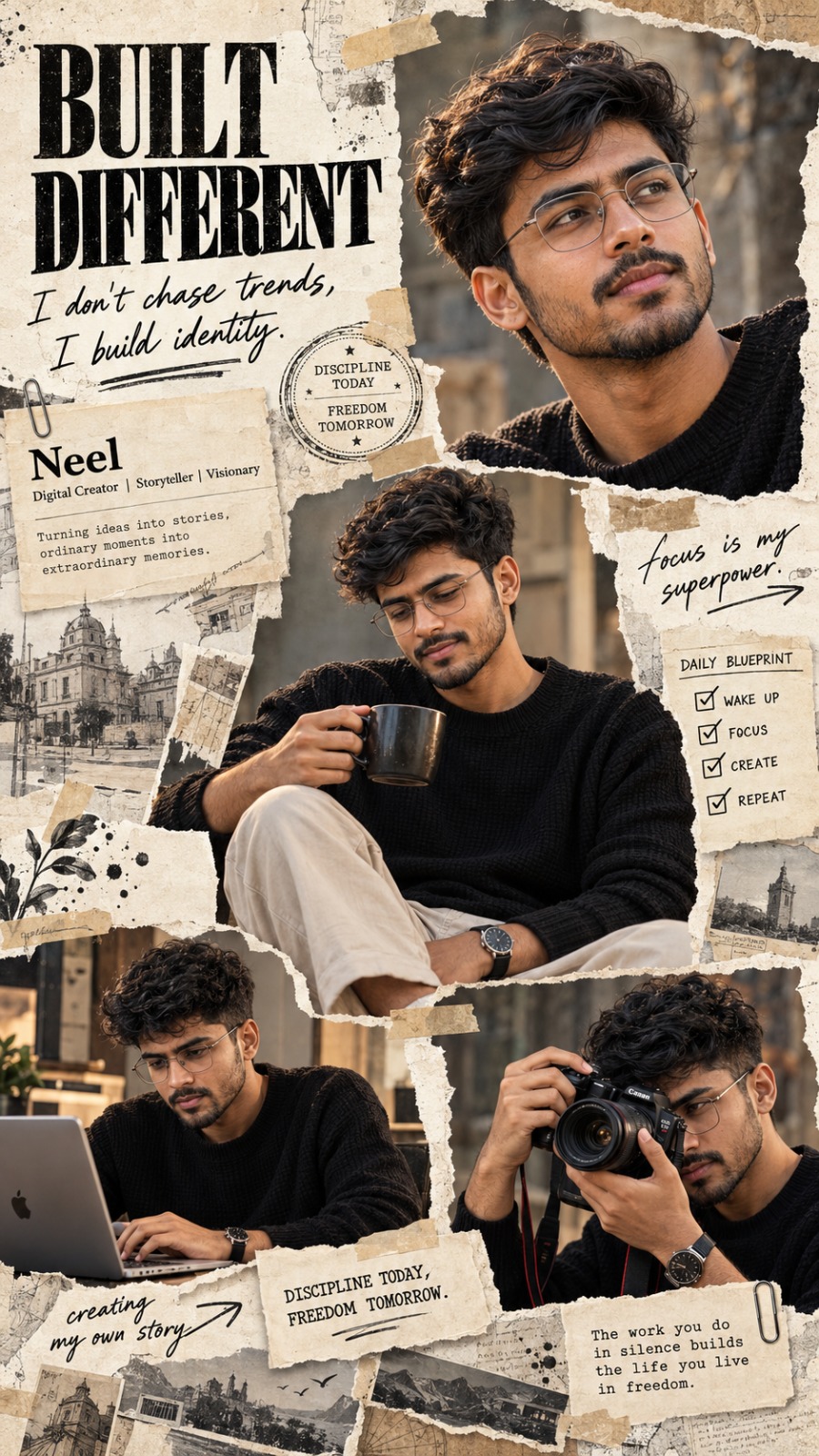
The Scrapbook Portrait Collage concept combines realistic portrait photography with the handcrafted appearance of an analog scrapbook. It brings together multiple views of the same adult man, layered paper cutouts, handwritten notes, editorial typography, and meaningful creative details. The overall presentation resembles a carefully assembled personal moodboard that communicates personality, ambition, creativity, and professional identity through photographs and printed ephemera.
The main idea is to present one individual in different aspects of everyday creative life. Rather than showing a single isolated portrait, the composition connects a thoughtful close-up, a relaxed seated moment, a laptop workspace, and a photography activity. These scenes communicate different sides of the same person while maintaining a consistent appearance throughout the layout.
The Scrapbook Portrait Collage style combines the polished quality of editorial photography with the imperfections of handmade paper design. Torn edges, wrinkled surfaces, masking tape, paper clips, ink marks, and overlapping shadows make the composition feel assembled from physical materials. These details give the poster a personal quality that a plain digital layout may not communicate as effectively.
Main Subject and Personal Appearance
The central subject is an adult man with voluminous, naturally curly dark hair, a full beard, and a thick moustache. Thin metallic eyeglass frames complete his appearance and contribute to an intelligent, thoughtful creative-professional character. His hair has natural irregularity, with individual curls and waves creating texture around the forehead and sides of the head.
His beard provides a strong visual outline around the jaw and chin. Natural skin details, subtle facial shadows, and realistic proportions help the portraits retain a photographic appearance. The glasses should sit naturally on the face, with restrained reflections that do not obscure the eyes.
Consistency is especially important because the man appears in several photographic panels. His hairstyle, beard, glasses, complexion, and clothing form a recognizable visual identity across the entire poster. The repeated appearance makes the different scenes feel like connected moments from one person’s life rather than unrelated photographs collected together.
Facial Expressions and Body Language
Each photographic panel communicates a slightly different mood. The large upper-right portrait shows the man looking thoughtfully upward and toward the viewer’s left. His lips remain relaxed, and his focused eyes suggest reflection and quiet confidence. This expression creates a strong introductory image for the overall composition.
The central seated photograph presents a more relaxed side of his personality. He holds a dark ceramic coffee mug near his chest while sitting comfortably, with his knees bent and his shoulders naturally positioned. His gaze angles slightly downward, creating an intimate, unforced moment that feels appropriate for a personal lifestyle portrait.
The lower-left scene shows him concentrating on an open laptop. His head inclines toward the screen, and his hands rest near the keyboard. This posture suggests planning, writing, digital work, or another focused creative activity without requiring additional explanatory elements.
In the lower-right photograph, he raises a professional camera to eye level and looks through the viewfinder. His hands hold the camera in a practical position, emphasizing concentration and attention to detail. Together, the poses give the Scrapbook Portrait Collage a narrative quality by presenting observation, relaxation, focused work, and creative practice.
Clothing and Accessories
The wardrobe is deliberately understated. A black textured knit sweater appears throughout the photographic scenes, creating continuity between the different panels. Its dark tone contrasts with the pale paper background, allowing the subject to remain prominent without introducing distracting colors.
In the seated photograph, light beige trousers provide a softer contrast against the sweater. Natural folds around the knees and waist help preserve the casual appearance of the pose. A restrained wristwatch adds a small personal accessory while maintaining the overall simplicity of the styling.
The thin metal glasses are another important identifying feature. Their delicate frame introduces subtle highlights around the eyes without competing with the facial expression. The dark coffee mug and professional camera serve as functional props, connecting the subject to specific activities.
The Scrapbook Portrait Collage aesthetic benefits from this restrained wardrobe because it allows the photographs, paper textures, and typography to share the composition without competing for attention.
Five Photographic Panels and Their Roles
The upper-right portrait functions as the main visual anchor. Its larger size gives the face immediate prominence and establishes the subject’s identity. The thoughtful upward gaze adds a sense of direction and reflection, while the irregular paper border connects the photograph to the handmade background.
The central seated portrait adds warmth and approachability. The coffee mug, relaxed posture, and visible beige trousers introduce a lifestyle element that balances the more formal close-up. Its placement near the center helps connect the upper portrait with the smaller scenes below.
The lower-left laptop photograph represents focused work. It introduces a recognizable creative workspace and gives the composition a practical, professional dimension. The visible keyboard and screen housing provide environmental context without needing a detailed office background.
The lower-right camera photograph emphasizes visual storytelling and photography. The camera becomes a meaningful prop rather than a decorative object, suggesting that the subject actively participates in creative work.
Smaller identity cards, handwritten notes, and graphic details complete the Scrapbook Portrait Collage by linking these scenes into a unified personal story.
Background and Analog Scrapbook Construction
The background is built from ivory paper, weathered beige sheets, wrinkled parchment, newspaper fragments, and torn photographic borders. Each layer contributes a different texture, creating the impression of a handmade editorial board.
Ripped edges are particularly important because they distinguish the design from a standard grid of rectangular photographs. Their irregular outlines make the photographs feel cut from printed pages and assembled by hand. Slightly curled paper, uneven surfaces, and subtle shadows reinforce this physical quality.
Beige masking tape can appear at selected corners, while a metal paper clip near the left edge adds a familiar stationery detail. Black ink splatters, charcoal marks, faint pencil sketches, and small paper fragments provide variation across the background.
The Scrapbook Portrait Collage uses these details to create depth without requiring a complicated photographic environment. Monochrome architectural sketches and faint handwritten marginalia contribute visual interest, but they remain secondary to the subject and headline.
Typography and Motivational Details
Typography plays a central role in the poster’s identity. The large headline, “BUILT DIFFERENT,” appears in bold black serif capitals across two lines in the upper-left area. Its strong weight and compact arrangement establish an immediate focal point opposite the large portrait.
Below the headline, the handwritten phrase “I don’t chase trends, I build identity.” introduces a personal statement. Its informal lettering contrasts with the headline’s structured typography, creating the feeling of a note written directly onto the page.
A cream identity card displays the name “Neel” alongside the descriptors “Digital Creator | Storyteller | Visionary.” This card helps communicate the personal-brand theme in a concise, editorial format.
Other details support the same message. A circular stamp carries “DISCIPLINE TODAY / FREEDOM TOMORROW.” A handwritten note reads “focus is my superpower.” The daily checklist contains “WAKE UP,” “FOCUS,” “CREATE,” and “REPEAT,” presenting a simple routine associated with consistency and creative productivity.
The phrase “creating my own story” appears near the lower-left area with a hand-drawn arrow. A lower-center note repeats the discipline and freedom theme, while the lower-right quote reads, “The work you do in silence builds the life you live in freedom.”
These text elements create a layered reading experience. The headline attracts attention first, the main portrait establishes personality, and the smaller notes provide additional meaning as the viewer explores the design.
Color Palette, Lighting, and Photographic Quality
The dominant palette includes ivory, aged beige, warm taupe, muted gray, charcoal black, and natural skin tones. These colors give the composition a restrained, timeless appearance. The absence of bright accent colors helps the photographs and typography remain cohesive.
Soft, diffused lighting creates gentle shadows across the face, beard, sweater, and hands. Subtle highlights define the glasses and hair without producing an overly glossy fashion appearance. The laptop and camera scenes follow the same neutral lighting approach, maintaining visual continuity.
The Scrapbook Portrait Collage uses muted color grading to bring the photographic panels together. Slightly desaturated tones, subtle film grain, and mild tonal variation create a printed editorial quality. Natural facial texture and visible knit fibers prevent the portraits from looking excessively smooth.
The paper layers also benefit from restrained shading. Small directional shadows separate overlapping sheets and photographic cutouts, making the composition feel dimensional while preserving the soft, understated atmosphere.
Composition, Visual Hierarchy, and Design Purpose
The vertical 9:16 format gives the poster a tall editorial structure. Its asymmetrical arrangement allows the headline, main portrait, supporting photographs, and smaller cards to occupy different areas without forming a rigid grid.
The upper-left headline balances the large upper-right portrait. The central seated scene provides a visual bridge between the upper and lower sections, while the laptop and camera photographs anchor the bottom of the design. Identity cards and handwritten annotations fill selected gaps and reinforce the scrapbook construction.
This arrangement creates several levels of attention. The viewer notices the headline and main face first, then explores the seated portrait and creative activities, followed by the smaller motivational notes. The resulting hierarchy makes the poster feel detailed without requiring every element to have equal prominence.
The Scrapbook Portrait Collage concept is useful for personal branding, creator introductions, portfolio covers, social media graphics, creative biographies, and digital presentation boards. It communicates personality through a combination of photographs, props, styling, and written statements.
Its greatest strength is the connection between visual identity and everyday activity. The same person appears thinking, relaxing, working, and creating. The paper construction gives those moments a unified visual frame, while the typography communicates a consistent message about discipline, focus, and independent identity.
Ultimately, this concept describes a personal editorial poster that feels carefully art-directed yet retains the warmth of a handmade scrapbook. Realistic portraits establish credibility, paper textures introduce individuality, and concise motivational statements give the layout a recognizable theme. The result is a cohesive creative identity presentation built around personality, work, and visual storytelling.
[[[
A. REFERENCE ANALYSIS
- Style: Photorealistic editorial portrait collage combined with an analog scrapbook, torn-paper textures, and creative personal-brand moodboard design.
- Camera: Eye-level to slightly low-angle portrait views, with close-up, seated, and activity-based framing across five overlapping photographic panels.
- Composition: Vertical poster with a large upper-right portrait, central seated portrait, lower-left laptop scene, lower-right camera scene, and smaller identity-card elements. Asymmetrical layout with layered paper cutouts.
- Subject: Adult man with voluminous, naturally curly dark hair, a full beard, dark moustache, and thin metallic eyeglass frames.
- Expressions and poses: Thoughtful sideward gaze in the main portrait; relaxed seated pose holding a coffee mug; focused downward gaze while using a laptop; eye-level concentration while operating a camera.
- Outfit: Black textured knit sweater, light beige trousers, and wristwatch. Preserve the understated, casual creative-professional styling.
- Lighting: Soft, directional, neutral-warm lighting with natural facial shadows, restrained highlights, and subtle separation from the background.
- Palette: Ivory, aged beige, warm taupe, charcoal black, muted gray, and natural skin tones.
- Textures: Crumpled parchment, distressed paper, ripped edges, masking tape, paper clips, ink splatters, grain, and overlapping paper shadows.
- Typography: Large black serif headline, handwritten motivational notes, typewriter-style copy, checklist, barcode, circular stamp, arrows, and small decorative marks.
- Uncertainty: Exact camera focal lengths, the subject’s precise age, and the original fonts are not determinable from the image alone.
B. MASTER PROMPT
Photorealistic Editorial Portrait Collage + Mixed-Media Scrapbook Poster + Creative Personal Branding + Multi-Scene Lifestyle Photography
Create a vertical 9:16 creative identity poster featuring one adult male subject repeated across five distinct photographic compositions. The overall design should resemble a premium editorial moodboard assembled from printed photographs, aged parchment, torn magazine pages, handwritten notes, and analog studio ephemera. Maintain a cohesive subject identity, realistic anatomy, natural photographic texture, and a muted ivory, beige, taupe, and charcoal color palette.
SUBJECT AND IDENTITY: Depict the same man consistently in every photographic panel, with voluminous dark curly hair, naturally irregular waves, a full dark beard and moustache, realistic facial proportions, and thin metallic eyeglass frames with transparent lenses. Preserve the natural skin texture, subtle facial stubble, hairline, and distinctive facial structure. Use a black textured knit sweater throughout the portraits, paired with light beige trousers in the seated composition. Include a restrained wristwatch. Avoid artificial beautification or changes to the subject’s appearance.
MAIN PORTRAIT: Position a large close-up portrait in the upper-right portion of the poster. Show the man from the chest upward, his head turned slightly toward the viewer’s left, looking thoughtfully upward and off-camera. His expression is composed and contemplative, with relaxed lips and naturally focused eyes. His curly hair extends toward the top and right edges. Use soft directional light to define the cheekbones, nose, beard, glasses, and hair, with subtle reflections on the eyeglass frames. Surround the photograph with an irregular, torn-paper edge over a warm gray and beige photographic backing.
CENTRAL SEATED PORTRAIT: Place a medium-to-large photographic cutout near the center. Show the same man seated casually with his knees bent, wearing the black knit sweater and loose light beige trousers. He holds a dark ceramic coffee mug near his chest and looks slightly downward with a relaxed, thoughtful expression. Keep the elbows and hands naturally positioned, with believable finger placement and realistic contact with the mug. Include a wristwatch and natural sweater folds. Use a three-quarter view and soft indoor lighting.
LOWER-LEFT CREATIVE WORK SCENE: Create a separate photographic panel showing the man seated at a desk, concentrating on an open laptop. Frame him from approximately the waist upward, with his head inclined toward the screen and his hands resting naturally near the keyboard. Retain the curly hairstyle, beard, eyeglasses, black sweater, and understated watch. Include part of the laptop keyboard and screen housing. The lighting should be neutral and soft, emphasizing the focused working posture without distracting from the portrait.
LOWER-RIGHT PHOTOGRAPHY SCENE: Show the same man raising a professional camera to eye level and looking through the viewfinder. His hands should grip the camera naturally, with fingers wrapped plausibly around the body and controls. Preserve the glasses, facial hair, dark sweater, and hairstyle. Use a close three-quarter angle, realistic camera proportions, and detailed lens reflections. Crop the scene into a rough-edged photographic cutout that overlaps the lower portion of the collage.
PAPER COLLAGE CONSTRUCTION: Build the background from overlapping off-white paper sheets, weathered parchment, torn newspaper fragments, wrinkled paper, and irregular ripped photographic borders. Add beige masking tape at selected corners, a metal paper clip near the left edge, black ink splatters, charcoal brush marks, faint pencil sketches, and small distressed paper fragments. Give each layer subtle directional shadows to create realistic physical depth. Integrate monochrome architectural sketches and faint handwritten marginalia into the background, keeping them subordinate to the photographs.
TYPOGRAPHY AND GRAPHIC ELEMENTS: In the upper-left quadrant, place the headline “BUILT DIFFERENT” in oversized, bold, condensed black serif capitals, arranged across two lines. Below it, add the handwritten phrase “I don’t chase trends, I build identity.” with delicate underlining. Place a small cream identity card on the left reading “Neel” with the smaller descriptors “Digital Creator | Storyteller | Visionary,” followed by brief, understated supporting copy. Add a small circular stamp with the words “DISCIPLINE TODAY / FREEDOM TOMORROW.”
On the right, include a small handwritten note reading “focus is my superpower.” Add a cream checklist card titled “DAILY BLUEPRINT” with four checkboxes labeled “WAKE UP,” “FOCUS,” “CREATE,” and “REPEAT.” Near the lower-left region, add “creating my own story” with a hand-drawn arrow. Place a lower-center paper note reading “DISCIPLINE TODAY, FREEDOM TOMORROW.” In the lower-right region, add a small typewriter-style quote: “The work you do in silence builds the life you live in freedom.” Preserve the spelling and wording of all specified text.
LIGHTING AND COLOR GRADING: Use soft, diffused, natural-looking portrait illumination with gentle facial shadows and subtle highlights. Maintain realistic skin tones and restrained contrast. Grade the photographs in muted warm neutrals, desaturated charcoal, soft gray, ivory, and weathered beige. Avoid strong orange casts, saturated colors, glossy fashion lighting, or dramatic neon effects.
FINISH AND DETAIL: Preserve realistic photographic faces, believable hands, detailed curls, visible knit fibers, natural garment folds, and convincing eyeglass reflections. Add subtle film grain and mild tonal variation. Blend photographic cutouts into the paper layout without erasing the torn edges. Maintain clear visual hierarchy between the headline, main portrait, supporting scenes, and handwritten annotations. The final result should feel personal, disciplined, creative, understated, and professionally art-directed.
OUTPUT: A high-detail vertical personal-brand poster with a consistent male subject, five coordinated portrait and lifestyle views, authentic analog scrapbook construction, legible editorial typography, and restrained neutral colors.
C. EDITABLE VARIABLES
| Variable | Current specification |
|---|---|
| [IDENTITY] | One consistent curly-haired, bearded man wearing glasses |
| [CAMERA ANGLE] | Eye-level to slightly low-angle; varies by panel |
| [POSE] | Looking upward, seated with mug, working at laptop, using camera |
| [EXPRESSION] | Thoughtful, relaxed, focused |
| [OUTFIT] | Black knit sweater, beige trousers, wristwatch |
| [LIGHTING] | Soft, diffused, neutral-warm |
| [COLOR & MOOD] | Ivory, parchment beige, taupe, charcoal |
| [TEXTURE & EFFECTS] | Torn paper, grain, ink splashes, masking tape |
| [BACKGROUND] | Layered scrapbook with monochrome sketch details |
| [TEXT] | “BUILT DIFFERENT” and the specified motivational notes |
| [ASPECT RATIO] | Vertical 9:16 |
| [AUTHORIZED CHANGES] | No additional changes specified |
Locked elements: Subject consistency, five-scene collage, glasses, curly hair, beard, black sweater, neutral palette, paper construction, and specified text.
Adjustable elements: Subject identity reference, individual panel positions, exact wording, typography, and collage density if you explicitly request changes.
D. NEGATIVE PROMPT
Inconsistent facial identity, different people across panels, duplicated facial features, mixed identities, altered hairstyle, straight hair, missing beard, missing glasses, opaque eyeglass lenses, distorted facial proportions, artificial skin, excessive beauty retouching, plastic skin, oversharpening, unnatural expressions, incorrect gaze direction, distorted hands, extra fingers, missing fingers, broken wrists, impossible camera grip,
malformed coffee mug, floating objects, inconsistent clothing, brightly colored outfits, glossy fashion styling, excessive orange grading, oversaturated colors, neon lighting, excessive bloom, smooth digital background, clean modern minimalist backdrop, missing torn edges, uniform panel borders, flat paper layers, missing collage shadows, illegible oversized body text, misspelled headline, altered specified quotes,
random logos, invented watermarks, excessive decorative elements, clutter obscuring faces, missing laptop, missing camera, missing coffee mug, incorrect aspect ratio, landscape framing, inconsistent lighting, excessive blur, low-resolution facial details, cartoon rendering, anime styling, painterly faces, unwanted changes to the specified composition.
E. RECONSTRUCTION BLUEPRINT
A vertical, neutral-toned creative-professional poster is assembled from overlapping photographs and distressed paper elements. In the upper-left corner, large black serif lettering reads “BUILT DIFFERENT,” followed by a handwritten statement about building identity rather than chasing trends. The upper-right section contains a large portrait of a curly-haired, bearded man wearing thin metal glasses and a black knit sweater, gazing thoughtfully upward and toward the left.
At the center, a larger lifestyle photograph shows the same man seated casually in a black sweater and beige trousers, holding a dark coffee mug. The lower-left photograph shows him working at an open laptop, his head inclined toward the screen. The lower-right photograph shows him holding a professional camera to his eye and looking through the viewfinder. All portraits maintain consistent facial features, hair, beard, glasses, and wardrobe.
The surrounding layout resembles a handmade editorial scrapbook: aged ivory paper, torn photographic edges, masking tape, paper clips, faded newspaper fragments, ink splatters, pencil marks, and small monochrome architectural sketches. Cream-colored cards carry the name “Neel,” creative-professional descriptors, a daily checklist, and concise motivational statements. Handwritten arrows, underlining, and a circular stamp add personality without competing with the portraits.
Soft natural light, realistic skin, detailed hair, visible knit texture, and muted charcoal-beige grading unify the photography. The final composition balances a strong headline, large hero portrait, three supporting lifestyle scenes, and smaller handwritten details, creating a polished personal-brand moodboard with an authentic analog-paper aesthetic.
F. LIMITATIONS
- The five portrait panels and paper elements are described from visible features; exact panel dimensions and original typefaces are estimates.
- Small handwritten text and fine print may be reproduced imperfectly by image-generation systems. For exact typography, render the portraits and collage first, then add the text in a design editor.
- To replace the man with a specific person’s identity, supply that person’s photo as the identity reference while preserving this collage’s poses, clothing, lighting, and layout.
]]]