
Crimson Scarf Portrait
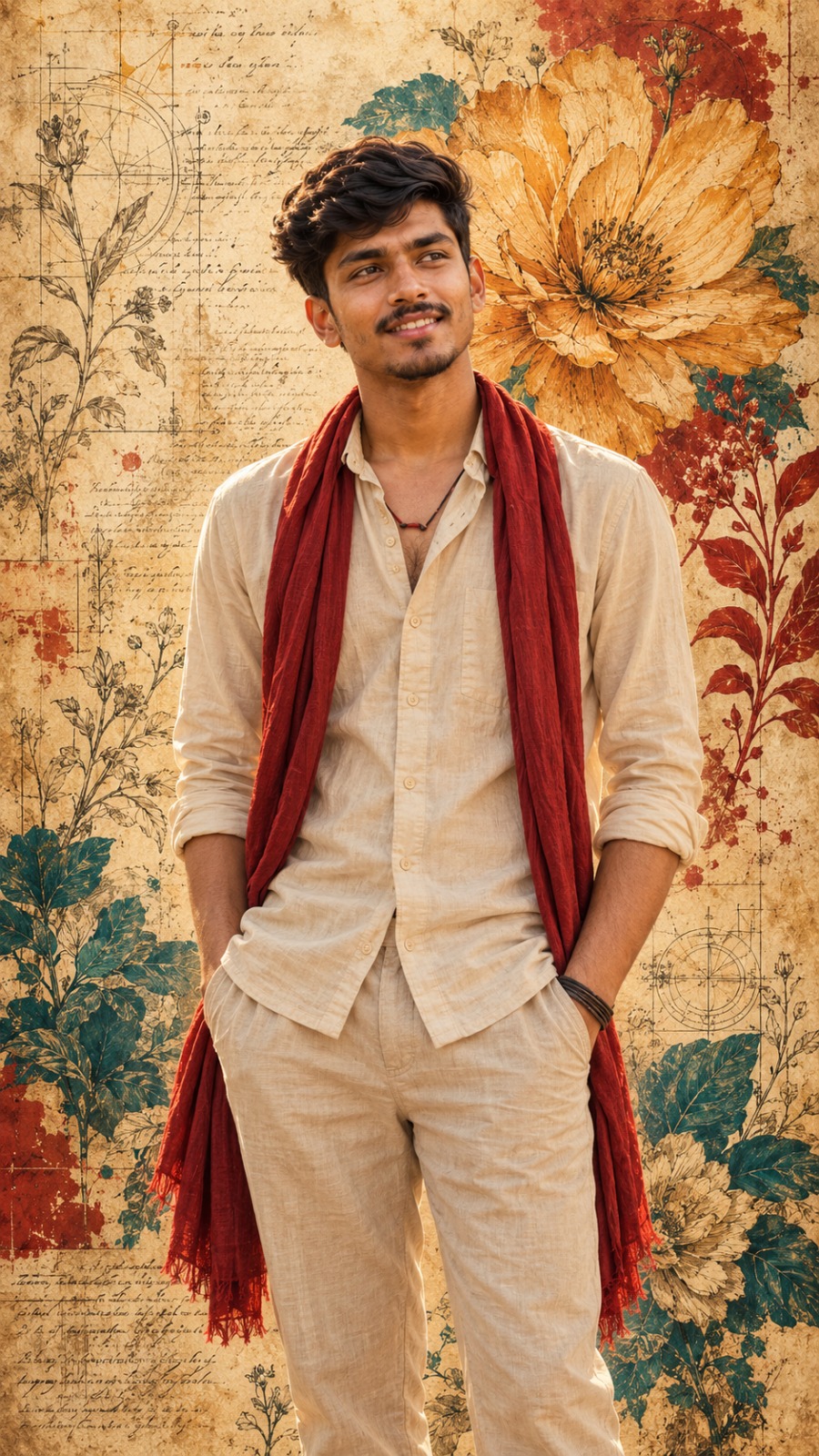
The Crimson Scarf Portrait concept combines realistic male fashion photography with the artistic character of antique botanical illustrations and aged manuscript pages. It presents a stylish young man in a carefully composed vertical portrait, surrounded by delicate floral drawings, faded handwriting, and vintage paper textures. The overall visual direction feels refined, contemplative, and artistic, balancing contemporary clothing with the timeless appearance of historical illustrations.
The central subject is a young adult man whose relaxed posture communicates quiet confidence. His body faces almost directly toward the viewer, while his head turns toward the upper-right. His chin is slightly raised, and his eyes look upward and away from the camera. This subtle difference between body direction and facial orientation creates a thoughtful expression without making the pose feel exaggerated. His shoulders remain relaxed, and both hands are tucked naturally into his trouser pockets. The stance feels comfortable and composed, making the portrait suitable for a sophisticated fashion editorial.
The man’s facial appearance contributes significantly to the visual identity of the composition. Thick, shoulder-length dark hair falls in natural waves and loose curls around the forehead, temples, and ears. The hair has considerable volume, with individual strands adding depth and a realistic sense of movement. A full beard and moustache create a strong frame around the lower face. Detailed facial hair, defined cheekbones, natural skin texture, and subtle pores help maintain the photographic quality of the portrait. The serious expression and upward gaze suggest reflection, independence, and understated elegance.
The outfit is built around an ivory-beige shirt and matching wide-leg trousers. The shirt has a relaxed fit, an open collar, several undone upper buttons, and a visible chest pocket. Its sleeves are rolled toward the forearms, giving the outfit an effortless, contemporary appearance. The lightweight cotton or linen fabric introduces natural creases and soft folds rather than looking stiff or overly tailored. The matching trousers maintain the same light color, creating a coordinated silhouette that feels minimal and refined.
The most visually striking clothing detail is the long crimson-red scarf draped around the back of the neck and over both shoulders. Its rich color provides a dramatic contrast against the pale outfit and the cream manuscript background. One end falls vertically along the left side of the figure, while the other descends on the right and extends slightly outward near the bottom. The gathered folds, wrinkled edges, and darker burgundy shadows give the scarf a convincing fabric texture. Bright crimson highlights add richness and draw attention toward the center of the composition.
A thin dark necklace with a small pendant introduces a subtle accessory detail. A narrow wristband adds another understated accent without distracting from the clothing. These elements preserve the simplicity of the overall styling. Rather than relying on numerous accessories, the concept emphasizes the contrast between neutral clothing, dark hair, and the dramatic red scarf.
Lighting establishes the portrait’s warm, editorial character. Directional sunlight enters from the upper-left, illuminating the forehead, nose, cheekbones, hair, shoulders, and shirt. The highlights have a golden quality that creates a natural connection between the subject and the warm tones of the antique background. Shadows beneath the jaw and around the beard provide facial definition, while darker areas within the scarf folds enhance its depth. Soft ambient fill prevents the shadowed areas from becoming visually empty and preserves the details of the pale clothing.
The background is an essential part of the creative concept. Instead of a modern studio or outdoor location, the man stands against aged ivory parchment covered with faded handwritten notes, technical diagrams, antique lettering, and delicate botanical studies. The paper has a weathered appearance, with subtle grain, faded ink, and uneven pigment variations. These details create the impression of a historical research page or an illustrated botanical manuscript.
An oversized golden-orange flower occupies the upper-right portion of the background. Its broad petals, delicate outlines, fine veins, and layered ochre shading introduce an organic focal point behind the subject. The flower balances the darker tones of the man’s hair and provides a warm visual counterpart to the crimson scarf. Its scale also gives the composition a distinctive poster-like quality.
Additional botanical elements appear around the lower edges. Red leaves and elongated floral forms introduce accents that complement the scarf, while dusty teal and turquoise illustrations provide a cooler contrast. Some of the botanical drawings are partially hidden behind the man’s silhouette or the hanging fabric. This overlapping arrangement makes the subject feel integrated into the illustrated environment rather than simply placed in front of a flat background.
The color palette relies on parchment beige, warm ivory, golden ochre, burnt sienna, muted brown, crimson red, dusty teal, and turquoise. These colors work together to establish an antique yet fashionable atmosphere. The pale clothing separates the figure from the darker botanical details, while the deep red scarf acts as the strongest accent. The golden flower connects the warm lighting with the background, creating a balanced and cohesive visual arrangement.
A lightly painterly finish unites the photographic subject with the vintage illustration. Fine ink outlines, delicate watercolor-like washes, faded lettering, and softly blended edges create the impression of a mixed-media artwork. However, the face, beard, curls, and fabric remain detailed enough to preserve the realism of the fashion portrait. The contrast between realistic human features and illustrated botanical forms gives the concept its distinctive character.
The vertical 9:16 composition is suited to portrait-oriented digital artwork, fashion posters, social media presentations, and mobile-friendly visual collections. The man remains the dominant central figure, while the large orange flower provides balance in the upper-right and the smaller botanical illustrations frame the lower body. The slightly low camera perspective adds presence without introducing exaggerated proportions. The lower crop emphasizes the clothing and scarf while maintaining the impression of a nearly full-body portrait.
This concept can be useful for personal fashion portraits, creative profile images, men’s style editorials, vintage-themed artwork, digital portfolio presentations, and artistic social media posts. It also appeals to people who appreciate a combination of traditional illustration techniques and contemporary photographic styling. The neutral outfit makes the red scarf especially effective, while the botanical manuscript adds a distinctive historical character that separates the composition from ordinary fashion photography.
The strongest feature of this visual direction is the relationship between the subject and the environment. The man’s confident stance and modern clothing provide a contemporary foundation, while the antique paper and botanical drawings introduce a sense of history and artistic craftsmanship. Warm sunlight connects both elements, and the crimson scarf provides a clear focal point. Every component supports the same mood of quiet sophistication, creative expression, and timeless style.
Ultimately, the Crimson Scarf Portrait concept is about balancing realism with artistic interpretation. Detailed hair, natural facial texture, realistic fabric folds, and carefully shaped lighting maintain a photographic foundation. Vintage manuscript markings, oversized floral illustrations, and delicate painterly blending add depth and imagination. Together, these features create an elegant male fashion portrait with a memorable palette, a thoughtful expression, and a richly textured botanical setting.
[[[
A. REFERENCE ANALYSIS
- Style: Photorealistic male fashion portrait blended with vintage botanical illustration and antique manuscript textures.
- Camera: Vertical 9:16 framing, nearly frontal body view, slightly low camera perspective, head turned toward the upper-right.
- Pose: Standing upright with relaxed shoulders, both hands inside trouser pockets, and chin slightly raised.
- Expression: Calm, serious, contemplative expression with a closed mouth and upward sideward gaze.
- Hair: Thick, voluminous, shoulder-length wavy dark hair with loose curls and a full textured beard and moustache.
- Outfit: Loose ivory-beige shirt with open collar and rolled sleeves, matching wide-leg trousers, and a long deep crimson-red scarf draped around the neck, hanging down both sides.
- Accessories: Thin dark necklace with a small pendant and a narrow wristband.
- Lighting: Warm directional sunlight from the upper-left, bright golden facial highlights, defined jaw shadows, and soft ambient fill.
- Background: Aged ivory manuscript paper covered with faded handwritten notes, technical diagrams, and botanical sketches. An oversized golden-orange flower fills the upper-right, with red and teal floral elements near the lower edges.
- Color grading: Muted parchment beige, burnt orange, crimson red, warm brown, and dusty teal.
- Texture and effects: Detailed hair strands, realistic fabric creases, fine botanical linework, distressed paper grain, and subtle painterly blending.
B. MASTER PROMPT
Create a photorealistic, semi-painterly Indian male fashion portrait in a vertical 9:16 composition, combining refined editorial photography with antique botanical illustration and vintage manuscript artwork.
SUBJECT AND POSE: A young adult man stands centrally in a relaxed, confident posture, his torso facing almost directly toward the camera. Both hands are tucked naturally into the pockets of his loose trousers, with his elbows slightly bent and shoulders relaxed. Turn his head toward the viewer’s right in a three-quarter profile and raise his chin slightly, directing his eyes upward and off-camera. Maintain a calm, serious, contemplative expression with relaxed closed lips. His head, shoulders, torso, and most of his legs are visible, with the lower legs cropped by the bottom edge.
FACE AND HAIR: Give him thick, voluminous, shoulder-length dark brown-to-black hair, naturally wavy and curly, with irregular loose strands framing the forehead, temples, and ears. Add a full, dense beard and moustache with realistic individual hair texture and a natural outline along the jaw. Preserve realistic facial anatomy, natural skin texture, subtle pores, defined cheekbones, and warm golden highlights across the forehead, nose, cheek, and beard. Avoid excessive smoothing or exaggerated facial features.
CLOTHING AND ACCESSORIES: Dress him in a loose ivory-beige cotton or linen shirt with an open, relaxed collar, several undone upper buttons, a short button placket, and one visible chest pocket. Roll the sleeves to the forearms and leave the shirt loosely draped over the waistband. Pair it with matching pale beige, wide-leg trousers featuring natural vertical folds and gathered creases. Drape a long, deep brick-red or crimson scarf around the back of his neck and over both shoulders.
One end hangs vertically down the viewer’s left side toward the lower leg; the other falls down the viewer’s right side and trails slightly outward near the bottom. Render thick gathered folds, wrinkled edges, and rich variations between bright crimson ridges and deep burgundy shadows. Add a thin dark necklace with a small understated pendant and a narrow dark wristband visible at the viewer’s left. Keep both hands inside the pockets and preserve the original relaxed stance.
CAMERA AND LIGHTING: Use a nearly frontal camera position at approximately chest height or slightly lower, with natural proportions and restrained perspective. Illuminate the subject with strong, warm directional sunlight from the upper-left. Create golden highlights across the face, curls, shoulders, and shirt, with defined shadows beneath the jaw, around the beard, inside the scarf folds, and along the opposite side of the body. Maintain soft ambient fill, realistic shadow transitions, and sufficient exposure to retain the fine texture of the ivory clothing.
BOTANICAL MANUSCRIPT BACKGROUND: Place the subject against an aged cream and ivory parchment page filled with faded handwritten notes, antique printed lettering, fine technical diagrams, delicate botanical studies, and lightly distressed paper markings. Behind the upper-right side of his head and shoulder, position a large golden-orange flower with broad, overlapping petals,
intricate hand-drawn veins, fine outlines, and layered ochre shading. Include red botanical leaves and elongated flower forms along the right side, plus a blue-green and turquoise floral illustration near the lower-left and lower-right edges. Let some botanical forms remain partially obscured by the man’s silhouette and scarf. Include a faint, partially visible serif heading near the upper-left, but do not introduce prominent new text or assume exact lettering.
ART DIRECTION AND COLOR: Combine photorealistic portrait rendering with a lightly painterly editorial finish, antique botanical illustration, fine ink outlines, and delicate watercolor washes. Use a restrained palette of warm ivory, parchment beige, golden ochre, burnt sienna, muted brown, deep crimson, dusty teal, and turquoise. Maintain rich contrast between the dark hair, red scarf, pale clothing, and light manuscript background. Add subtle paper grain, faded ink, delicate pigment variation, and softly blended edges where the photographic subject meets the illustrated backdrop.
COMPOSITION AND FINISH: Keep the man as the dominant central subject, with the oversized orange flower balancing the upper-right and the smaller colorful botanical illustrations framing the lower body. Preserve clear facial detail, individual curls, beard texture, natural fabric wrinkles, and realistic folds in the scarf. Maintain the original vertical proportions, relaxed hands-in-pockets pose, upward rightward gaze, warm sunlight, antique manuscript setting, and elegant Indian ethnic-fashion editorial mood. The result should feel like a premium fine-art fashion photograph layered into a vintage botanical research page. No additional people, no modern environment, no unrelated props, and no unnecessary typography.
C. EDITABLE VARIABLES
| Variable | Current value |
|---|---|
| [USER IDENTITY] | Male subject; use a supplied identity photo if likeness is required |
| [CAMERA ANGLE] | Nearly frontal, slightly low perspective |
| [POSE & BODY GEOMETRY] | Upright stance, relaxed shoulders, both hands in pockets |
| [FACE DIRECTION & EXPRESSION] | Head turned right, chin raised, contemplative expression |
| [CAMERA & PERSPECTIVE] | Vertical 9:16, near-full-body portrait |
| [OUTFIT & ACCESSORIES] | Ivory shirt and trousers, crimson scarf, minimal necklace |
| [LIGHTING & SHADOWS] | Warm upper-left directional sunlight |
| [COLOR & MOOD] | Parchment, ochre, crimson, muted teal; reflective and artistic |
| [TEXTURE & EFFECTS] | Natural hair and fabric texture, antique paper grain, painterly blending |
| [BACKGROUND & OBJECTS] | Vintage manuscript, large orange flower, red and teal botanical motifs |
| [TEXT] | Faded manuscript writing; preserve as decorative background |
| [ASPECT RATIO] | 9:16 vertical |
| [OBJECT CHANGE] | None |
| [POSE CHANGE] | None |
| [ADDITIONAL EDITS] | None specified |
| [NEGATIVE CONSTRAINTS] | No extra people, altered outfit, changed pose, modern setting, or unwanted effects |
D. NEGATIVE PROMPT
Wrong identity, inconsistent facial features, altered head direction, forward-facing gaze, lowered chin, exaggerated smile, changed pose, arms raised, hands outside pockets, malformed hands, extra fingers, extra limbs, distorted anatomy, unnatural body proportions, shortened torso, exaggerated wide-angle perspective, changed crop, zoomed-in framing, missing scarf, incorrect scarf color, scarf wrapped over the face, altered shirt design, dark trousers, modern streetwear, added prominent jewelry, hats,
sunglasses, extra people, modern buildings, urban backgrounds, redesigned botanical artwork, missing orange flower, excessive flowers, incorrect color palette, harsh artificial flash, flat lighting, overexposed shirt, crushed facial detail, unnatural skin tones, excessive orange grading, plastic skin, beauty filters, oversmoothing, excessive sharpening, lost hair texture, synthetic fabric, cartoon rendering, glossy 3D appearance, excessive glow, lens flare, smoke, heavy blur, illegible prominent typography, invented logos, watermarks, borders.
E. RECONSTRUCTION BLUEPRINT
A centrally positioned adult man stands against an antique cream manuscript page in a vertical near-full-body portrait. His torso faces the viewer while his head turns to the right and his chin lifts slightly, creating a thoughtful upward gaze. Thick wavy dark hair falls around his forehead and ears, framing a full beard and moustache. He wears a loose, open-collar ivory shirt with rolled sleeves, matching relaxed trousers, and a long crimson scarf draped over both shoulders. Both hands remain tucked into his pockets, and the scarf’s long ends hang down the front of his body.
Warm sunlight enters from the upper-left, illuminating the man’s face, hair, shoulders, and shirt while creating deep shadows beneath his jaw and within the red scarf’s folds. Behind him, an oversized golden-orange flower occupies the upper-right. Faded manuscript writing, delicate technical diagrams, and fine botanical linework cover the aged parchment background. Red floral forms and muted teal-blue botanical illustrations frame the lower edges. The entire composition uses restrained vintage colors, realistic photographic detail, subtle watercolor blending, and fine paper texture to create an elegant fusion of contemporary ethnic-fashion portraiture and antique botanical art.
F. LIMITATIONS
- The exact camera and lighting equipment cannot be identified from the image alone.
- The bottom crop obscures the feet and some lower-leg details.
- The precise necklace pendant and wristband design are uncertain.
- Decorative manuscript text is too faded to reproduce reliably; preserve its visual character rather than inventing exact wording.
- If the portrait must resemble a particular person, provide a separate identity reference. Text-only prompting cannot guarantee exact identity or pixel-perfect reconstruction.
]]]