
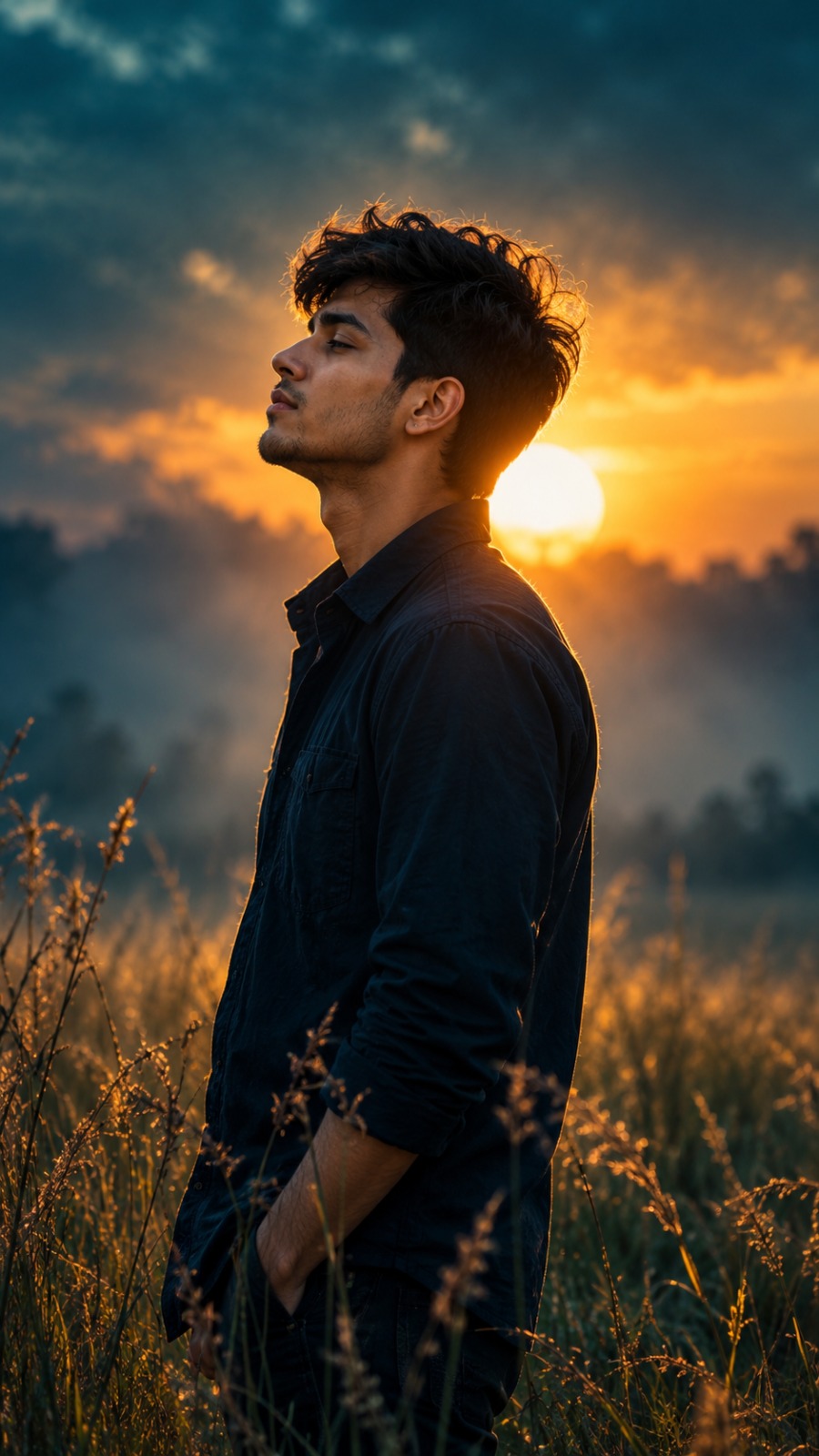
Cinematic Silhouette Portrait
The creative concept focuses on a solitary adult man standing in a natural outdoor environment, surrounded by tall wild grasses and atmospheric blue mist. The central visual idea is to combine a realistic male profile with dramatic sunset backlighting, deep shadows, and a cinematic color palette. Rather than presenting every facial feature clearly, the composition emphasizes the outline of the man’s head, beard, nose, shoulders, and clothing. This creates a powerful visual impression that feels quiet, thoughtful, and emotionally expressive.
The subject is positioned slightly left of the vertical centerline. His body stands upright, with the shoulders relaxed and the arms held close to the torso. The lower portion of his body gradually disappears into the dark foreground, where grasses and shadows overlap. This arrangement keeps attention on the upper silhouette while allowing the environment to become part of the composition. The figure appears still and grounded, with no exaggerated movement or theatrical gestures.
The head is turned almost completely toward the left side of the frame. Its profile creates a recognizable contour along the forehead, nose bridge, nose tip, lips, chin, and beard. The chin is slightly elevated, suggesting a moment of reflection or quiet observation. The eyes appear closed or lowered, although their precise position remains difficult to determine because the face is mostly shadowed. The closed lips and restrained expression contribute to the contemplative atmosphere. Instead of relying on a visible smile or direct eye contact, the design communicates emotion through posture, silhouette, and light.
The hairstyle is short to medium in length, with thick, dark hair that appears naturally tousled. A few loose strands extend beyond the main outline, giving the hair a slightly irregular and lifelike appearance. The beard is full and dense, connected to a substantial moustache. Its lower edge has a coarse, uneven texture that extends below the chin. These facial hair details are particularly important because the bright backlight reveals portions of the outline while leaving the central facial area dark. The result is a recognizable masculine profile without excessive facial detail.
The clothing consists of a dark long-sleeved garment, possibly a shirt or lightweight jacket, with a raised collar. Its exact construction is not fully visible because the front of the body receives very little light. The garment blends into the shadows, with occasional blue-gray highlights along the shoulders and outer edges. The restrained clothing treatment keeps the subject visually unified and avoids unnecessary distractions. No prominent accessories or bright patterns compete with the silhouette.
Lighting is the defining feature of this concept. A concentrated golden-white sun sits immediately behind the rear of the head and upper shoulder. Because the light source is partially obscured by the figure, it creates a bright halo around the silhouette rather than illuminating the face directly. Thin amber highlights trace parts of the hair, ear, beard, neck, and shoulder. These delicate edges separate the dark subject from the luminous atmosphere and give the portrait its dramatic depth.
The contrast between the bright background and the nearly black subject is intentional. The face remains predominantly unlit, allowing the profile to retain a mysterious quality. The shoulders and torso merge into deep navy and black shadows, while the sun creates a warm focal point near the upper portion of the frame. This exposure relationship makes the image feel cinematic, as though the viewer is observing a quiet moment just before sunset.
The background is built from layers of deep teal, cyan-blue, navy, and smoky gray. The atmosphere becomes brighter and more luminous near the sun, then gradually transitions into darker blue-green tones toward the corners. The soft tonal changes suggest mist, distant vegetation, or a hazy outdoor landscape without introducing recognizable buildings or mountains. This lack of sharply defined scenery is important because it keeps the portrait focused on the relationship between the figure and the light.
Tall wild grasses occupy the foreground and rise from the bottom edge. Some stems stand nearly vertical along the outer edges, while others curve diagonally across the lower torso. Their varied shapes create natural movement and establish a sense of depth. Most grasses appear as dark silhouettes, although a few edges catch subtle cyan or golden highlights. Some blades are softly blurred, suggesting different distances from the camera. This layered vegetation makes the scene feel immersive rather than like a simple portrait placed against a flat background.
Atmospheric haze softens the transitions between the subject and the environment. The mist gives the blue background a diffused appearance, while the bright area surrounding the sun creates a gentle bloom. A subtle vignette darkens the outer borders and upper corners, naturally directing attention toward the illuminated profile. A faint lens-flare arc may appear near the bottom-left edge, but it remains secondary to the main lighting effect. The small white four-point sparkle in the bottom-right corner acts as a restrained decorative finishing detail.
The color palette balances cool and warm tones. Deep navy provides the darkest foundation, teal and cyan create the atmospheric midtones, and smoky gray softens the transitions. Golden amber and warm white appear primarily around the sun and the silhouette’s outer edges. This limited palette creates visual harmony because each color serves a clear purpose. Cool colors establish distance and solitude, while warm light introduces a sense of hope, reflection, or quiet intensity.
The vertical 9:16 composition supports a tall, cinematic presentation. The subject occupies the central and lower portions of the image, while a generous area of blue atmospheric negative space remains above his head. This open space makes the portrait feel expansive and allows the luminous background to balance the dark figure. The nearly eye-level perspective keeps the profile natural and avoids an exaggerated viewpoint. The overall framing resembles a carefully composed cinematic still rather than a conventional studio portrait.
The artistic style combines fine-art portrait photography with atmospheric outdoor photography. Realistic silhouette contours are paired with restrained color grading, soft environmental diffusion, and dramatic backlighting. The image does not depend on complex props, decorative clothing, or a busy landscape. Its strength comes from the simplicity of the pose, the contrast between darkness and light, and the interaction between the subject and the surrounding mist.
This visual concept is suitable for portrait photography collections, cinematic profile images, social media posts, personal wallpapers, artistic portfolios, music-inspired visual projects, and reflective editorial designs. Its minimal composition also makes it useful when a particular mood matters more than showing every detail of the subject’s face. The silhouette can feel personal while remaining visually understated.
The design offers a strong way to communicate solitude, confidence, introspection, and quiet determination. The elevated chin and still posture suggest composure, while the concealed face leaves room for interpretation. The warm halo prevents the dark scene from feeling completely cold, creating a subtle emotional balance between mystery and reassurance.
Overall, the concept is defined by its disciplined composition, dramatic exposure, realistic male profile, natural foreground vegetation, and controlled teal-and-amber color grading. Every element contributes to the same visual purpose. The grasses frame the subject, the mist creates depth, the sunset separates the silhouette from the background, and the negative space preserves a sense of calm. Together, these features describe a premium cinematic portrait with an atmospheric and introspective character.
[[[
A. REFERENCE ANALYSIS
- Style: Moody cinematic fine-art photography with dramatic sunset backlighting.
- Composition: Vertical 9:16 portrait, with a large area of blue atmospheric negative space above the subject.
- Camera angle: Nearly eye-level, side-profile view from the subject’s right.
- Pose: Upright standing posture, shoulders relaxed, arms close to the torso, lower body obscured by shadows and grasses.
- Face: Near-pure left-facing profile, chin slightly raised, eyes apparently closed or lowered, lips closed.
- Hair and beard: Short-to-medium tousled dark hair with loose strands, thick moustache, and dense full beard.
- Clothing: Dark long-sleeved garment with a raised collar; exact garment type is uncertain.
- Lighting: Intense golden-white sun behind the head and shoulder, creating a dark silhouette and warm rim lighting.
- Background: Deep teal and cyan mist, softly diffused blue atmosphere, and tall wild grasses crossing the foreground.
- Effects: Atmospheric haze, soft sun bloom, dark corner vignette, and a faint possible lens-flare arc near the bottom-left.
- Graphic detail: Small white four-point sparkle near the bottom-right corner.
- Color palette: Deep navy, teal, cyan-blue, smoky gray, and warm amber.
B. MASTER PROMPT
Cinematic Fine-Art Portrait Photography + Moody Atmospheric Outdoor Photography + Photorealistic Male Silhouette + Dramatic Sunset Backlighting
Create a vertical 9:16 cinematic portrait of a bearded man standing in a misty field of tall wild grasses, facing toward the left edge of the frame. The image should have a quiet, contemplative atmosphere, with the subject rendered as a deep, nearly black silhouette against a luminous blue-cyan background and a small golden-white sun positioned immediately behind the rear of his head and upper shoulder.
CAMERA AND COMPOSITION: Use a natural eye-level perspective with minimal distortion, resembling a 50–85 mm full-frame-equivalent portrait lens. Frame the subject from the head through the torso and lower body, allowing the legs to merge into the dark foreground and extend beyond the bottom crop. Place the man slightly left of the vertical centerline. Position his head around the upper-middle third of the frame, leaving generous negative space filled with blue mist above him. Keep the camera upright with no noticeable Dutch tilt. Maintain a softly blurred background and a clearly recognizable silhouette contour.
POSE AND HEAD POSITION: The man stands upright with his torso oriented sideways and his face turned almost completely toward image-left. His head is nearly upright with a subtle backward inclination, and his chin is gently elevated. His shoulders are relaxed and slightly rounded. His arms remain close to his body, with their precise positions obscured by the dark clothing. Do not invent visible hand gestures or reveal hidden anatomy. His posture is still and natural, without walking or dramatic movement.
FACE, HAIR, AND BEARD: Create a strong left-facing facial silhouette with a clearly defined forehead, nose bridge, nose tip, lips, chin, and beard outline. Add thick, dark facial hair consisting of a full beard connected to a substantial moustache, with a coarse, irregular lower edge extending below the chin. His hair is short-to-medium in length, dense and slightly tousled on top, with a few loose strands extending from the silhouette. Keep the eyes closed or lowered if visible, with a neutral, composed expression. Do not introduce a smile or direct eye contact. Preserve the face as predominantly shadowed, without artificially revealing detailed skin features.
CLOTHING: Dress him in a dark black or very deep navy long-sleeved shirt or lightweight jacket with a raised collar. Use a relaxed fit around the shoulders and torso. Allow the garment to blend naturally into the shadows, with only faint blue-gray folds and subtle edge highlights. Avoid bright fabric colors, prominent patterns, or additional accessories.
SUNSET BACKLIGHTING: Place a low, intensely luminous golden-white sun immediately behind the right-rear edge of the man’s head and upper shoulder. The sun should remain partially occluded by the silhouette, producing a concentrated halo and warm amber rim light around portions of the hair, ear, beard, neck, and shoulder. Keep the front of the face almost completely unlit. Preserve the dramatic exposure difference between the bright atmosphere and the nearly black subject. Add subtle natural light bloom and delicate halation around the sun, without excessive artificial glow.
ATMOSPHERE AND BACKGROUND: Fill the background with layered deep-blue, teal, cyan, and smoky blue-gray haze. Use a soft, diffuse sky or misty woodland atmosphere with indistinct cloud-like tonal variations. Make the area around the sun brighter and more cyan, gradually transitioning to darker blue-green tones toward the upper corners and outer edges. Add atmospheric depth through soft background diffusion, with no sharply defined buildings, mountains, or additional people.
FOREGROUND GRASSES: Surround the subject with tall, thin wild grasses and elongated plant stems emerging from the lower frame. Include delicate vertical stems near both edges, a taller slender stem near the right border, and several curved diagonal blades crossing in front of the lower torso. Render most grasses as dark silhouettes, with occasional faint cyan or golden highlights along the edges nearest the sun. Vary their thickness, curvature, sharpness, and focus to create natural depth. Allow some foreground blades to appear softly out of focus while keeping the subject’s outer silhouette recognizable.
COLOR GRADING AND TEXTURE: Apply a cinematic teal-and-amber palette. Use deep navy and cyan-blue shadows, cool teal atmospheric midtones, and restrained golden-white highlights around the sun. Preserve dark black levels and the intentionally underexposed subject. Add a subtle vignette that darkens the upper corners and outer borders while retaining the luminous center. Keep the atmosphere soft, hazy, and realistic. Avoid excessive sharpening, artificial clarity, brightened facial features, or oversaturated colors.
FINAL DETAIL: Include a small, crisp, white four-point sparkle graphic near the bottom-right corner, separated from the man’s silhouette. If a faint colored lens-flare arc is included near the bottom-left edge, keep it subtle and secondary. The final image should feel solitary, atmospheric, cinematic, and introspective, with the profile silhouette, low sun, blue mist, and wild grasses remaining the dominant visual elements.
C. EDITABLE VARIABLES
- [USER IDENTITY]: Bearded adult man; specific identity unspecified.
- [CAMERA ANGLE]: Eye-level side-profile view.
- [POSE & BODY GEOMETRY]: Upright stance, relaxed shoulders, arms close to torso.
- [FACE DIRECTION & EXPRESSION]: Left-facing profile, slightly raised chin, eyes closed or lowered.
- [CAMERA & PERSPECTIVE]: Vertical 9:16 portrait, estimated 50–85 mm equivalent perspective.
- [OUTFIT & ACCESSORIES]: Dark long-sleeved garment with raised collar; accessories not clearly visible.
- [LIGHTING & SHADOWS]: Strong golden backlight, near-black silhouette, minimal facial fill.
- [COLOR & MOOD]: Deep teal, cyan-blue, navy, smoky gray, golden amber.
- [TEXTURE & EFFECTS]: Mist, atmospheric haze, subtle bloom, vignette, possible faint lens flare.
- [BACKGROUND & OBJECTS]: Tall wild grasses, diffuse sky, low sun, white sparkle overlay.
- [TEXT]: None.
- [ASPECT RATIO]: Vertical 9:16.
- [OBJECT CHANGE]: None.
- [POSE CHANGE]: None.
- [ADDITIONAL EDITS]: Preserve the original silhouette and dramatic exposure.
- [NEGATIVE CONSTRAINTS]: No visible face brightening, added people, altered profile, artificial light sources, or unrequested scenery.
D. NEGATIVE PROMPT
Front-facing portrait, three-quarter frontal face, direct eye contact, exaggerated upward head tilt, smiling expression, clean-shaven face, missing moustache, short beard, incorrect hair silhouette, brightly illuminated face, visible artificial skin texture, beauty lighting, front flash, overexposure across the entire image, bright clothing, colorful outfit, visible jewelry, sunglasses, hat, dramatic hand gestures, walking pose, extra people, buildings, sharply defined landscape, mountains, city lights, excessive grass density, missing foreground grass, missing sun halo, sun in the wrong position, cold white daylight, oversaturated orange grading, purple color cast, excessive bloom, strong artificial lens flare, heavy motion blur, excessive sharpening, HDR halos, noisy textures, bright corners, flat lighting, horizontal framing, excessive zoom, missing bottom-right sparkle.
E. RECONSTRUCTION BLUEPRINT
A solitary bearded man stands in profile in a field of tall grasses, facing left. His chin is slightly raised, his head nearly upright, and his eyes appear closed or lowered. His dark, tousled hair has a few loose strands, and a thick moustache joins a dense beard that defines his facial silhouette. He wears a dark long-sleeved garment with a raised collar. His arms remain close to his body, while the lower half of his stance is obscured by shadows and vegetation.
A low golden-white sun glows immediately behind the rear of his head and upper shoulder, creating a luminous halo and thin warm highlights around the hair, beard, neck, and shoulder. The rest of his body remains nearly black, with very little frontal illumination.
The background is filled with deep teal, cyan-blue, and smoky gray mist, brighter near the sun and darker toward the corners. Tall, slender grasses rise from the bottom edge, crossing the lower torso and framing both sides. Some blades catch faint blue or golden light. Soft atmospheric diffusion and a subtle vignette create depth without revealing distinct landscape features. A small white four-point sparkle sits near the bottom-right corner. The final composition is a moody, minimalist, vertical cinematic portrait dominated by silhouette, mist, and contrasting warm sunlight.
F. LIMITATIONS
- The eyes and most facial details are obscured, so their exact appearance cannot be reliably reconstructed.
- The garment, lower-body pose, and hands are hidden by shadow and foreground grasses.
- The apparent lens flare may be a photographic artifact or a post-production effect.
- Exact camera settings, lens, and time of day cannot be established from the image alone.
- For closer visual fidelity, use the reference image as a conditioning image and preserve the original exposure, silhouette, crop, and sun placement.
]]]