
Grayscale Editorial Portrait
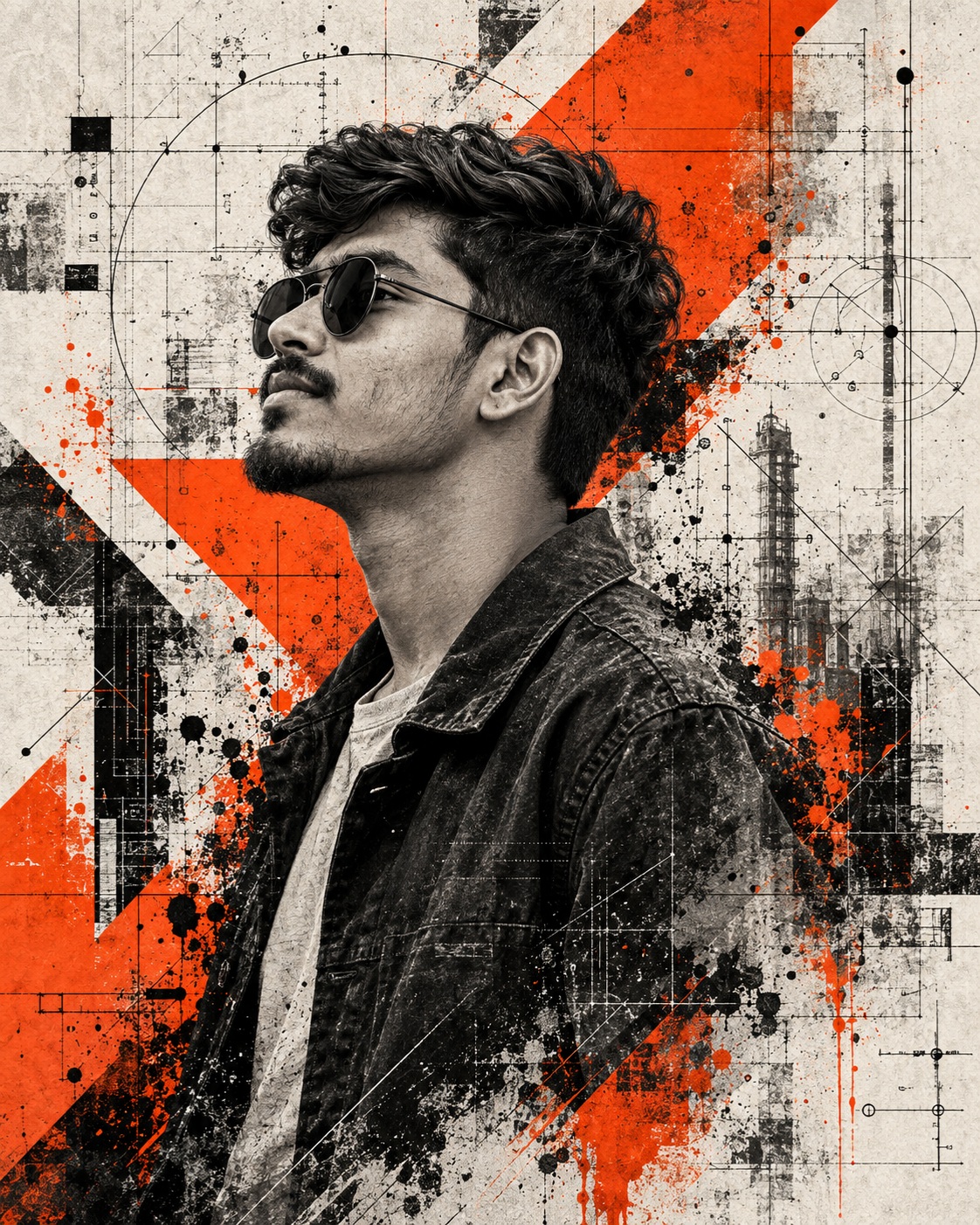
This concept is built around a single adult male presented as a strong editorial side-profile figure. The central idea is not a conventional studio portrait, but a carefully reconstructed graphic portrait in which the person becomes part of a distressed print composition. The man occupies the central-left portion of the vertical frame, with enough surrounding negative space for the technical drawings, ink marks, and orange-red geometry to remain visually important. His scale is deliberately controlled, so the composition does not feel like a tightly cropped headshot.
The main subject is defined by a clearly masculine facial silhouette, visible beard and moustache, textured dark hair, neck, shoulders, and upper torso. The profile is especially important because the nose, lips, chin, forehead, and raised head create a recognizable graphic contour. The head is angled strongly toward the left, with the chin lifted only slightly. This gives the portrait a confident, thoughtful, fashion-editorial presence without requiring an exaggerated expression. The sunglasses conceal the eyes, so the visual character comes from the profile line, facial planes, beard, hair, and head position rather than direct eye contact.
The face is intended to retain the supplied person’s recognizable identity. Facial proportions, distinctive features, natural asymmetries, hair characteristics, and other identifying details remain important, but they are interpreted through the artwork’s monochrome visual language. The concept avoids the feeling of a photograph simply placed on top of a graphic design. Instead, the facial structure and body should feel integrated with the same printed, engraved, charcoal, and mixed-media treatment used throughout the composition.
The hairstyle has short textured sides with more volume toward the top, while the beard and moustache create a strong dark contour around the lower face. Round dark sunglasses with thin frames add a distinctive fashion-editorial element. They also strengthen the circular and geometric language already present in the background. The clothing remains visually restrained: a dark jacket over a lighter inner shirt, with the same visible neckline, folds, shadow relationships, and silhouette as the reference. The clothing is not meant to become a fashion showcase by itself; it supports the face and graphic structure.
The pose is one of the most important parts of the concept. The body is not simply placed into a generic profile pose. The head tilt, neck angle, shoulder direction, torso position, and amount of visible body are all tied to the reference composition. The upper torso extends toward the lower-left area and becomes increasingly absorbed into the surrounding texture. This creates a transition between person and artwork. Preserving this relationship makes the composition feel intentionally designed rather than assembled from separate elements.
The background is equally important. It resembles a weathered sheet of editorial design material, architectural drafting paper, and experimental printmaking combined into one surface. Off-white and gray paper tones provide the foundation, while faint technical drawings, grids, measurement marks, circular construction diagrams, and fine geometric lines create an analytical layer. These details suggest drafting, architecture, engineering, and graphic experimentation without becoming a literal architectural scene.
Black ink and charcoal marks provide the strongest texture. Splashes, smoky patches, scratches, stains, broken marks, and distressed edges appear around the subject and across the paper. Some of these marks visually overlap the hair and shoulders, helping the figure feel embedded in the print. The background should remain dense enough to feel tactile, but the technical information should still sit behind the person rather than competing with the facial profile.
The orange-red elements act as the controlled color counterpoint. Large angular painted or geometric forms sit behind and around the silhouette, creating energetic shapes against the otherwise monochrome field. Their placement, scale, overlap, transparency, and splattered edges are important because they establish the graphic rhythm of the composition. Orange and red are accents rather than a general color treatment, so the entire portrait should not become warm-toned or orange graded.
Lighting is interpreted through strong grayscale tonal modeling. The face has visible planes and texture, with restrained highlights and deep shadows. Hair, beard, sunglasses, jacket, and ink marks contain genuinely dark values, while the paper and skin occupy a broader range of muted grays. This gives the portrait a printed, tactile quality and prevents it from looking like a softly lit modern studio photograph.
The visual style combines photographic detail with engraved illustration, editorial poster design, charcoal texture, distressed paper, and technical drawing. Fine skin and beard detail can remain recognizable, but the rendering belongs to the artwork as a whole. This mixed-media balance is what gives the concept its distinctive personality: realistic facial information is surrounded by deliberately imperfect marks, broken lines, paper wear, and graphic geometry.
Compositionally, the portrait relies on controlled negative space. The man is large enough to command attention but not so large that the background disappears. The vertical 2:3 orientation supports a fashion-poster or magazine-editorial feeling. The central-left placement also allows the technical marks and orange-red shapes to create movement around the silhouette. The result is intended to feel like a finished art print rather than an ordinary portrait photograph.
The camera feel is therefore editorial and photographic in its initial structure, but the final appearance is interpreted as mixed-media print art. The side profile should feel optically deliberate, with natural perspective and believable proportions. The artwork should not introduce a new camera angle, a tighter crop, a centered pose, or a different scale. The visual interest comes from how faithfully the identity, profile, clothing silhouette, and graphic layers coexist.
The creative purpose is to combine personal identity with a sophisticated monochrome design language. It can work particularly well as a profile poster, social media artwork, personal branding graphic, fashion-inspired portrait, editorial cover concept, portfolio visual, music or cultural artwork, or a dramatic display piece. It also offers a strong option for users who want a personal photograph to feel artistic without turning it into a completely different character or genre.
One of the strongest benefits of this concept is its balance between recognition and stylization. The person remains visually identifiable, while the surrounding treatment provides a more designed and expressive presentation. The restrained palette also makes the orange-red elements more noticeable, allowing a few bold shapes to create energy without overwhelming the grayscale portrait.
Overall, the concept describes a disciplined transformation of a male side-profile portrait into a high-end mixed-media editorial artwork. Its defining ingredients are identity preservation, strict profile geometry, controlled subject scale, dark round sunglasses, textured hair and beard, a restrained jacket-and-shirt silhouette, distressed paper, architectural drafting marks, black ink and charcoal texture, angular orange-red graphics, deep grayscale contrast, and carefully preserved negative space. Every layer contributes to the same visual system, producing a cohesive portrait with a tactile printed character and a strong contemporary editorial presence.
[[[
REFERENCE ANALYSIS
- Format/composition: Vertical editorial portrait, approximately 2:3. The character occupies the central-left portion of the frame from the lower torso/chest upward, with substantial graphic background visible around the silhouette. Do not crop tighter or enlarge the subject.
- Subject: One adult man in a strong left-facing side profile, head raised slightly. His face, beard, hairstyle, sunglasses, neck, shoulders, and upper torso are clearly visible. The body extends toward the lower-left edge and is partially absorbed into the graphic texture.
- Pose: Strict side-profile geometry. Nose points left, chin slightly elevated, shoulders angled naturally, gaze concealed by dark round sunglasses. Preserve the exact head tilt, neck angle, shoulder position, and silhouette.
- Appearance/clothing: Short textured dark hair with longer volume on top, closely clipped sides, full short beard and moustache, round dark sunglasses with thin frames, dark jacket over a lighter inner shirt.
- Visual style: High-contrast monochrome mixed-media editorial artwork rather than ordinary photography. The man’s rendering is detailed grayscale with photographic/engraved texture, while the surrounding design combines technical drawing, distressed paper, ink splatters, geometric construction lines, and vivid orange-red graphic shapes.
- Background: Off-white/gray weathered paper-like field with architectural/technical drafting diagrams, grids, measurement marks, circles, fine construction lines, black ink/charcoal splashes, and distressed textures. Large angular orange-red painted/geometric elements sit behind and around the subject.
- Lighting/color: Predominantly black, charcoal, white, and gray. Strong directional tonal modeling on the face and beard. Saturated orange-red accents provide the only major color contrast. Keep the dark areas genuinely dark and preserve the gritty tonal range.
- Identity replacement: Replace the reference man with [USER IDENTITY] while preserving the reference character’s exact screen-space size, profile orientation, pose, visibility, crop, clothing silhouette, and interaction with the graphic layers. The user’s original photograph must not dictate framing or pose.
MASTER PROMPT
Use the supplied reference image as the master visual blueprint. Replace only the reference character with the supplied user identity. Maintain the exact subject scale, screen-space proportion, cropping, and visibility of the reference character; do not normalize, enlarge, or reframe. Preserve all other visual information, composition, environment, lighting, color, depth, atmosphere, objects, background and artistic rendering as faithfully as possible.
Reconstruct the reference as a finished vertical mixed-media editorial portrait. Replace the original male character with [USER IDENTITY], using the user’s actual facial structure, proportions, recognizable features, hair characteristics, and natural asymmetries, while rendering that identity entirely in the reference artwork’s visual language.
The character must remain in the exact strong left-facing side profile shown in the reference: head turned almost completely sideways toward the left edge, chin subtly elevated, forehead/nose/lips/chin forming the same profile silhouette, neck descending into the same shoulder position, and upper torso occupying the same lower-left region. Preserve the exact amount of head, neck, shoulders, chest, and jacket visible in frame. Do not reveal additional body parts that are outside the reference crop. Do not use the user’s source-photo pose or camera angle; reconstruct the user’s identity into the reference pose.
Preserve the reference’s dark round sunglasses, thin frame construction, dark lenses, beard/moustache treatment, and overall clothing silhouette. [OUTFIT] should default to the reference outfit unless explicitly changed. Clothing must follow the same position, folds, shadows, neckline, and silhouette.
Render the face and body in high-contrast grayscale, with finely resolved skin texture, beard texture, hair strands, facial planes, and subtle photographic/engraved detail. The identity should be unmistakably [USER IDENTITY], but there must be no pasted photographic face, conventional face-swap appearance, or photorealistic face placed over an illustrated body. The entire character must belong naturally to the same monochrome mixed-media artwork.
Preserve the background exactly as a distressed graphic-art composition: weathered off-white and gray paper, faint technical architectural drawings, drafting grids, measurement annotations, circular construction diagrams, fine geometric lines, blueprint-like marks, black charcoal/ink splatters, smoky distressed patches, scratches, stains, and layered print textures. Preserve the large angular orange and red geometric/painted shapes behind the character, including their approximate placement, scale, overlaps, transparency, splatter edges, and relationship to the silhouette.
Maintain the dense black ink and charcoal splattering around the hair, shoulders, lower torso, and background. Preserve the orange-red paint bursts and diagonal graphic elements without adding new decorative motifs. The orange should remain a controlled accent against the grayscale image rather than becoming an overall color grade.
Match the original lighting and tonal structure: strongly modeled grayscale face, deep blacks in the hair, beard, sunglasses, jacket, and surrounding ink, restrained highlights on the skin and hair, muted gray midtones, and no artificial brightening of the face. Preserve the gritty, printed, distressed, tactile quality of the reference.
Maintain the original camera viewpoint, perspective, negative space, subject placement, subject scale, background density, depth relationships, and vertical framing. The result should look like the exact same artwork after its original character has been replaced by [USER IDENTITY], not like a newly designed portrait inspired by it.
If text is present in the supplied reference, preserve meaningful text, diagrams, measurements, and technical markings in their original positions and visual treatment. Ignore insignificant logos, watermarks, signatures, or brand marks unless explicitly requested. [TEXT] applies only when the user explicitly supplies replacement text.
EDITABLE VARIABLES
- [USER IDENTITY]: The supplied person’s identity; preserve their actual facial structure, proportions, distinctive features, hair characteristics, and asymmetries.
- [OUTFIT]: Reference outfit — dark jacket over lighter inner shirt. Change only if explicitly specified.
- [TEXT]: None unless explicitly supplied by the user.
- [OBJECT CHANGE]: None.
- [POSE CHANGE]: Reference pose — exact left-facing side profile with slightly raised chin and matching shoulder/torso geometry.
- [ADDITIONAL EDIT]: None unless explicitly specified.
NEGATIVE PROMPT
identity loss, different face, incorrect facial structure, original character remaining, added person, extra person, face swap, pasted face, photographic face pasted onto illustration, wrong identity, wrong profile direction, frontal face, three-quarter face, wrong head tilt, wrong gaze direction, wrong pose, wrong shoulder geometry, wrong body position, wrong camera angle, changed crop, changed composition, redesigned background, altered negative space, enlarged subject, normalized subject size, centered subject, zoomed in, zoomed out, expanded framing, full body, revealing hidden body parts, reconstructing cropped limbs,
changed screen-space proportion, changed subject placement, missing sunglasses, different sunglasses, altered beard, altered hair silhouette, different clothing silhouette, missing technical drawings, missing geometric graphics, missing orange-red shapes, missing ink splatters, clean background, smooth digital background, modern minimalist background, photorealistic conversion, unwanted realism, unwanted anime conversion, unwanted painting style, mixed visual styles, generic cinematic look, orange cinematic grading, oversaturation, brightened face, lifted shadows, lost black levels, flattened contrast, excessive color,
altered lighting, changed mood, lost paper texture, lost print texture, lost distressing, lost haze, missing scratches, missing drafting lines, missing architectural diagrams, added objects, removed objects, altered environment, bad anatomy, extra limbs, distorted hands, facial distortion, artificial beauty enhancement, symmetry correction, de-aging, identity beautification, unnecessary modifications. ]]]