
Gothic Architect Portrait
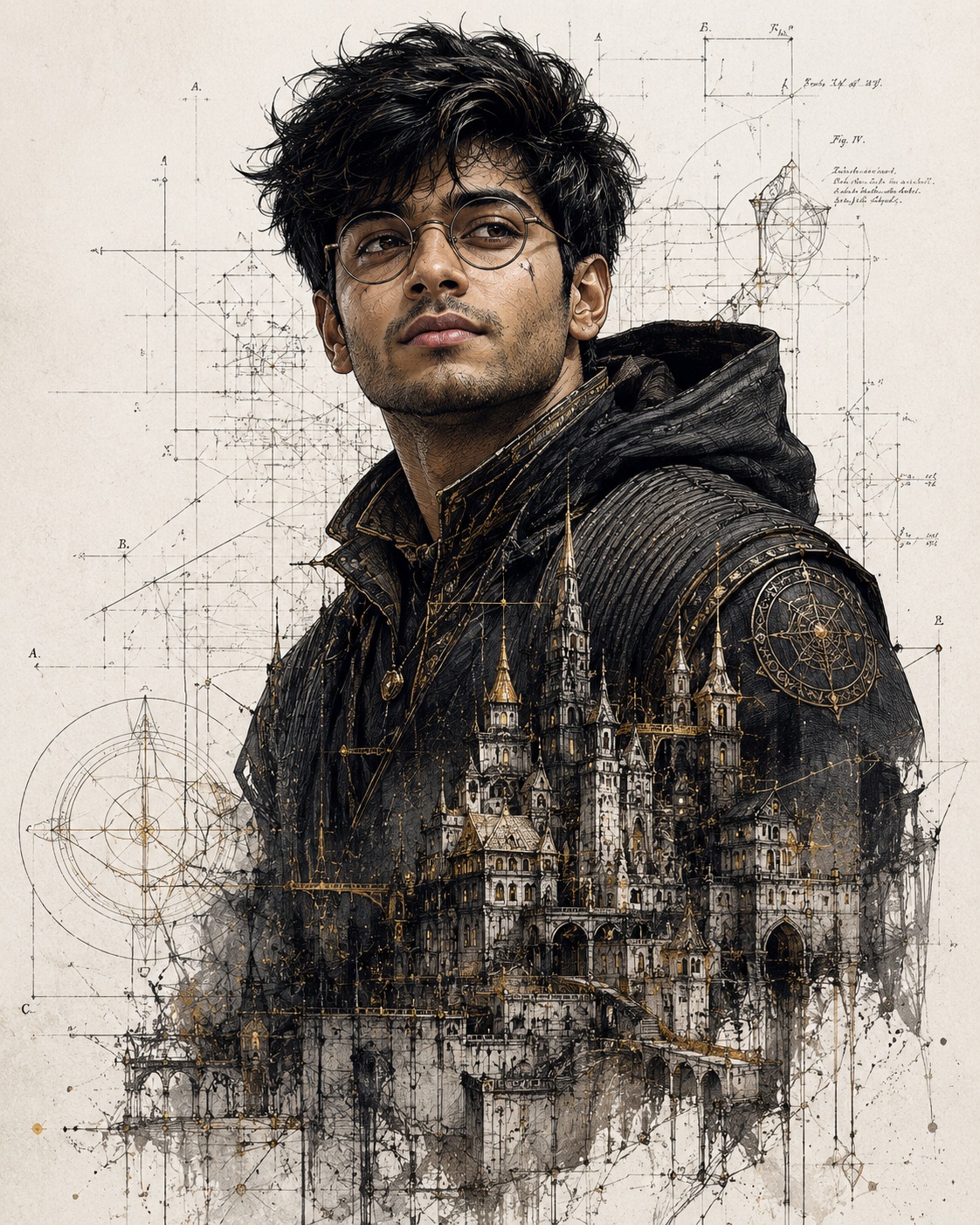
Gothic Architect Portrait describes a sophisticated visual concept where a single young adult male becomes the central figure in an imagined world of architecture, scholarship, and gothic fantasy. The artwork is built around the relationship between the man’s thoughtful portrait and a miniature medieval city that appears to grow naturally from the lower part of his clothing and torso.
Instead of treating the architectural element as a separate object placed beside the character, the concept makes the buildings feel like an extension of his imagination, knowledge, and identity.
The main subject is a masculine adult male shown in a strong three-quarter view. His head is placed in the upper-middle to left area, while his body angles slightly toward the viewer. His face turns toward the left and tilts subtly upward, producing an intelligent, reflective expression.
The pose feels calm and deliberate rather than aggressive. This thoughtful direction is important because the character resembles an architectural scholar, fantasy designer, or mysterious academic figure who appears to carry an entire imagined city within his world.
The face is designed to remain natural and recognizably human. If a Person Source is supplied, its purpose is limited to facial identity, body thickness, and original skin tone. The visual concept calls for preservation of facial structure, eye shape, eyebrows, nose, lips, jawline, ears, facial hair, and natural skin variation.
Rather than using a polished beauty treatment, the face is described through fine illustrated hatching, subtle pores, beard stubble, facial creases, and controlled ink shading. These marks create the feeling of a carefully hand-rendered portrait.
The hair is a major part of the character’s silhouette. It is thick, messy, tousled, and individually described with inked strands. The loose hair extends naturally around the upper head and blends with the dark hood behind him. The hood creates a strong dark shape around the neck and shoulders while preserving the scholar-like fantasy character. Round, thin-framed eyeglasses add an intellectual quality and immediately distinguish the subject from a conventional medieval warrior.
A subtle facial scar or mark near the cheek and eye region provides another small identity detail. Short stubble appears across the jaw, cheeks, chin, and upper lip. The ear anatomy remains carefully defined rather than simplified. Together, the glasses, stubble, facial mark, messy hair, and serious expression create a mature but youthful academic character with a mysterious gothic personality.
The clothing is dark, layered, and textural. The subject wears a hooded garment with a scarf or layered collar around the neck and chest. Vertical ribbing and fine textile lines give the shoulder and torso areas physical depth. The sleeve includes a small circular medieval-inspired crest or emblem, which works as a decorative costume detail rather than a modern brand mark. The clothing remains primarily graphite, charcoal, and black, with delicate gray linework describing folds, seams, fabric edges, and layered construction.
The most distinctive feature is the miniature gothic architecture emerging from the lower torso. Towers, pointed roofs, narrow windows, balconies, bridges, walls, spires, roof tiles, stair-like structures, and tiny architectural openings are combined into a dense medieval settlement. The architecture is not presented as a generic castle icon. It has the visual complexity of a miniature city drawn by someone who understands structure, perspective, and historical architectural forms.
This lower architectural world gives the concept its strongest storytelling quality. It suggests that the character is connected to an entire imagined civilization. The city can be read as a symbolic extension of thought, creativity, memory, study, or fantasy. Because the structures visually integrate into the lower clothing and torso, the transition between human figure and architecture becomes a central design feature.
The architecture uses dark linework with selective antique gold, bronze, ochre, and muted brown accents. These warmer notes remain concentrated within small architectural details instead of covering the whole artwork. Their limited presence makes individual towers, roofs, windows, and ornamental elements stand out against the mostly monochrome composition.
Surrounding the character is a dense but delicate architectural blueprint framework. Thin construction lines, rectangles, circles, arcs, perspective guides, measurement marks, geometric diagrams, arrows, intersection points, drafting grids, and faint technical annotations create the impression of a working architectural sheet. These elements make the artwork feel intellectual and handcrafted while reinforcing the connection between the portrait and the miniature city.
The blueprint marks vary in strength. Some lines are crisp enough to be noticed immediately, while others are extremely faint and dissolve into the off-white paper. Some construction geometry appears behind the character and some passes around or partially over the surrounding composition. This layering creates depth without turning the blueprint into a heavy graphic frame.
The paper background is clean ivory or off-white. This light surface is essential because it allows the black ink portrait and architectural linework to remain crisp. Small stains, scattered ink marks, scratches, unfinished strokes, and sketch fragments add an authentic studio-workbook feeling. The artwork therefore resembles a rare concept sheet, illustrated manuscript, architectural study, and fantasy character portrait combined into one visual object.
The mood is sophisticated dark academia mixed with gothic fantasy and architectural concept art. It feels mysterious, intellectual, magical, and handcrafted. The subject does not appear cheerful or theatrical. Instead, the expression and restrained palette suggest someone absorbed in ideas, ancient structures, hidden histories, and imagined worlds.
The visual language avoids a glossy modern poster treatment. It favors crisp black contours, fine cross-hatching, delicate line variation, controlled washes, and carefully layered architectural marks. The combination can feel similar to a hand-inked graphic novel illustration merged with a technical drawing and a gothic fantasy design sheet.
Composition is carefully balanced. The face remains in the upper-middle region, slightly left of center. Hair and hood create a visual expansion toward the upper areas, while the shoulders and dark clothing extend toward the right. The miniature city grows downward from the lower chest and torso into the bottom-center. Around all of these elements, generous white space keeps the composition airy instead of crowded.
The 9:16 vertical format supports this hierarchy. It gives the portrait enough height for the face and hair while providing a substantial lower area for the architectural city. The tall format also makes the artwork suitable for mobile screens, portrait posters, digital galleries, and social media presentation.
Lighting is neutral and controlled rather than cinematic. Strong ink-defined shadows provide depth, but there is no orange-and-teal photographic grading or dramatic background glow. The artwork depends on line quality, paper contrast, hatching, and selective color accents. This keeps the visual character closer to premium illustration and concept design than to a conventional photograph.
The architecture should remain dense but readable. Individual towers and structures need enough separation that the lower portion does not become an indistinguishable dark mass. Fine openings, roofs, bridges, stairs, balconies, and spires create visual rhythm. The selective warm details act as small points of interest within the otherwise graphite-heavy city.
The concept also benefits from the contrast between soft human features and hard architectural geometry. The face, hair, and fabric contain organic curves, while the blueprint and buildings introduce circles, straight lines, measured angles, and repeated structural patterns. This difference gives the composition a distinctive rhythm and makes the character feel naturally connected to architectural design.
The creative purpose of this concept is to communicate intelligence through visual storytelling. Instead of simply showing an academic character, the artwork makes his imagined environment physically visible. The miniature gothic settlement becomes a metaphor for the ideas, plans, worlds, and stories contained within his mind.
This style can be used for fantasy character posters, architectural fantasy artwork, book-cover concepts, character profile graphics, dark academia collections, gaming-inspired designs, fictional scholar portraits, social media artwork, personal creative projects, and atmospheric editorial illustrations. It is particularly suitable when a creator wants a character image that feels intelligent and unusual rather than simply heroic.
The detailed blueprint surroundings can also make the artwork feel like a design artifact from a fictional world. The viewer can imagine the character as an architect, scholar, cartographer, magical designer, or keeper of an ancient city. This open-ended storytelling gives the image more depth than a straightforward portrait.
Overall, the concept combines portrait identity, gothic architecture, technical drafting, dark academic styling, and fantasy symbolism. Its strongest qualities are the thoughtful male expression, messy inked hair, glasses, layered hooded clothing, miniature medieval settlement, delicate blueprint geometry, selective antique accents, and spacious paper background. Every part contributes to a single coherent visual language.
The result is intended to feel premium, intelligent, mysterious, handcrafted, and richly detailed. It balances dense architectural information with generous negative space, allowing the viewer to discover small details without losing the main portrait. The character remains the emotional anchor, while the miniature city becomes the visual narrative engine beneath him.
[[[
1. Main Goal & Scenario
Reconstruct the Main Reference as a vertical 9:16 fantasy architectural character illustration: a young adult male wizard/architectural scholar in three-quarter view, wearing dark layered clothing, with an intricate miniature gothic castle/city emerging and integrating into the lower portion of his torso.
2. Multi-Person Identity & Gender Mapping Lock
- One male human subject only.
- No female subjects, secondary characters, crowds, or additional people.
- Preserve the subject strictly as a masculine adult male.
- No face blending or gender alteration.
3. Strict Facial & Skin Tone Preservation Lock
- If a Person Source is provided, use it ONLY for the male subject’s face ID, body thickness, and exact original skin tone.
- Preserve exact facial structure, eye shape, eyebrows, nose, lips, jawline, ears, facial hair, and natural skin texture.
- Do not beautify, smooth, tan, lighten, darken, or normalize the skin.
- Maintain natural pores, subtle beard stubble, facial creases, and realistic skin variation.
4. Micro-Detail & Calendar/Prop Marking Lock
- Reproduce the Main Reference’s dense architectural blueprint overlay surrounding the subject.
- Preserve thin construction lines, rectangles, circles, arcs, perspective guides, measurement marks, geometric diagrams, tiny handwritten-style technical annotations, arrows, intersection points, and faint drafting grids.
- Reproduce the intricate miniature medieval city/castle integrated into the lower torso.
- Include every visible tower, pointed roof, narrow window, balcony, wall, bridge, spire, roof tile, tiny architectural opening, staircase-like structure, and layered building.
- Preserve the small circular crest/emblem on the upper-right sleeve.
- Preserve the tiny warm golden/brown highlights throughout the architectural miniature.
- Keep the scattered ink strokes, sketch fragments, stains, scratches, construction marks, and unfinished linework around the lower composition.
5. Identity Mapping & Face Scale
- One male face only.
- Subject’s head occupies the upper-middle/left region.
- Face is shown in a strong three-quarter profile, looking toward the left side of the frame.
- Keep the head proportional to the body.
- Do not enlarge the face into a giant portrait.
- Preserve the serious, thoughtful, intelligent expression.
6. Pose Source Lock
- 100% replicate the Main Reference pose.
- Male subject faces toward the left while his torso remains angled slightly toward the viewer.
- Head tilted subtly upward/left.
- Shoulders positioned diagonally.
- Neck naturally connects into the raised shoulder and hood.
- Arms/body remain integrated into the lower architectural composition.
- Do NOT copy pose from any Person Source photograph.
7. Typography Letter Content Lock
- No large title or name is present in the Main Reference.
- Do not introduce any prominent typography.
- Preserve only the tiny technical/drafting-style markings that naturally belong to the reference composition.
- No decorative title, caption, quote, or name.
8. ONE TEXT ONE PLACE Lock
- Do not add a user name unless the user explicitly supplies one.
- Never place a name in multiple locations.
- Keep all technical markings confined to the blueprint/sketch areas where they naturally appear in the reference.
9. Exact Text Style & Size Replication Lock
- Any tiny reference annotations must remain tiny, handwritten/technical blueprint-style, thin and understated.
- Never convert them into large bold typography.
- Never add 3D gold letters.
- Technical markings should look like architectural drafting notes rather than poster typography.
10. Direct Text Injection Command
- No user-provided name has been supplied.
- Therefore do not invent or hardcode any name.
- If text is later supplied, render exact text only once using the visual language and scale appropriate to the Main Reference.
11. No Giant Central Figure Lock
- Do not make the human figure fill the entire canvas.
- Maintain the reference’s balance between portrait subject, architectural miniature, and blueprint framework.
- The lower architectural city must remain highly visible and visually important.
- Do not place oversized text over the body.
12. Vibe, Color & Mood Lock
- Sophisticated dark academia + gothic fantasy + architectural concept-art mood.
- Mostly monochrome black, graphite, charcoal, ivory, off-white, and gray.
- Selective antique gold, bronze, ochre, and muted brown accents appear mainly within the miniature architecture and small clothing details.
- Clean white/off-white paper background.
- Intellectual, mysterious, magical, handcrafted, highly detailed atmosphere.
- No neon colors.
- No modern glossy digital-poster appearance.
- No heavy warm/golden color grading over the entire image.
13. Micro-Details & Crop
- Exact tall vertical crop.
- Preserve the large amount of white/off-white negative space around the character.
- Hair is messy, thick, tousled, and individually inked strand-by-strand.
- Preserve round thin-framed eyeglasses.
- Preserve the subtle facial scar/mark near the right cheek/eye region.
- Preserve short facial stubble across jaw, cheeks, chin, and upper lip.
- Keep the detailed ear anatomy.
- Preserve the dark hood behind the head.
- Reproduce the fine vertical ribbing and layered texture of the shoulder clothing.
- Preserve the ornate embroidered/illustrated sleeve emblem.
- Keep the lower torso visually transforming into an elaborate medieval/gothic architectural settlement.
- Preserve rough unfinished sketch strokes extending beyond the architectural form.
- Preserve faint stains and scattered ink marks on the paper.
14. Identity, Raw Skin & Anti-Fake
- Natural illustrated skin texture with visible fine hatching.
- Do not create plastic 3D skin.
- Facial shading should use detailed cross-hatching and controlled ink strokes.
- Preserve realistic masculine facial proportions.
- Maintain natural eye reflections without oversized anime eyes.
- No beauty-filter effect.
15. Hand-Prop & Neck-Head Alignment
- Maintain anatomically correct neck-to-shoulder connection.
- Preserve the exact visible clothing/arm placement.
- The architectural structures must appear physically integrated into the lower clothing/body area rather than randomly floating.
- No disconnected limbs or impossible joints.
16. Body Proportion & Limb Scaling
- Realistic slim-to-average adult male proportions.
- Shoulders moderately broad but not exaggerated.
- Natural neck width.
- Realistic ears, hands, fingers, shoulders, and torso.
- No muscular superhero anatomy.
- No oversized hands or distorted limbs.
17. Outfit Fit, Drape & Wrap
- Dark layered hooded garment.
- Hood sits behind the neck and shoulders with natural folds.
- Upper clothing has dense vertical textile/ribbed texture.
- Preserve the dark layered scarf/collar structure around the neck and chest.
- Sleeve should contain the ornate medieval-inspired circular/crest-like patch.
- Clothing remains dark graphite/black with fine gray ink detailing.
- No modern logos or brand marks.
18. Selective Color & Tone Mapping
- Background: ivory/off-white paper.
- Blueprint lines: pale gray, graphite, thin black.
- Character: predominantly black, charcoal, gray, and muted skin tones.
- Architecture: black linework with selective antique gold, bronze, ochre, and brown details.
- Gold accents must remain selective and concentrated, never flooding the whole image.
- Preserve the original high-contrast monochrome-with-gold-accent appearance.
19. No Random Logos & Clean Text
- No modern logos.
- No watermark.
- No signature.
- No social-media branding.
- No random symbols.
- Only reproduce reference-consistent architectural drafting marks and the existing sleeve emblem.
20. Perfect Spelling & Text Rendering
- Do not invent readable text.
- Technical markings should remain subtle and naturally integrated.
- No accidental alphabetic characters, gibberish typography, giant pseudo-text, or floating words.
21. Text Ratio & Style Lock
- Keep text/annotation density extremely small relative to the overall image.
- The artwork is primarily a visual illustration, not a typography poster.
- Blueprint annotations must remain secondary to the portrait and architecture.
- Never add a large central title.
22. Opacity, Layering & Ghost
- Blueprint construction lines should have varied opacity: some crisp, some extremely faint.
- Some lines pass behind the subject while others appear around or partially over the composition.
- Architectural linework should have multiple depth layers.
- No solid ghost duplicates.
- No repeated faces or duplicated architecture.
23. Duplicate Mapping & Pose Variety
- Exactly one male subject.
- Exactly one integrated architectural city/castle composition.
- No duplicate heads, faces, bodies, or extra characters.
- Do not repeat the same tower unnaturally.
- Architectural repetition must feel like a dense medieval city rather than copy-pasted objects.
24. Professional Quality Boost
- Ultra-high-detail professional illustration.
- Hybrid of technical architectural blueprint drawing + hand-inked graphic novel portrait + gothic fantasy concept art.
- Extremely crisp black ink contours.
- Fine cross-hatching.
- Delicate line variation.
- Controlled watercolor-like muted washes.
- Intricate architectural detailing.
- High-resolution print-quality finish.
- Every small element should remain sharp and intentional.
25. Body Visibility & Scene Density
- Upper half: primarily the male portrait.
- Lower half: dense miniature gothic/medieval city integrated into his torso.
- Surrounding canvas: architectural construction diagrams and drafting geometry.
- Keep enough white space to preserve the original airy blueprint aesthetic.
- Lower architecture should be dense and highly intricate without becoming an indistinguishable dark blob.
26. Composition/Camera & Lighting
- Vertical 9:16 composition.
- Three-quarter portrait framing.
- Subject positioned slightly left of center.
- Face in upper-middle region.
- Hair extends naturally toward upper-left and upper-center.
- Hood and shoulders expand toward the right.
- Architectural miniature grows from the lower chest toward the bottom-center.
- Blueprint geometry surrounds the entire figure.
- Soft neutral illumination with strong ink-defined shadows.
- No cinematic orange/teal grading.
- No photographic depth-of-field blur.
- Maintain sharp linework across both character and architecture.
27. Quality Lock & User Customization
- Preserve the Main Reference’s exact composition, pose, crop, facial orientation, clothing silhouette, blueprint geometry, architecture placement, line density, selective gold accents, white-space ratio, and artistic style.
- If a Person Source is supplied, use it only for locked identity/skin/body attributes.
- If the user later supplies a name, add it only once and only where instructed.
- Otherwise keep the artwork free of any user-added name or prominent text.
28. Bad Output Mistakes & Negative Prompt
NEGATIVE PROMPT: wrong identity, generic face, face paste, face blending, gender swap, altered skin tone, darkened skin, artificial tan, plastic skin, smooth skin, beauty filter, wrong pose, copied Person Source pose, normalized pose, giant head, giant central figure, extra humans, extra characters, duplicate person, duplicate face, duplicate architecture, anime face, oversized eyes, distorted glasses, missing glasses, wrong hair, short hair, clean modern haircut, missing stubble, missing facial mark, broken neck, bad anatomy, bad hands,
extra fingers, hulk hands, incorrect clothing, modern clothing, random logo, modern branding, watermark, signature, giant title, giant typography, 3D gold text, unauthorized name, hallucinated name, spelling mistakes, readable gibberish, excessive text, missing blueprint lines, missing construction geometry, missing architectural diagrams, missing medieval towers, missing miniature city, generic buildings, low-detail castle,
copy-pasted towers, flat architecture, blurry linework, smooth vector-only style, photorealistic photo, CGI, plastic 3D render, neon colors, excessive gold, warm cinematic grading, dark muddy background, low contrast, oversaturated colors, empty lower section, missing micro-details, missing cross-hatching, missing ink scratches, missing paper texture, amateur quality, low resolution, AI artifacts. ]]]
” https://prompt.mahantababu.com/