
Dark Fantasy Warrior
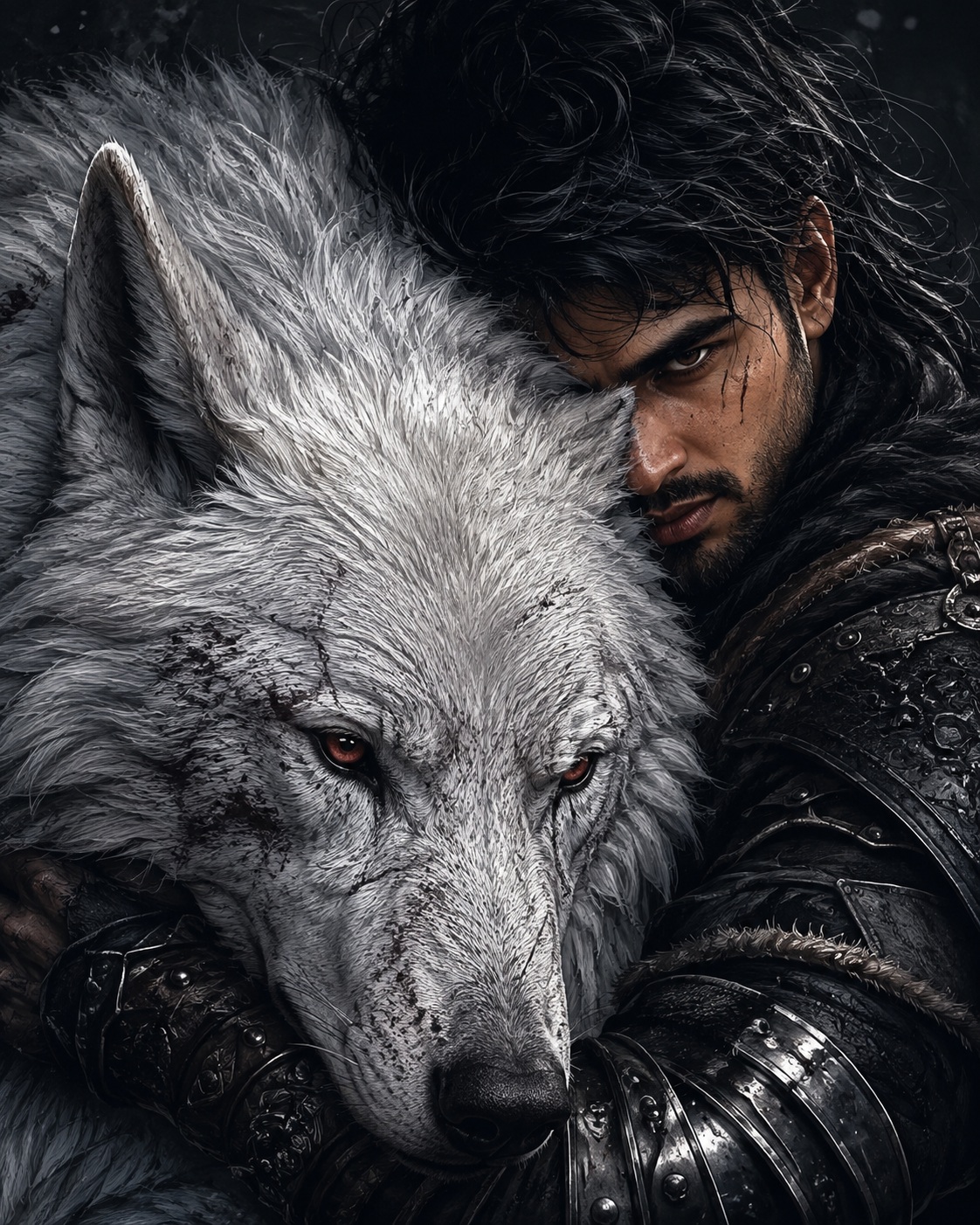
The Dark Fantasy Warrior concept presents a powerful close-up relationship between one rugged adult male warrior and one massive white wolf. The central creative idea is not simply a warrior portrait and not simply an animal illustration. The visual strength comes from placing both subjects extremely close together, allowing the wolf to dominate the foreground while the warrior remains partially concealed behind the wolf.
This creates a feeling of trust, protection, loyalty, strength, and shared survival. The composition feels like a moment taken from a larger medieval legend, but it remains tightly framed so that almost every visible area is occupied by meaningful character detail.
The human subject is clearly an adult male with a strong masculine presence. His appearance is rugged rather than polished. Long, messy, wavy black hair spreads around the upper-right portion of the composition, with individual loose strands contributing to the weathered character of the portrait. His beard and facial hair are dense and naturally textured. The face is intentionally only partly visible,
which is important because the warrior is not supposed to become a conventional centered portrait. One intense eye area, strong eyebrows, a defined nose, lips, forehead details, and facial hair create a concentrated expression of seriousness and determination. If an identity source is supplied, the concept places particular importance on preserving the person’s natural facial structure, skin tone, body thickness, and recognizable features rather than turning the subject into an idealized fantasy face.
The facial treatment is especially important to the overall character. Natural skin texture, subtle pores, realistic facial hair, and small irregularities help maintain a raw masculine appearance. The face should feel lived-in and weathered rather than cosmetically perfected. The expression is intense and protective, with the warrior’s attention closely connected to the wolf. Because the human face emerges from behind the wolf’s head, the partial visibility itself becomes part of the storytelling. The hidden areas create mystery while the visible eye and facial structure provide enough information to establish the warrior’s identity and emotional presence.
The wolf is the visual anchor of the entire scene. It is exceptionally large and occupies most of the left and central foreground. Its white coat creates a dramatic contrast against the dark warrior and nearly black background. The head is positioned diagonally, extending from the upper-left region toward the lower-center portion of the frame. Its pointed ears rise prominently toward the upper-left and upper-center areas, giving the silhouette an instantly recognizable northern-wilderness character. The large dark nose sits near the lower-middle portion, while the reddish or dark crimson eyes create an unusual and memorable focal detail.
The fur is one of the most important visual features. Instead of appearing as a smooth white surface, the wolf has dense, layered, individually readable strands. Silver-gray and subtle blue-gray variations add depth throughout the coat. The direction of the fur follows the anatomy of the head, neck, and body, helping the animal feel substantial and believable. Around the face, muzzle, ears, cheeks, and neck, the fine linework gives the fur a handcrafted illustrated quality. The contrast between highlighted strands and deeper shadowed layers makes the wolf appear extremely dense and tactile.
The relationship between the two subjects is equally important. The warrior is positioned behind and beside the wolf, leaning close to it rather than standing separately. His arms and body wrap around or support the animal from behind. This creates a protective physical connection and makes the scene feel intimate without becoming sentimental. The wolf remains the larger foreground presence, while the warrior functions as the darker secondary layer. This hierarchy prevents the human character from overwhelming the animal and preserves the distinctive visual balance of the reference concept.
The clothing reinforces the medieval-fantasy setting. The warrior wears dark protective clothing combined with layered armor, padded material, worn leather, fabric, stitched details, fur-trimmed sections, and segmented metallic protection. The lower-right portion carries particular visual weight through the armored forearm and gloved hand. The metal surfaces are weathered rather than pristine, showing scratches, small highlights, worn edges, and subtle tonal variation. These details suggest a character who has experienced difficult conditions rather than a ceremonial warrior wearing untouched costume armor.
The armor also helps define the composition through its darker geometric forms. Curved plates, seams, clasps, leather sections, and layered construction create a strong contrast with the soft irregularity of the wolf’s fur. The materials therefore communicate different forms of strength: the wolf represents organic power and instinct, while the armor represents human resilience and protection. Keeping both material types highly detailed makes the scene visually rich without requiring an elaborate background.
The background is intentionally subdued. A very dark environment allows the white wolf to emerge strongly while keeping the warrior’s black hair and dark armor integrated into the surrounding shadows. There is no need for a busy landscape because scenery would compete with the tightly connected subjects. The nearly black background creates a concentrated portrait atmosphere and directs attention toward the wolf’s face, the warrior’s visible eye, the hair, the armor, and the interaction between them.
The color palette is cold and restrained. White, silver-gray, charcoal, black, steel-gray, muted blue-gray, and natural skin tones establish the visual foundation. The wolf’s reddish eyes provide a small but powerful tonal accent. The cool palette supports the northern-warrior atmosphere and gives the artwork a mysterious, severe character. Warm golden grading, cheerful colors, and bright modern photographic tones would weaken this particular mood because the creative direction depends on coldness, shadow, and controlled contrast.
Lighting is dramatic and directional. Selected areas of the wolf’s fur catch crisp highlights, allowing individual strands to separate from darker layers. The warrior’s face receives enough illumination to reveal the important facial features while leaving portions of his head and body concealed. Hair strands can catch narrow cool highlights, while armor plates receive small reflective glints. Deep shadows around the clothing, background, and recessed fur create depth without making the entire image visually flat.
The camera feeling is close, intimate, and portrait-oriented. A 9:16 vertical composition gives the wolf enough space to dominate the frame while allowing the warrior’s upper-right presence to remain visible. The close camera position creates foreground depth because the wolf sits slightly nearer to the viewer than the warrior. This makes the animal appear imposing without requiring unnatural proportions. The tight crop also ensures that the viewer immediately encounters the characters rather than being distracted by distant scenery.
The pose is a major storytelling element. The warrior’s head emerges from behind the wolf rather than sitting beside it as an independent portrait. The wolf’s head angles downward, creating a diagonal flow through the composition. The warrior’s arms follow the animal’s body and provide a natural visual bridge between the human and animal forms. This arrangement communicates physical closeness, protection, and companionship while retaining a serious warrior aesthetic.
Small details increase the professional illustration quality. Loose hair strands, beard hairs, fur fibers, armor scratches, stitched fabric, metal edges, leather textures, folds, clasps, and tiny highlights give the scene a handcrafted density. The face benefits from similarly careful treatment through natural skin texture and individual facial hairs. These micro-details are not merely decorative; they establish material realism and make the fantasy setting feel tangible.
The creative purpose is to combine character portraiture, animal symbolism, medieval costume design, and dramatic fantasy storytelling into one concentrated visual. The warrior can represent courage, loyalty, survival, guardianship, and determination, while the white wolf adds mystery, instinct, wilderness, and legendary symbolism. Their physical closeness suggests a bond stronger than a conventional character-and-animal pairing.
This style can work particularly well for fantasy character posters, profile artwork, gaming-inspired visuals, book-cover concepts, social media artwork, character showcases, dramatic wallpapers, mythology-inspired designs, and personal creative projects. It can also appeal to viewers who enjoy northern warrior aesthetics, dark medieval worlds, wolf symbolism, rugged masculine portraits, and highly detailed fantasy illustration.
Overall, the concept is built around contrast: white fur against black surroundings, organic texture against metal armor, partially hidden identity against a highly expressive eye, soft fur against hard protective plates, and a massive animal foreground against a partially concealed human figure. Those contrasts give the composition its visual power. The result is intended to feel mysterious, protective, intense, legendary, and emotionally connected while remaining focused, text-free, and visually disciplined.
[[[
1. Main Goal & Scenario
Reconstruct the Main Reference as a vertical fantasy character illustration: a rugged dark-haired warrior intimately positioned behind and beside a massive white wolf, with the wolf dominating the foreground and the warrior partially concealed behind its head and fur.
2. Multi-Person Identity & Gender Mapping Lock
- One male human subject only.
- Preserve the male subject as a masculine adult warrior.
- The wolf is an animal and must remain visually distinct from the human.
- No additional humans, animals, or creatures.
3. Strict Facial & Skin Tone Preservation Lock
- If a Person Source photo is supplied, use it ONLY for the man’s facial identity, body thickness, and exact original skin tone.
- Preserve distinctive facial structure, eyes, eyebrows, nose, lips, beard, and natural skin texture exactly.
- Never artificially tan, lighten, darken, beautify, smooth, or plasticize the skin.
4. Micro-Detail & Calendar/Prop Marking Lock
- No calendar or date markings are present.
- Reproduce every visible wolf-fur strand, facial-hair strand, armor seam, leather texture, metal plate, scratch, fold, clasp, and tiny highlight.
- Preserve the small decorative patterns and weathered details visible across the warrior’s clothing and armor.
- Maintain the intricate linework throughout the wolf’s muzzle, ears, eyes, nose, and fur.
5. Identity Mapping & Face Scale
- Keep the warrior’s face partially hidden behind the wolf exactly as shown.
- One intense visible eye area, strong eyebrows, defined nose, lips, beard, and long wavy black hair.
- Human face must remain proportionate to the body and wolf.
- Do not enlarge the human head or turn him into a giant central figure.
6. Pose Source Lock
- 100% replicate the Main Reference pose.
- The warrior is positioned directly behind the wolf’s head, leaning/pressing close to it.
- His face emerges from the upper-right/center area behind the wolf.
- The wolf’s head angles diagonally downward toward the lower center.
- The warrior’s arms/body wrap around and support the wolf from behind.
- Do NOT copy any pose from a Person Source photograph.
7. Typography Letter Content Lock
- The reference contains NO visible typography or lettering.
- Do not introduce any title, caption, quote, initials, signature, or decorative text.
8. ONE TEXT ONE PLACE Lock
- No text in the final image.
- Do not add text anywhere on the artwork, clothing, armor, background, or props.
9. Exact Text Style & Size Replication Lock
- No typography required.
- Preserve the reference’s clean illustration surface without invented lettering.
10. Direct Text Injection Command
- NO TEXT.
- Do not render any name or words unless the user explicitly provides text in the current request.
11. No Giant Central Figure Lock
- The wolf must remain the dominant foreground subject.
- The warrior stays partially obscured behind the wolf.
- Do not place the warrior standing over the composition.
- Do not enlarge the human until he overwhelms the wolf.
12. Vibe, Color & Mood Lock
- Dark, mysterious, intense medieval-fantasy / northern warrior atmosphere.
- Cold monochromatic palette dominated by white, silver-gray, charcoal, black, muted blue-gray, and subtle skin tones.
- Strong dramatic emotional connection between warrior and wolf.
- Preserve the serious, powerful, protective, almost legendary mood.
- No warm golden color grading, cheerful colors, or modern photographic appearance.
13. Micro-Details & Crop
- Exact tight vertical crop.
- Wolf occupies most of the left and central foreground.
- Wolf’s large pointed ears rise toward the upper-left/upper-center.
- Wolf’s face extends diagonally from upper-left toward lower-center.
- Preserve the large black nose near the lower-middle area.
- Preserve the wolf’s piercing reddish/dark red eyes.
- Warrior’s long messy/wet-looking black hair spreads across the upper-right region.
- Keep individual loose hair strands visible around the forehead and sides.
- Preserve the warrior’s forehead markings/scars and facial hair.
- Keep the partial fur-covered shoulder/arm and armor visible on the right.
- Preserve the cropped lower-left wolf fur and lower-right armored glove/arm.
14. Identity, Raw Skin & Anti-Fake
- Human skin must retain natural pores and subtle texture.
- No airbrushed skin.
- No exaggerated beauty retouching.
- No artificial glossy skin.
- Preserve realistic beard density and individual facial hairs.
- Keep the warrior’s rugged masculine appearance.
15. Hand-Prop & Neck-Head Alignment
- Warrior’s arms remain wrapped around/supporting the wolf.
- Preserve the visible gloved/armored hand at the lower-right.
- Maintain natural connection between the warrior’s shoulders, arms, neck, and head.
- Wolf’s neck and head must connect naturally into its large fur-covered body.
- No broken anatomy or disconnected limbs.
16. Body Proportion & Limb Scaling
- Warrior has a strong but realistic adult male build.
- Do not create exaggerated muscularity.
- Hands and fingers must have realistic proportions.
- Wolf must be anatomically believable despite the stylized illustration treatment.
- Do not create oversized human hands or distorted paws.
17. Outfit Fit, Drape & Wrap
- Warrior wears dark medieval/fantasy protective clothing and layered armor.
- Preserve the black/dark-gray padded material around the shoulders and torso.
- Preserve metallic segmented armor on the lower-right arm/forearm.
- Preserve worn leather/fabric elements with decorative stitched or fur-trimmed edges.
- Armor must follow the body’s natural contours.
- No modern clothing, military uniform, or futuristic armor.
18. Selective Color & Tone Mapping
- White wolf fur: predominantly cool white with silver-gray and very subtle blue-gray shading.
- Wolf nose: deep charcoal/black with a slightly textured moist surface.
- Wolf eyes: intense dark reddish/crimson tones.
- Warrior hair: near-black with cool blue-gray highlights.
- Armor/clothing: black, charcoal, steel-gray, muted silver.
- Skin: natural original tone if a Person Source is supplied.
- Maintain strong contrast between white wolf and dark warrior.
19. No Random Logos & Clean Text
- No logos.
- No watermark.
- No signatures.
- No brand marks.
- No invented symbols or writing.
- Any decorative armor markings must remain purely faithful to the reference.
20. Perfect Spelling & Text Rendering
- Not applicable because the output must contain zero text.
- Absolutely no accidental letters or pseudo-text anywhere.
21. Text Ratio & Style Lock
- Maintain the reference’s text-free composition.
- Do not reserve space for typography.
- Do not add a poster title or decorative caption.
22. Opacity, Layering & Ghost
- No ghosting.
- No duplicated human.
- No duplicated wolf.
- All subjects and armor elements must have solid, clean illustration definition.
- Fur layers must overlap naturally with realistic depth.
23. Duplicate Mapping & Pose Variety
- Exactly one warrior and one wolf.
- No duplicate wolf heads.
- No duplicate faces.
- No additional wolves in the background.
- No secondary characters.
24. Professional Quality Boost
- Ultra-detailed professional fantasy illustration.
- Crisp hand-drawn/inked linework combined with sophisticated painterly shading.
- Extremely detailed individual fur strands.
- Detailed facial rendering and hair strands.
- High-resolution finish.
- Rich tonal separation without losing the dark mood.
25. Body Visibility & Scene Density
- Tight portrait composition.
- Wolf’s head and upper body dominate approximately the left/center portion.
- Warrior occupies the upper-right and background layer.
- Armor and gloved hand provide visual weight in the lower-right.
- No empty scenery competing with the characters.
- Background should remain very dark and unobtrusive.
26. Composition/Camera & Lighting
- Portrait 9:16 composition.
- Tight close-up / intimate character portrait.
- Camera positioned close to the subjects.
- Wolf is slightly closer to camera than the warrior, creating strong foreground depth.
- Dramatic directional illumination across the wolf’s white fur and warrior’s face.
- Deep shadows around the armor, hair, and background.
- Strong rim/highlight definition along selected fur and hair strands.
- Maintain the exact visual hierarchy and framing of the Main Reference.
27. Quality Lock & User Customization
- Preserve the Main Reference composition, pose, crop, proportions, color palette, lighting, subject placement, outfit construction, fur direction, facial expression, and illustration style.
- If the user later supplies a name/text, add it ONLY according to their explicit instruction; otherwise keep the image completely text-free.
- If Person Source images are supplied, use them only for the locked identity/skin/body attributes and never borrow their pose, clothing, or background.
28. Bad Output Mistakes & Negative Prompt
NEGATIVE PROMPT: wrong identity, generic face, face paste, face blending, gender swap, altered skin tone, darkened skin, artificial tan, plastic skin, smooth skin, beautified face, wrong pose, copied Person Source pose, normalized pose, giant human, giant central figure, extra humans, extra wolves, duplicate wolf, duplicate face, wolf with incorrect anatomy, distorted muzzle, malformed ears, incorrect eyes, missing red eyes,
wrong fur direction, smooth fur, low-detail fur, missing hair strands, short hair, modern clothing, futuristic armor, wrong armor, incorrect gloves, oversized hands, hulk hands, extra fingers, missing fingers, broken neck, broken anatomy, floating limbs, disconnected arms, bad hand placement, wrong crop, landscape composition, wide shot, bright background, warm golden grading, saturated warm colors, dull colors, flat lighting,
random scenery, random props, random logos, watermark, signature, text, letters, captions, title, unauthorized typography, hallucinated name, hardcoded name, duplicate text, low density, low detail, blurry face, blurry fur, amateur illustration, photorealistic conversion, 3D CGI look, plastic rendering, AI artifacts, distorted facial features, incorrect emotional expression, missing micro-details. ]]]
” https://prompt.mahantababu.com/