
Red Comic Portrait
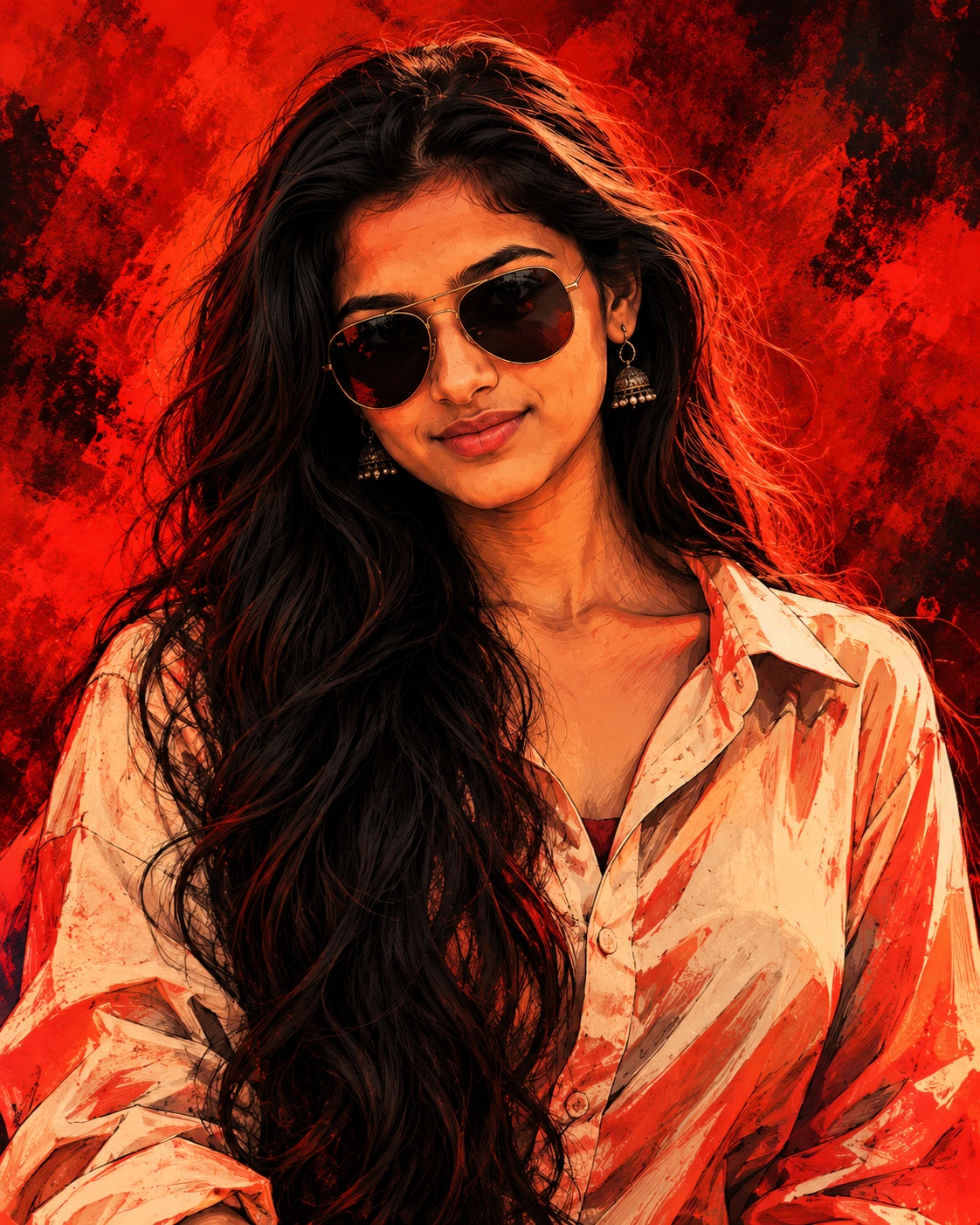
The concept presents a single adult woman as a large, visually dominant figure inside a tightly framed vertical portrait. The artwork is designed as a highly stylized red-and-black comic-book illustration rather than conventional photography. The woman occupies most of the available frame, creating an immediate sense of scale and presence. Her head sits around the upper-center while her shoulders extend toward the side edges and the torso continues toward the lower portion of the composition.
The framing is deliberately tight. A substantial amount of the character remains visible, but the artwork does not pull back into a full-body portrait. The large subject scale is essential because the visual impact depends on the relationship between the face, sunglasses, hair mass, shirt, and surrounding red-black textures. Red Comic Portrait therefore relies on compact framing to make the character feel powerful and visually immediate.
The woman’s upper body faces the viewer while her shoulders remain relaxed and slightly asymmetric. Her head carries a subtle tilt to one side, and the chin is lowered slightly. This combination creates a confident but controlled pose. The expression is calm and somewhat serious, with relaxed lips and a direct presence despite the sunglasses obscuring the eyes.
The face remains the identity-bearing element beneath the oversized eyewear. If a supplied person is used, recognizable facial structure, proportions, distinctive features, and natural asymmetries remain important. The identity should feel like the same person translated into a graphic illustration rather than a generic character. Red Comic Portrait preserves this identity while allowing the surrounding artwork to dramatically reinterpret its visual presentation.
The oversized dark aviator sunglasses are one of the strongest character-defining accessories. Their large rounded lenses cover much of the eye area and become significant black graphic shapes across the face. Thin frame elements, the bridge, lens darkness, and subtle reflections contribute to their recognizable construction. The glasses should appear integrated into the painted artwork rather than pasted over it.
Small earrings provide a restrained feminine detail. Because the sunglasses and hair already create strong visual elements around the face, the earrings remain comparatively subtle. They add a small highlight and support the polished fashion quality of the character without distracting from the dominant graphic treatment.
The hair is perhaps the largest secondary visual element. It is extremely long, thick, dark, and softly wavy. A central part establishes the upper silhouette, while loose strands move around the head. The major hair mass flows heavily over the woman’s right shoulder and across the lower-right region of the image. This large dark shape provides a powerful counterweight to the bright red atmosphere.
Hair volume is important because it creates a strong silhouette around the face. The dark waves contrast with the saturated crimson environment and help isolate the woman’s head from the background. Loose strands and irregular edges add movement, while the larger mass maintains the stable composition.
The clothing is a light cream or off-white collared shirt with broad sleeves and an open upper neckline. This creates an important contrast against the predominantly red and black environment. The shirt is not rendered as a clean white photographic garment. Instead, it receives warm red reflections, dark graphic folds, painterly marks, and strong tonal modeling.
The collar and neckline help establish the upper-body structure. Broad sleeves and visible folds contribute to the graphic silhouette. Red illumination crosses portions of the fabric, creating warm shadows and making the light garment feel naturally embedded in the crimson environment.
The color palette is extremely controlled. Saturated crimson red dominates the atmosphere, while deep black defines hair, sunglasses, heavy shadows, and graphic contours. Warm orange-red illumination appears within the skin and clothing, but the overall visual identity remains red and black. Pale highlights are used selectively to create separation and visual focus.
The red atmosphere is not simply a color filter. It is part of the environment and lighting system. The surrounding red pigment, smoke-like forms, and painterly textures appear to illuminate the character. Skin, hair, sunglasses, and shirt therefore share the same environmental influence, making the composition feel cohesive.
The background is abstract rather than representational. There is no recognizable room, street, landscape, or architectural setting. Instead, the space resembles dense clouds of red pigment, dark smoke, distressed paint, ink fragments, and atmospheric brushwork. These textures create depth without introducing identifiable objects.
The background supports the character by providing tonal contrast and movement. Dark areas can merge behind the hair, while brighter crimson patches can frame the face and shoulders. The irregular texture keeps the background active but prevents it from becoming a literal scene.
The illustration style is built from heavy black contour lines, painterly brushwork, graphic crosshatching, simplified facial planes, sharp highlights, and textured ink-like edges. The face remains anatomically convincing while its tonal information is reduced into deliberate graphic forms. This gives the artwork the appearance of a hand-painted comic or poster illustration.
Crosshatching adds additional structure to areas of shadow and transition. Rather than using smooth airbrushing everywhere, the artwork relies on visible marks to describe form. Brush textures and ink-like edges make the rendering feel tactile and expressive.
Facial planes are simplified but remain recognizable. The goal is not to reproduce every photographic skin detail. Instead, the artwork identifies the major planes of the forehead, cheeks, nose, mouth, jaw, and neck through light, red, and black relationships. This graphic simplification is a major part of the visual language.
Strong black shapes provide the deepest tonal anchors. The sunglasses, hair, and selected facial or clothing shadows contain near-black values. These dark areas contrast with warm illuminated skin and crimson background textures, creating the high-impact appearance associated with the reference.
The lighting is dramatic but remains faithful to the established graphic style. Red environmental illumination reaches the face, hair, and shirt, producing warm reflections and colored shadows. Highlights remain selective rather than uniformly bright. This keeps the artwork intense without flattening the tonal structure.
The mood is bold, rebellious, dramatic, and graphic. It has a strong fashion-editorial quality but is presented through comic-book and painted poster language. The combination of dark sunglasses, oversized hair, red illumination, and heavy black contours gives the subject a confident visual presence.
Red Comic Portrait can be useful for personal poster artwork, social media profile graphics, fashion-inspired illustrations, music visuals, editorial character artwork, digital poster designs, creative portfolios, and dramatic personal branding. Its strong color identity makes it especially recognizable in visual feeds and promotional layouts.
The identity replacement structure is also important. The supplied person’s photograph functions primarily as an identity source. It should provide facial structure and recognizable characteristics, but its original pose, camera angle, crop, clothing, and background do not control the final artwork. The reference establishes those visual relationships.
This distinction allows the artwork to preserve the person’s identity while retaining the composition that defines the concept. Red Comic Portrait therefore does not simply apply a red filter to an existing photograph. It reconstructs the person into the reference’s illustrated pose, scale, clothing, hair arrangement, lighting, and graphic language.
The large hair mass is especially important to this reconstruction. Even if the identity source has a different hairstyle, the reference establishes long, thick, dark waves as a major compositional feature. The hair should maintain its approximate volume, direction, overlap, and relationship with the shirt and background.
The same principle applies to clothing. The cream collared shirt creates a strong contrast against the red environment and provides broad light areas for painterly red reflections. Its collar, sleeves, neckline, folds, and silhouette should remain connected to the reference structure.
The composition does not require additional decorative elements. Its visual richness comes from the character itself, the red-black atmosphere, the brush textures, and the graphic rendering. Extra objects, scenery, typography, or unrelated effects would weaken the focused poster character.
The artwork is therefore intentionally concentrated. Face, sunglasses, hair, shirt, and red environment form the complete visual vocabulary. Each component contributes to the same dramatic aesthetic rather than introducing unrelated themes.
The vertical format reinforces the character’s elongated silhouette. The long hair creates downward movement while the shoulders establish horizontal width. This interaction makes the composition feel balanced despite the strong asymmetry of the hair mass.
The face remains visually important even though the sunglasses obscure the eyes. The head placement, chin angle, facial planes, sunglasses, hairline, and mouth create the identity structure. The surrounding red illumination then amplifies the emotional presence without requiring an exaggerated facial expression.
The final visual language is best understood as a fusion of fashion portraiture, graphic illustration, comic-book painting, ink drawing, and distressed digital poster art. It maintains recognizable human anatomy while embracing deliberate stylization, strong color contrast, rough textures, and expressive brushwork.
The defining characteristics are the tight vertical crop, large female subject, slightly tilted head, lowered chin, dark aviator sunglasses, extremely long dark wavy hair, cream collared shirt, saturated crimson environment, deep black shadows, painterly brush marks, bold ink contours, crosshatching, simplified facial planes, smoky red background, and intense editorial mood.
Together, these details create a cohesive artwork with a powerful graphic identity. The portrait feels dramatic without relying on unrelated cinematic effects, because the energy comes directly from the controlled red-black palette, strong silhouette, expressive texture, and confident character presentation.
Rank Math Ready Post Content:
Red Comic Portrait is a dramatic character-art concept built around saturated crimson lighting, deep black shadows, oversized dark sunglasses, extremely long wavy hair, and bold comic-book illustration. Red Comic Portrait combines fashion styling with painted ink textures, graphic contours, crosshatching, and an abstract red-black atmosphere.
Red Comic Portrait for Dramatic Graphic Fashion
Red Comic Portrait uses a vertical composition with the woman filling most of the frame. Her head remains near the upper-center while her shoulders reach toward the side edges and her torso continues downward. Red Comic Portrait preserves this tight framing to maintain the powerful scale of the reference.
The pose gives Red Comic Portrait its confident character. The upper body faces toward the viewer, the shoulders remain relaxed and slightly asymmetric, and the head carries a subtle tilt with a slightly lowered chin. Red Comic Portrait uses this geometry to create a calm but intense presence.
The facial identity remains important in Red Comic Portrait. A supplied woman’s recognizable facial structure, proportions, distinctive features, and natural asymmetries can remain visible beneath the stylized rendering. Red Comic Portrait translates those features into graphic painted planes instead of placing a conventional photograph into the illustration.
Large dark aviator sunglasses are central to Red Comic Portrait. The oversized lenses create strong black shapes across the upper face, while the frame and bridge preserve the fashion character. Red Comic Portrait treats the sunglasses as part of the illustration rather than as an isolated accessory.
Small earrings provide a subtle feminine detail. In Red Comic Portrait, they remain visually restrained so the major focus stays on the face, sunglasses, hair, and red lighting. This balance keeps the character polished while maintaining the dramatic graphic style.
The long hair creates one of the strongest silhouettes in Red Comic Portrait. Thick dark waves surround the head, fall over the shoulders, and create a large flowing mass across the right side and lower-right area. This hair structure adds movement and creates a powerful dark contrast against the crimson environment.
Red Comic Portrait with Crimson Ink and Comic Texture
Red Comic Portrait uses a saturated red and deep black palette. Crimson dominates the surrounding atmosphere, while near-black values define hair, sunglasses, heavy shadows, and graphic contours. Warm orange-red illumination appears within the skin and clothing without turning the entire image into a separate color scheme.
The cream collared shirt provides an important light area. Red Comic Portrait preserves the broad sleeves, open neckline, collar, folds, and clothing silhouette while allowing red reflections to cross the fabric. The contrast between cream fabric and dark hair helps organize the upper body.
Red Comic Portrait uses bold black contour lines to establish the illustrated structure. Painterly brush strokes and irregular ink-like edges prevent the artwork from looking mechanically smooth. Crosshatching adds additional texture to shadows and transitional areas.
The face in Red Comic Portrait is simplified into strong graphic planes. Forehead, cheeks, nose, lips, jaw, and neck are described through relationships between warm red illumination, deep shadows, and selective highlights. This creates recognizable anatomy without ordinary photographic rendering.
Brush texture is another major characteristic of Red Comic Portrait. Visible strokes, rough edges, pigment-like marks, and distressed surfaces give the artwork a hand-painted comic-book quality. The texture remains deliberate and supports the overall composition.
The background of Red Comic Portrait is an abstract field of crimson pigment, smoke-like forms, dark patches, and distressed brush textures. There is no recognizable physical location. The environment exists primarily to support the figure and intensify the red-black atmosphere.
Red Comic Portrait uses the background as a tonal extension of the character. Dark areas can merge with the hair, while brighter crimson regions can frame portions of the face and shoulders. This makes the woman feel embedded in the same painted environment.
The lighting is strongly integrated with the palette. Red Comic Portrait does not simply place a red color over neutral lighting. The crimson environment creates warm illumination on skin, hair, and clothing, while black shadows remain deep and graphic.
The mood is bold, dramatic, rebellious, and visually intense. Red Comic Portrait combines fashion confidence with comic-book artwork, making it suitable for creative poster designs, personal artwork, editorial graphics, social media visuals, and character-focused digital compositions.
Identity and composition serve different purposes. Red Comic Portrait uses the supplied person to establish recognizable identity, while the reference controls pose, scale, crop, hair arrangement, clothing, sunglasses, lighting, and environment. This preserves the visual structure instead of allowing a source photograph to redesign the artwork.
Red Comic Portrait therefore remains a reconstruction rather than a simple photographic effect. The person becomes part of the established illustrated world, with the same heavy contours, painterly marks, crosshatching, red illumination, and graphic shadow structure.
The hair arrangement is especially important. Red Comic Portrait relies on long, thick, dark waves as a major compositional mass. The hair moves over the right shoulder and across the lower-right region, balancing the figure and creating strong directional movement.
The cream shirt provides a second structural contrast. Red Comic Portrait uses its light surface to receive warm red reflections and dark graphic folds. The collar and open neckline help establish the upper-body silhouette without introducing additional fashion elements.
The composition remains deliberately focused. Red Comic Portrait does not require scenery, architecture, props, text, or unrelated decorative effects. The visual richness comes from the woman, the red-black atmosphere, the hair, sunglasses, clothing, and illustration texture.
The vertical framing also gives Red Comic Portrait a poster-like presence. The large subject fills the frame while the hair extends downward, creating a strong vertical flow. The slightly asymmetric shoulders and hair placement prevent the portrait from feeling rigid.
The sunglasses conceal the eyes but increase the graphic impact of the face. Red Comic Portrait uses their dark lenses as visual anchors, allowing the surrounding facial planes and red illumination to remain expressive without relying on visible eye contact.
The illustration avoids ordinary photorealism. Red Comic Portrait is defined by stylized facial planes, ink contours, painterly brushwork, crosshatching, sharp highlights, deep shadows, and controlled texture. These features create a distinctive artistic identity.
Paste original prompt here manually.
Red Comic Portrait ultimately combines personal identity with a powerful red-black editorial illustration language. Red Comic Portrait is defined by its tight vertical framing, oversized aviator sunglasses, long dark hair, cream collared clothing, crimson atmosphere, black graphic shadows, painterly brush marks, and comic-book rendering.
For users seeking dramatic personal artwork, Red Comic Portrait provides a cohesive visual direction that feels bold and expressive. Red Comic Portrait keeps the subject recognizable while giving the presentation a strong illustrated personality. Its saturated red atmosphere and deep black contrasts create an immediate visual signature.
Red Comic Portrait can also adapt naturally to poster-style presentation, fashion artwork, profile graphics, creative branding, editorial character visuals, and social media artwork. The combination of recognizable identity and disciplined graphic styling makes Red Comic Portrait visually distinctive without requiring unrelated effects.
The overall concept remains focused on one subject, one palette, and one strong artistic language. Red Comic Portrait brings together identity, pose, hair, sunglasses, clothing, lighting, texture, and atmosphere into a unified visual composition designed to feel dramatic, polished, rebellious, and intensely graphic.

[[[
REFERENCE ANALYSIS
- Format/composition: Vertical portrait, approximately 2:3. The woman fills most of the frame, from the top of her hair to the lower torso, with both shoulders extending toward the side edges. Preserve this tight framing exactly.
- Subject scale/placement: Single woman centered slightly right, with her large hair mass extending strongly down the right side and across the lower-right corner. Her face sits near the upper-center. Do not normalize or reduce her scale.
- Pose: Upper body facing the camera, head tilted subtly to her right, chin slightly lowered. Shoulders are relaxed and asymmetric. The portrait has a direct, confident presence.
- Face/identity: Large dark aviator sunglasses obscure the eyes. Neutral-to-slightly serious expression, relaxed lips, small visible earrings. Preserve the replacement user’s facial structure underneath the sunglasses.
- Hair: Extremely long, thick, dark wavy hair, parted near the center, with loose strands around the head and a large flowing mass over the right shoulder and chest.
- Clothing: Light cream/white collared shirt with an open upper neckline and broad sleeves. Strong red/orange reflected illumination creates warm shadows and graphic folds across the fabric.
- Visual style: Highly stylized digital illustration / comic-book painting. Strong black ink-like contours, painterly brushwork, graphic crosshatching, sharp highlights, simplified facial planes, and exaggerated color contrast.
- Lighting/color: Dominant saturated crimson/red environment. Warm orange-red light illuminates the skin, hair, and shirt from the surrounding atmosphere. Deep near-black shadows define the hair and sunglasses. Very high contrast.
- Background: Abstract smoky red-black textured field, resembling clouds of red pigment, ink, smoke, and distressed paint. No recognizable location or objects.
- Mood: Bold, dramatic, rebellious, graphic, intense. Preserve the artwork’s stylized visual energy without adding unrelated cinematic effects.
- Identity replacement: Replace only the illustrated woman with [USER IDENTITY]. Keep the exact reference pose, scale, crop, hair silhouette, sunglasses, clothing, lighting, red environment, and rendering style.
MASTER PROMPT
Use the supplied reference image as the master visual blueprint. Replace only the reference character with the supplied user identity. Maintain the exact subject scale, screen-space proportion, cropping, and visibility of the reference character; do not normalize, enlarge, or reframe. Preserve all other visual information, composition, environment, lighting, color, depth, atmosphere, objects, background and artistic rendering as faithfully as possible.
Reconstruct the reference as a vertical, highly stylized red-and-black digital comic-book illustration. Replace the original woman with [USER IDENTITY], preserving her actual facial structure, proportions, distinctive features, natural asymmetries, and recognizable identity. Render the identity entirely within the reference’s illustrated visual language; do not paste a realistic photographic face into the artwork.
Maintain the exact reference framing and subject scale. The woman remains large within the vertical frame, with her head near the upper-center, shoulders extending toward the side edges, and torso continuing toward the bottom edge. Preserve the exact visible body area, edge distances, negative space, and camera distance. Do not zoom out, zoom in, recenter, or reveal additional body parts.
Reconstruct the exact pose: upper body facing the camera, shoulders relaxed and slightly asymmetric, head subtly tilted to one side, chin slightly lowered, with a calm, confident expression. The user’s source photograph must not determine the final pose. Reconstruct [USER IDENTITY] into the reference’s exact head angle, neck geometry, shoulder placement, and torso orientation.
Preserve the large dark aviator sunglasses, including their oversized rounded lenses, thin metallic frame, bridge, reflections, lens darkness, and exact position across the face. The sunglasses must remain an integral part of the illustrated character rather than appearing pasted on afterward. Preserve the small visible earrings.
Recreate the reference’s very long, thick, dark wavy hair: center-parted, voluminous around the head, with loose flyaway strands surrounding the silhouette and a massive flowing hair section cascading over the character’s right shoulder and across the lower-right portion of the frame. Preserve the exact hair mass, direction, overlaps, silhouette, and interaction with the shirt and background.
Preserve the light cream/off-white collared shirt, broad sleeves, open neckline, collar structure, folds, wrinkles, and silhouette. Maintain the same clothing placement and visible area. [OUTFIT] defaults to the reference clothing unless explicitly changed.
Render the character using the reference’s bold graphic illustration language: heavy black contour lines, painterly brush strokes, controlled crosshatching, textured ink-like edges, simplified but anatomically convincing facial planes, sharp highlights, deep shadow blocks, visible brush texture, and selective fine linework. Maintain a hand-painted comic-book/poster quality rather than converting the image into ordinary photography.
The entire scene is dominated by a saturated crimson-red and deep black palette. Preserve the intense red illumination across the skin, hair, shirt, and surrounding atmosphere. Use warm orange-red highlights on skin and clothing, near-black shadows in the hair and sunglasses, and limited pale highlights where present in the reference. Do not introduce unrelated colors or neutralize the red atmosphere.
Preserve the abstract smoky red-black background, consisting of dense red pigment/smoke-like clouds, dark distressed areas, irregular brush textures, fine particulate marks, and atmospheric paint-like variation. There is no recognizable physical location. Do not add scenery, architecture, objects, text, or decorative elements not present in the reference.
Preserve the reference’s dramatic tonal structure: intensely dark hair and sunglasses, luminous warm facial planes, strong red environmental light, deep shadows, crisp graphic edges, and textured transitions between black and red. Do not brighten the face independently or flatten the shadows.
The final result should look like the exact supplied reference artwork after its original woman has been replaced with [USER IDENTITY], with the same scale, crop, pose, sunglasses, hair mass, clothing, red-black palette, background texture, lighting, and comic-book rendering.
EDITABLE VARIABLES
- [USER IDENTITY]: Supplied user’s identity; preserve recognizable facial structure, proportions, distinctive features, hair characteristics, and natural asymmetries.
- [OUTFIT]: Reference cream/off-white collared shirt; change only if explicitly requested.
- [TEXT]: None.
- [OBJECT CHANGE]: None.
- [POSE CHANGE]: Reference pose — front-facing upper body, subtle head tilt, slightly lowered chin, relaxed asymmetric shoulders.
- [ADDITIONAL EDIT]: None unless explicitly specified.
NEGATIVE PROMPT
identity loss, different face, wrong facial structure, original woman remaining, added person, extra person, face swap, pasted photographic face, realistic face pasted onto illustration, wrong identity, beauty-filter identity, altered facial proportions, wrong pose, frontal head with no tilt, wrong head angle, raised chin, wrong shoulder geometry, changed torso orientation, changed crop, changed composition, enlarged subject, reduced subject, recentered subject, zoomed in, zoomed out, expanded framing, changed screen-space proportion,
full body, revealing hidden body areas, altered camera distance, missing sunglasses, different sunglasses, small sunglasses, transparent lenses, altered hair silhouette, short hair, thin hair, missing long hair, hair on wrong side, altered clothing, different shirt, dark shirt, changed collar, missing sleeves, redesigned background, realistic scenery, added objects, clean background, blue background, neutral background, pastel palette,
desaturated red, orange-only palette, excessive colors, cinematic teal-orange grading, photorealism, anime, watercolor, oil painting, 3D render, flat vector art, smooth airbrushed illustration, generic comic style, weak contrast, brightened shadows, lost black levels, lost red atmosphere, missing smoky texture, missing brush texture, missing ink contours, missing crosshatching, altered lighting, changed mood, excessive beauty retouching, facial reshaping, unnecessary modifications. ]]]