
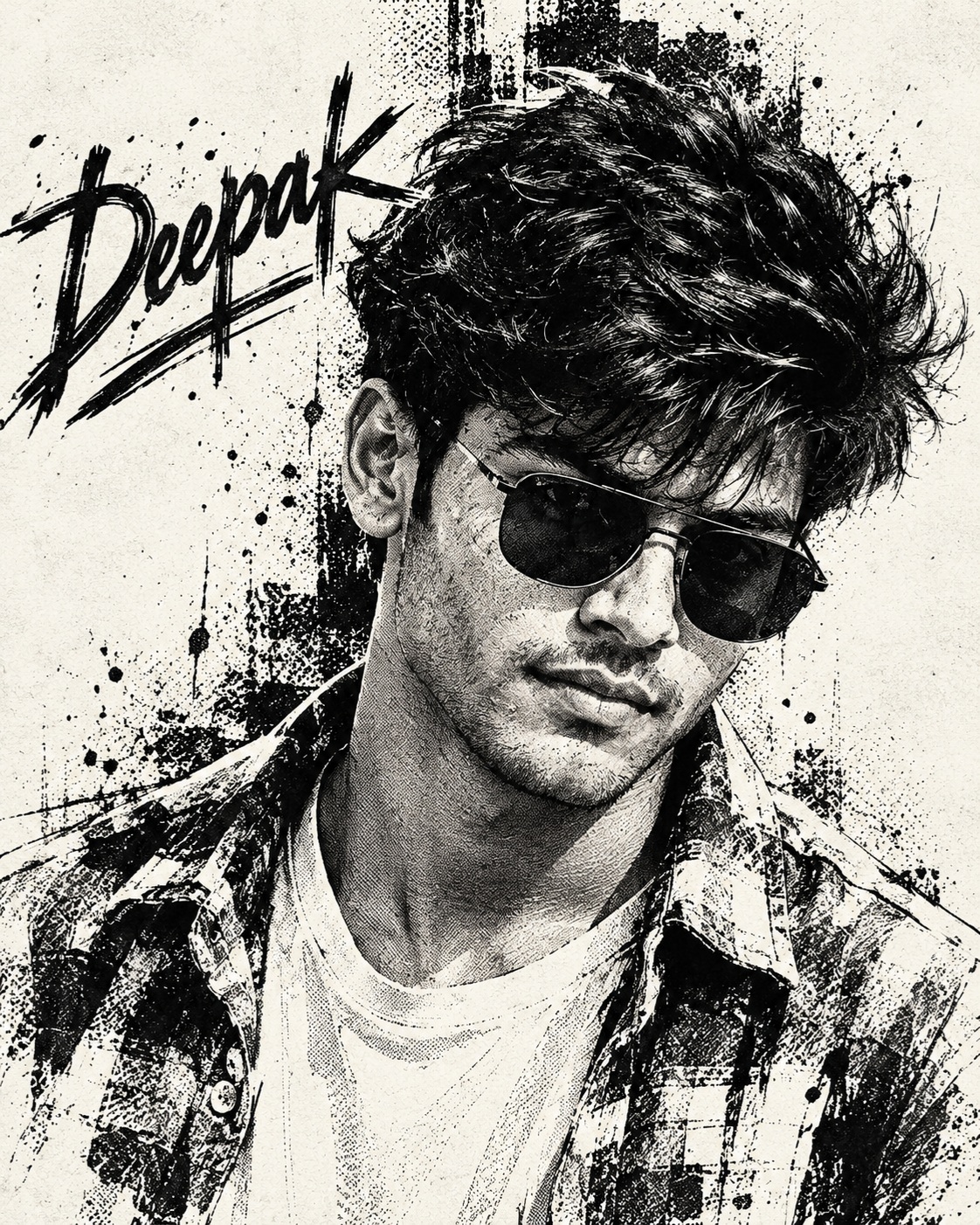
Monochrome Ink Portrait
The concept presents a single adult male as a tightly framed graphic portrait created through a raw black-and-white printmaking aesthetic. Instead of treating the subject as an ordinary photographic portrait, the design translates his identity into a deliberately rough combination of screen-print texture, ink sketching, halftone dots, charcoal-like marks, broken contours, and fragmented tonal shapes. The compact composition makes the face and upper torso the dominant visual elements.
The man’s head occupies the upper-central portion of the square frame, while the shoulders and upper chest extend toward the lower edge. The crop is intentionally tight, giving the character a strong presence without showing unnecessary body area. This compact framing is one of the defining characteristics of the design because it allows the graphic treatment of the face, sunglasses, hair, and clothing to occupy most of the available visual space.
The pose is not a conventional straight-on portrait. The head is lowered and turned slightly toward the viewer’s left, producing an approximate three-quarter orientation. The chin remains lowered, while the face points toward the lower-front portion of the image. This creates a subtle downward attitude that gives the portrait a serious, graphic presence. The neck and shoulders follow the head direction naturally rather than remaining perfectly symmetrical.
The sunglasses are an important structural element. Their dark lenses create large near-black shapes across the face, giving the composition immediate visual weight. The frames remain relatively simple, allowing the strong black lenses to function almost like graphic blocks within the portrait. They also create a recognizable connection between the facial identity and the screen-print aesthetic.
Facial hair contributes another strong contour. The moustache and beard region are interpreted through rough tonal masses, broken lines, and fragmented shading rather than smooth photographic detail. Hair characteristics are preserved as part of the person’s recognizable identity, but the final treatment converts individual strands and facial planes into a controlled graphic vocabulary.
The hairstyle is short and textured, occupying the upper portion of the composition. Rather than appearing as a perfectly polished photographic hairstyle, it becomes part of the rough print surface. Dark fragmented areas, brush-like marks, and broken edges can merge around the hairline, creating an organic transition between the subject and the surrounding graphic marks.
The identity itself remains central to the concept. When a supplied person is used, recognizable facial structure, proportions, distinctive features, natural asymmetries, and hair characteristics should remain identifiable. However, those features are interpreted through the same monochrome print language as the rest of the artwork. The result is intended to feel like one cohesive graphic portrait rather than a realistic face placed over an illustration.
The clothing is light-colored and layered, with a collared shirt or jacket-like silhouette. Broad gray areas describe the garment, while loose black contour strokes define the collar, shoulders, folds, and overlapping fabric. The clothing does not need photographic fabric detail. Its purpose is to establish the upper-body structure and provide additional areas for the screen-print texture to interact with.
The monochrome palette is deliberately strict. White, off-white, pale gray, mid-gray, charcoal, and near-black provide the entire tonal range. There are no colored accents. Skin is not represented through natural complexion colors; instead, facial form emerges from the relationship between white space, gray halftones, and dark ink masses.
The face is built through graphic contrast rather than smooth gradients. Coarse halftone dots can define transitional areas, while crosshatching, stippling, broken contours, charcoal-like patches, and irregular ink blocks describe facial planes. This approach gives the artwork a tactile printed character and prevents it from appearing like a digitally polished grayscale photograph.
Halftone texture is especially important because it creates the visual language of traditional reproduction. Instead of continuous photographic tones, portions of the face can dissolve into patterned dots or rough tonal clusters. The texture creates variation in density, allowing highlights to remain relatively open while darker areas become increasingly dense and graphic.
Broken ink contours provide another layer of visual character. Some edges remain clearly defined while others fragment or disappear into the surrounding white space. This imperfect edge treatment makes the artwork feel handmade and printed rather than mechanically generated. It also allows the silhouette to breathe visually instead of becoming a perfectly outlined vector shape.
The background remains minimal. There is no conventional environment, architecture, landscape, or decorative scene. An off-white or pale paper field provides the foundation, allowing the portrait itself to carry most of the visual information. This simplicity is important because it prevents unnecessary scenery from competing with the graphic face.
Dark fragmented marks around the upper hair and head region provide a subtle connection between subject and background. These marks can appear as broken brush strokes, ink fragments, distressed patches, or irregular print artifacts. They should remain connected to the reference composition rather than becoming unrelated decorative elements.
The lighting is translated into graphic tonal structure rather than ordinary photographic illumination. Strong areas of shadow become black or charcoal masses, while illuminated areas remain white or light gray. The sunglasses and hair can contain the deepest blacks, while facial planes emerge through intermediate values.
The overall mood is raw, editorial, slightly gritty, and handmade. It is not polished in the conventional beauty-photography sense. The imperfections are part of the visual appeal. Uneven ink density, rough edges, paper grain, distressed patches, halftone variation, and partially dissolved details create a sense of physical printmaking.
The composition has a strong poster-like quality even though it remains portrait-focused. The large face, compact crop, limited palette, and aggressive graphic marks create a visual that could work as an editorial art print, personal poster, music-related artwork, fashion graphic, social media profile artwork, or experimental portrait presentation.
The design purpose is to turn recognizable identity into a bold graphic interpretation without losing the person’s underlying facial character. The source identity provides the human structure, while the reference establishes the pose, scale, crop, sunglasses, clothing arrangement, tonal approach, and print language.
One of the most important features is the separation between identity and pose. The supplied photograph should not determine how the person is positioned. The reference remains the blueprint for head direction, chin position, shoulder geometry, body visibility, and framing. This creates consistency across different identity sources.
The compact crop also makes the portrait visually powerful. Because the character occupies most of the square frame, the viewer encounters the sunglasses, facial structure, hair, and upper clothing immediately. The limited background keeps attention concentrated on the graphic interpretation of the person.
The artwork’s handmade character comes from controlled imperfection. Halftone dots do not need to be perfectly uniform, ink edges can break apart, and tonal patches can dissolve unevenly. These characteristics help create the impression of a physical screen print or ink-based editorial artwork.
At the same time, the composition should remain intentional. The roughness is not random visual noise. Black masses, gray areas, halftone fields, white spaces, and contour marks should collectively describe the person’s face and upper body. This keeps the graphic style expressive while preserving recognizable structure.
The strict black-and-white treatment also makes the concept versatile. Without color, attention shifts toward facial structure, silhouette, contrast, texture, and composition. The absence of color gives the portrait a timeless editorial quality and allows the print textures to become the primary visual signature.
The concept can be useful for personal posters, monochrome profile artwork, creative portfolios, fashion-editorial graphics, music-inspired visuals, social media portraits, magazine-style compositions, or identity-focused artwork. Its raw treatment can also work well when a user wants a personal photograph interpreted through a more experimental visual language.
The defining ingredients are the square format, tight crop, large male subject, lowered three-quarter head position, dark sunglasses, textured short hair, facial hair, light collared clothing, off-white background, coarse halftone dots, rough ink contours, fragmented black masses, gray tonal areas, paper grain, distressed marks, and strict monochrome palette.
Together, these elements create a portrait that feels tactile, graphic, editorial, and deliberately imperfect. The identity remains recognizable through structure and proportion, while the artistic language transforms the presentation into something closer to a screen-printed portrait than a standard photograph.
[[[
REFERENCE ANALYSIS
- Format/composition: Square, tightly framed monochrome graphic portrait. The character fills most of the central frame, with the head and upper torso visible. Preserve the compact crop and do not expand the composition.
- Subject placement/scale: Single male character occupying the central area, with the head near the upper-center and shoulders/upper chest extending toward the bottom edge. The subject is relatively large within the frame.
- Pose: Head angled downward and slightly toward the viewer’s left. Face is approximately three-quarter view rather than a strict frontal portrait. Chin lowered, gaze directed downward/forward beneath dark sunglasses. Shoulders are angled naturally.
- Appearance: Male figure wearing dark sunglasses, with a prominent moustache/beard area and short textured hair. The facial structure is communicated through strong graphic shadows and linework rather than smooth photographic detail.
- Clothing: Light-colored collared shirt/jacket or layered garment, represented with loose sketch-like contours and broad gray tonal areas.
- Visual style: Highly stylized black-and-white screen-print / ink-sketch / halftone illustration. The portrait combines coarse halftone dots, rough brush marks, fragmented ink blocks, contour lines, photographic tonal remnants, and distressed print texture.
- Background: Minimal pale/off-white background with no conventional environment. Some dark fragmented graphic marks merge into the hair and upper head region.
- Lighting/color: Strictly monochrome: white, pale gray, mid-gray, charcoal, and near-black. Strong contrast with large black graphic masses around the sunglasses, hair, facial shadows, and clothing.
- Mood: Raw, graphic, editorial, slightly gritty and handmade rather than polished photographic.
- Identity replacement: Replace only the illustrated man with [USER IDENTITY]. Preserve the user’s recognizable facial structure while translating it into the exact rough monochrome print language of the reference.
MASTER PROMPT
Use the supplied reference image as the master visual blueprint. Replace only the reference character with the supplied user identity. Maintain the exact subject scale, screen-space proportion, cropping, and visibility of the reference character; do not normalize, enlarge, or reframe. Preserve all other visual information, composition, environment, lighting, color, depth, atmosphere, objects, background and artistic rendering as faithfully as possible.
Reconstruct the reference as a square black-and-white screen-print / ink-sketch portrait. Replace the original male character with [USER IDENTITY], preserving the user’s actual facial structure, proportions, recognizable features, hair characteristics, and natural asymmetries, but translate the entire identity into the reference’s coarse monochrome graphic language.
Keep the character at the exact reference scale and position, occupying most of the square image with the same head size, shoulder width, upper-body visibility, and edge relationships. Preserve the tight crop. Do not turn this into a conventional centered headshot or reveal additional body areas.
Reconstruct the exact reference pose: head angled downward, slightly turned into a three-quarter orientation, chin lowered, with the face directed toward the lower/front portion of the image. Preserve the precise neck angle, shoulder geometry, head tilt, facial orientation, and sunglasses position. Do not use the user’s original photograph’s pose. Adapt the user’s identity into the reference pose.
Preserve the dark sunglasses, with their strong black graphic lenses and simplified frame construction. Preserve the facial hair/moustache characteristics as appropriate to the user’s identity while maintaining the reference’s bold graphic treatment. Reconstruct the user’s hair into the same rough, fragmented, textured silhouette occupying the upper portion of the frame.
Render the face using coarse halftone dots, crosshatching, broken ink contours, stippling, rough charcoal-like patches, screen-print grain, fragmented photographic tonal information, and irregular black brush masses. Facial planes should emerge through carefully controlled black, gray, and white shapes rather than smooth realistic shading. Preserve recognizable identity despite the intentionally reduced graphic detail.
Preserve the light-colored collared clothing and layered upper-body silhouette from the reference. Use loose black contour strokes and irregular gray/black printed patches to describe the fabric, folds, collar, and shoulders.
Keep the background minimal and off-white, with no added scenery. Preserve the fragmented dark graphic marks that merge around the upper hair/head area and the subtle distressed print artifacts surrounding the figure.
The entire image must remain strictly monochrome. Use only white, off-white, light gray, mid-gray, charcoal, and black. No color accents, no skin-color rendering, no warm grading, and no colored background.
Preserve the raw, imperfect editorial screen-print aesthetic: uneven ink density, visible halftone dots, broken contours, rough edges, paper grain, distressed patches, imperfect registration-like texture, and intentional areas where detail dissolves into white space. Do not make the image clean, glossy, hyper-realistic, or digitally smooth.
The finished result should look like the same original monochrome graphic artwork with its original character replaced by [USER IDENTITY], while everything else remains locked to the reference.
EDITABLE VARIABLES
- [USER IDENTITY]: Supplied user’s identity; preserve actual facial structure, proportions, recognizable features, hair characteristics, and natural asymmetries.
- [OUTFIT]: Reference light collared/layered clothing; change only if explicitly requested.
- [TEXT]: None unless explicitly supplied.
- [OBJECT CHANGE]: None.
- [POSE CHANGE]: Reference pose — head lowered, slightly three-quarter, downward/frontward gaze, matching shoulder geometry.
- [ADDITIONAL EDIT]: None unless explicitly specified.
NEGATIVE PROMPT
identity loss, different face, wrong facial structure, original character remaining, added person, extra person, face swap, pasted realistic face, photorealistic face, wrong identity, wrong pose, frontal portrait, head raised, looking upward, wrong head angle, wrong chin position, wrong shoulder geometry, changed crop, changed framing, enlarged subject, reduced subject, zoomed in, zoomed out, altered screen-space proportion, expanded body visibility, full body, redesigned background, added scenery, colorful background, colored clothing,
color photography, skin-tone rendering, smooth realistic shading, glossy digital portrait, clean vector art, 3D render, anime, watercolor, oil painting, cinematic photography, excessive detail, excessive sharpness, smooth gradients, missing halftone, missing ink texture, missing screen-print grain, missing rough contours, missing distressed marks, altered sunglasses, missing sunglasses, altered hair silhouette, generic portrait, beauty retouching, facial reshaping, unnecessary modifications. ]]]