
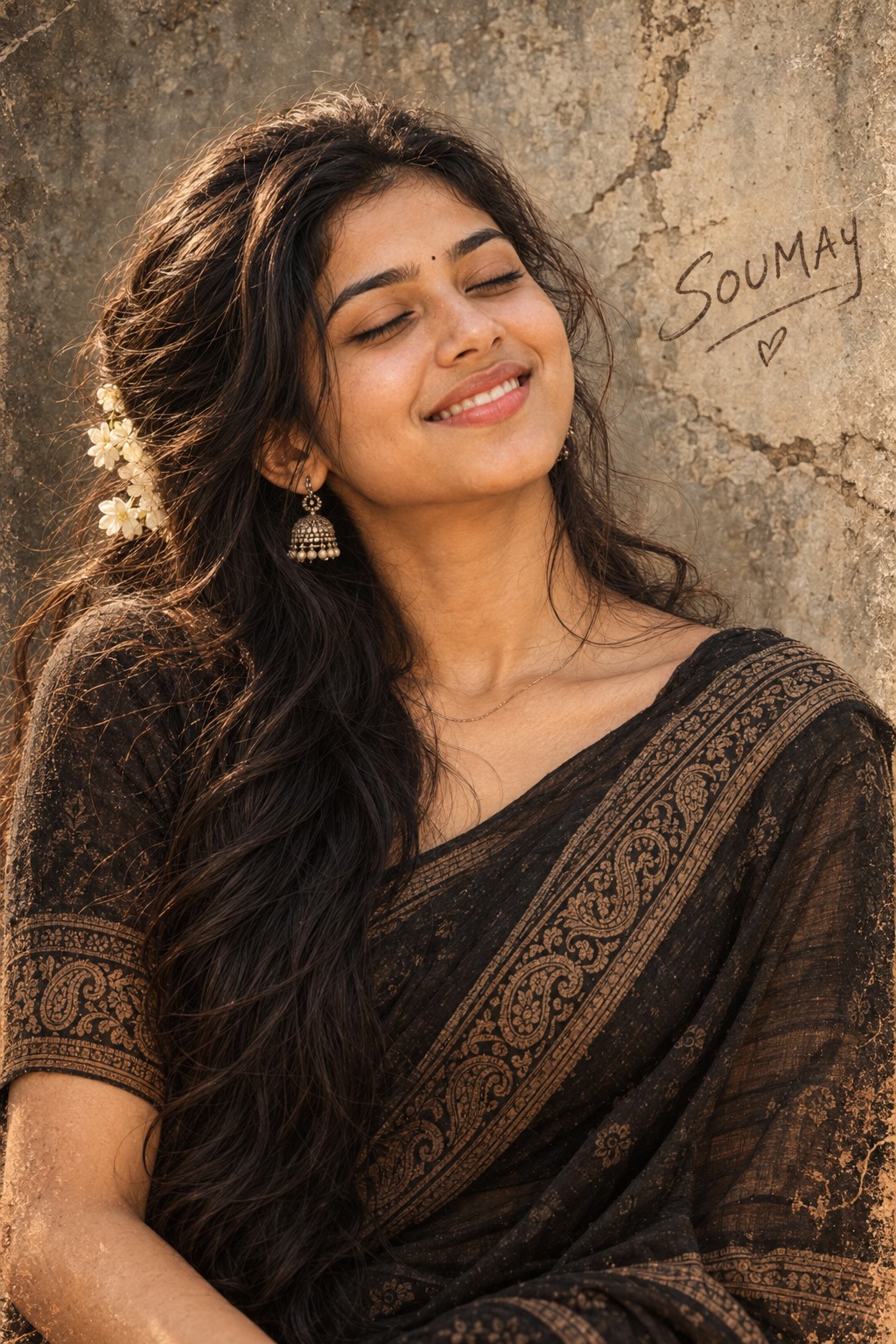
Joyful Sari Portrait
The concept presents a single woman in a tightly framed intimate portrait with a strong emphasis on natural emotion, expressive facial detail, and understated traditional styling. The woman occupies most of the vertical composition, appearing from approximately the chest or upper torso upward. Because the framing is close, her face, hair, smile, sari, and small personal styling details become the main visual focus.
The composition is intentionally simple and personal. There is no crowded environment or elaborate decorative setting competing with the subject. Instead, the portrait relies on the woman’s expression and the physical texture of the surrounding wall to create visual interest. This simplicity gives the artwork a candid quality, as though a genuine joyful moment has been captured in a quiet, warm environment.
The woman’s pose is one of the most expressive aspects of the concept. Her head is gently tilted upward and slightly backward, while her face turns subtly toward the upper-left. Her eyes are closed and she has a broad, natural smile. The expression communicates happiness without looking forced, making the portrait feel spontaneous and emotionally genuine.
The raised angle of the face also creates a graceful relationship between the woman’s neck, jawline, cheeks, and shoulders. One shoulder is positioned slightly higher, adding a small amount of natural asymmetry to the pose. These details help the portrait avoid the stiffness of a conventional posed photograph.
Facial identity remains an important part of the artwork. The woman’s recognizable facial structure, eyes, eyebrows, nose, lips, jawline, cheeks, and natural asymmetry are intended to remain visually distinctive. The identity is integrated into the soft photographic and artistic treatment rather than appearing like a separate face placed over a different body.
The expression is especially important because the smile is the emotional center of the portrait. The broad natural smile creates a joyful and peaceful impression, while the closed eyes suggest that the woman is fully absorbed in the moment. Together, these features create a feeling of genuine happiness rather than a formal posed expression.
The hair is long, dark, and naturally wavy. It falls loosely around the head and shoulders, with soft flyaways that add movement and realism. The hair is not presented as perfectly styled or rigidly controlled. Its natural irregularity supports the candid character of the portrait and works well with the slightly vintage visual treatment.
Small clusters of white flowers are tucked into the woman’s hair near the side or back. These flowers are delicate rather than dominant. They introduce a soft visual accent against the dark hair and create a subtle connection between traditional styling and the warm neutral environment.
The small black bindi is another understated traditional detail. It sits naturally within the facial composition without becoming the main focal point. Along with the dark sari and white flowers, it gives the portrait a culturally grounded identity while maintaining a simple and elegant appearance.
The sari is dark or black with a textured, slightly sheer quality and subtle traditional patterning. Its visible drape around the shoulder and upper torso helps establish the woman’s silhouette. The dark fabric also creates a strong tonal contrast against the warmer gray and beige wall.
The sari is not intended to appear overly glossy or heavily decorated. Its visual appeal comes from texture, folds, understated patterning, and natural drape. This restrained treatment supports the intimate mood and allows the face and smile to remain the strongest visual elements.
The background is a rough warm-gray or beige plaster and stone wall. It contains visible organic texture, uneven tonal variation, and faint cracks. This wall gives the portrait a physical sense of place without introducing a complicated scene.
The wall texture is important because it provides an understated visual counterpoint to the smoothness of the woman’s face. Small cracks, irregular surfaces, and muted color variation create a vintage environmental quality. The background therefore feels authentic and tactile rather than like a clean studio backdrop.
Lighting is soft and warm. Directional illumination gently falls across the woman’s face and hair, creating subtle highlights around the cheekbones and forehead. Shadows remain restrained, allowing facial features and natural skin texture to remain visible.
The lighting is not dramatic in a theatrical sense. Instead, it creates a gentle glow that supports the woman’s joyful expression. The warm light also helps the white flowers stand out softly against the dark hair and gives the black sari a subtle dimensional quality.
The palette is deliberately muted. Warm beige, gray, charcoal black, natural skin tones, and soft white floral accents form the primary color family. This restrained palette gives the artwork a calm, timeless character and avoids the artificial feeling associated with excessive saturation.
The portrait also has a slightly vintage artistic finish. Subtle photographic grain and textured rendering contribute to the feeling of an image with physical character. The grain should remain delicate rather than becoming heavy or distracting.
The overall style sits between cinematic portrait photography and textured artistic portraiture. The face remains naturally recognizable, while the soft grain, muted contrast, warm lighting, and textured environment introduce an editorial and nostalgic quality.
The mood is joyful, peaceful, candid, and emotionally warm. The closed eyes and broad smile communicate happiness, while the minimal background and soft lighting keep the emotional tone intimate. The result is expressive without becoming overly dramatic.
The composition is particularly effective because it allows emotion to carry the visual narrative. There is no need for a large prop, elaborate background, or complex gesture. The woman’s face, smile, hair, flowers, sari, and relaxed posture provide enough information to create a memorable portrait.
Personalization is designed to remain subtle. A name, date, title, occasion, quote, dedication, location, or additional message can be integrated into an open area of the wall or surrounding composition. The text should share the same understated visual character as the portrait.
Names and titles can appear as elegant handwritten or editorial lettering. Dates can use small handwritten or printed notation. A short quote or message can become a delicate inscription within an open section of the background. Multiple details can be arranged as one cohesive visual grouping rather than as separate modern text elements.
The lettering is intended to use muted cream, warm gray, charcoal, or soft brown tones. These colors allow the personalization to blend with the wall and remain visually subordinate to the woman’s face and expression.
The exact wording of personal information is meaningful. Names, dates, quotes, messages, and dedications can represent specific memories, so the concept treats them as precise content rather than decorative filler. When no personal information is supplied, the artwork remains clean and naturally focused on the portrait.
The text should feel as though it belongs to the original artwork. It should not resemble a floating digital caption or a modern interface element. Instead, the understated typography can resemble handwritten editorial design that was considered as part of the composition from the beginning.
The design purpose is to create a portrait that feels personal without becoming visually complicated. The woman remains the clear subject, while the wall, lighting, sari, flowers, and subtle typography create supporting layers. This makes the concept suitable for meaningful personal artwork and refined social visuals.
The style can be used for personal portraits, traditional sari photography, celebration artwork, anniversary visuals, cultural portraits, social media graphics, personalized gifts, elegant profile images, and decorative wall artwork. Its restrained appearance makes it versatile for both intimate personal use and polished editorial presentation.
The close framing is especially useful when the woman’s expression needs to remain dominant. Because the face occupies a large part of the composition, the natural smile and closed eyes remain immediately visible. This makes the emotional quality of the portrait easy to understand even when viewed at a smaller size.
The contrast between the dark sari and warm wall also creates a strong visual structure. The dark fabric defines the lower silhouette, while the warm background surrounds the face and hair. White flowers add small highlights, creating a simple but effective three-tone relationship.
The natural hair texture adds another layer of movement. Loose waves and flyaways soften the silhouette and keep the portrait from appearing overly formal. The flowers introduce a delicate traditional detail without changing the relaxed character.
The artwork also benefits from subtle imperfections. Natural skin texture, visible wall grain, restrained shadows, and soft photographic grain help preserve a sense of authenticity. These details make the portrait feel lived-in rather than overly processed.
Overall, the concept is built around emotional simplicity. The woman’s joyful smile is the main story, while the upward head angle, closed eyes, flowing hair, white flowers, dark sari, warm textured wall, and gentle lighting all support that story.
The combination of cinematic framing and understated traditional styling makes the portrait feel both contemporary and timeless. It can communicate happiness and cultural elegance without relying on excessive decoration or dramatic visual effects.
The final creative direction can therefore be understood as an intimate warm portrait centered on a naturally joyful woman. The image combines expressive emotion, recognizable identity, flowing dark hair, delicate white flowers, a textured sari, rough neutral surroundings, soft warm illumination, subtle grain, and restrained personalized typography into one cohesive visual language.
[[[
REFERENCE ANALYSIS
- Composition: Vertical intimate portrait, tightly framed around a single woman from approximately chest/upper-torso upward. The subject occupies most of the frame.
- Pose: Head tilted slightly upward/back, eyes closed, broad natural smile, joyful expression. One shoulder is slightly raised and the face turns subtly toward the upper-left.
- Hair: Long, loose, naturally wavy dark hair with soft flyaways. Small clusters of white flowers are tucked into the hair near the side/back.
- Face & styling: Small black bindi, minimal traditional styling, natural skin texture and expressive smile.
- Outfit: Dark/black sari with a textured, slightly sheer appearance and subtle traditional patterning.
- Background: Rough warm-gray/beige plaster or stone wall with visible organic texture and faint cracks.
- Lighting: Soft warm directional light, gently illuminating the face and hair while retaining muted shadows.
- Style: Artistic cinematic portrait with a slightly vintage, textured photographic/illustrative finish. Natural skin, soft grain and understated contrast.
- Mood: Joyful, peaceful, candid and emotionally warm.
- Personalization: User can provide name, date, quote, message, occasion, dedication or any custom details. These must be integrated into the artwork using the same understated, handwritten/editorial aesthetic rather than looking like a pasted digital caption.
MASTER PROMPT
Use the supplied reference image as the master visual blueprint. Replace only the reference character with the supplied user identity. Maintain the exact subject scale, screen-space proportion, cropping, and visibility of the reference character; do not normalize, enlarge, or reframe. Preserve all other visual information, composition, environment, lighting, color, depth, atmosphere, objects, background and artistic rendering as faithfully as possible.
Reconstruct the reference as a vertical intimate cinematic portrait with the same tight framing and warm, textured aesthetic.
Replace the original woman’s identity with [USER IDENTITY]. Preserve the user’s recognizable facial structure, eyes, eyebrows, nose, lips, jawline, cheeks, natural asymmetry and distinctive features. Integrate the user’s identity naturally into the reference’s soft photographic/artistic rendering. Do not paste a photorealistic face onto a different body.
Preserve the exact pose: the woman’s head is gently tilted upward/back, eyes closed, with a joyful natural smile. Maintain the same face angle, neck position, shoulder orientation and visible amount of upper body. Do not copy a different pose from the user’s identity photo.
Preserve the long, dark, naturally wavy hair, including loose strands and flyaways. Keep the small clusters of white flowers tucked into the hair in the same approximate position and visual scale.
Preserve the small black bindi and understated traditional styling. Keep the facial rendering natural, with visible skin texture and the same soft expressive smile.
Preserve the dark/black sari, including its textured fabric, subtle traditional patterning, drape and visible shoulder/upper-torso silhouette.
Keep the background as the same rough warm-gray/beige plaster or stone wall, including its natural cracks, uneven texture and muted tonal variation. Do not replace it with a clean studio backdrop or decorative scenery.
Match the reference lighting: soft warm directional light falling naturally across the face and hair, gentle highlights around the cheekbones and forehead, and restrained shadows. Preserve the slightly muted exposure and intimate atmosphere.
Maintain the reference palette of warm beige, gray, charcoal black, natural skin tones and soft white floral accents. Preserve subtle photographic grain and the slightly vintage artistic finish.
LIVE USER TEXT / DETAILS
The user may provide any combination of:
- [USER NAME]
- [DATE]
- [OCCASION]
- [TITLE]
- [CUSTOM MESSAGE]
- [QUOTE]
- [DEDICATION]
- [LOCATION]
- [ADDITIONAL DETAILS]
At generation time, replace these variables with the exact values supplied by the user.
The personalized information must be integrated into the image using the same understated visual language as the reference.
- A name/title → elegant handwritten or subtle editorial lettering.
- A date → small handwritten date or understated printed notation.
- A short quote/message → delicate handwritten inscription integrated naturally into an open area of the wall/background.
- An occasion → subtle editorial/calligraphic heading.
- Multiple details → arrange them as a small cohesive handwritten/printed composition rather than separate modern text boxes.
Use muted cream, warm gray, charcoal or soft brown lettering so the text belongs naturally to the photograph.
Exact-text rule: reproduce every user-provided name, date, quote, message and detail exactly as supplied. Do not paraphrase, shorten, translate, autocorrect or invent information.
If the user provides no text/details, do not invent any.
Do not add creator names, usernames, watermarks or signatures unless explicitly requested.
The text must look like it was originally designed into the portrait, not digitally pasted afterward. Keep it subtle enough that it does not cover the woman’s face, eyes, smile, hair or other important identity features.
The final image should look like the same original portrait, personalized specifically with the user’s identity and supplied details, while preserving the reference’s exact composition, mood, pose, lighting and artistic language.
EDITABLE VARIABLES
- [USER IDENTITY]: Supplied user’s identity.
- [USER NAME]: User-provided name.
- [DATE]: User-provided date.
- [OCCASION]: User-provided occasion.
- [TITLE]: User-provided title.
- [CUSTOM MESSAGE]: User-provided message.
- [QUOTE]: User-provided quote.
- [DEDICATION]: User-provided dedication.
- [LOCATION]: User-provided location.
- [ADDITIONAL DETAILS]: Any other user-provided information.
- [OUTFIT]: Reference dark sari unless explicitly changed.
- [TEXT STYLE]: Subtle handwritten/editorial typography matching the reference.
- [POSE CHANGE]: None unless explicitly requested.
- [OBJECT CHANGE]: None unless explicitly requested.
NEGATIVE PROMPT
identity loss, different face, generic face, original character remaining, added person, extra person, face swap, pasted face, artificial face, wrong facial proportions, altered smile, open eyes, wrong gaze, wrong head angle, wrong pose, altered shoulder position, changed crop, changed framing, enlarged subject, reduced subject, recentered composition, changed camera distance, altered screen-space proportion, full body, expanded torso, missing hair, straight hair, missing white flowers, missing bindi, wrong sari,
modern clothing, redesigned background, clean studio background, colorful scenery, harsh lighting, flash photography, excessive HDR, oversaturation, orange-teal grading, plastic skin, excessive smoothing, anime, cartoon, 3D render, glossy digital art, lost wall texture, lost grain, modern textbox, floating digital caption, invented text, altered user text, misspelled name, wrong date, missing user details, placeholder text, visible variable names, creator watermark, username, signature, unnecessary modifications. ]]]