
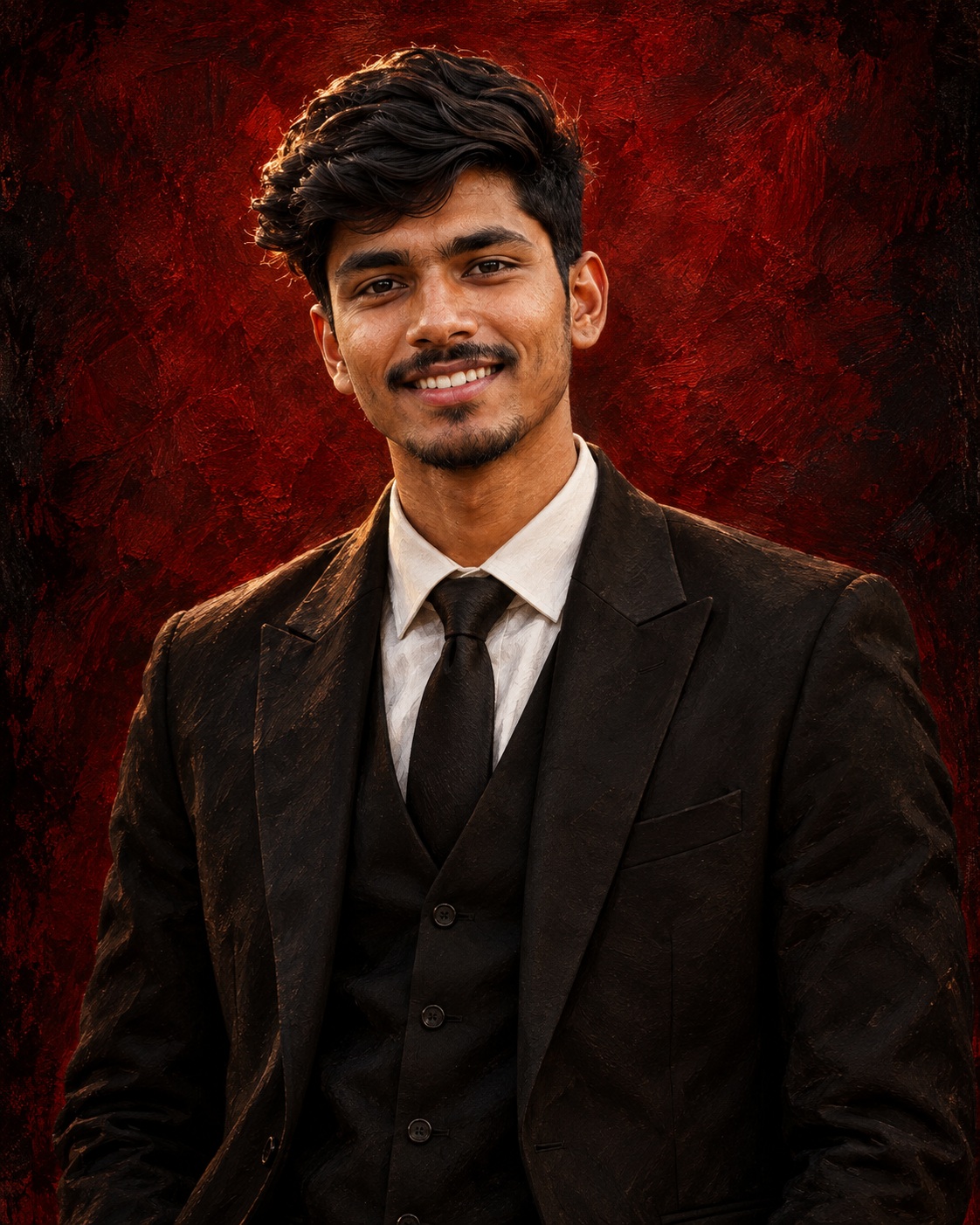
Dark Painterly Portrait
This concept is built around a single male subject presented as a tightly framed, dark fine-art portrait. The visual idea is not a broad fashion photograph or a full-body character scene. The frame stays close to the upper torso, allowing the face, hair, neck, shoulders, chest, and upper part of the suit to carry almost all of the visual attention. The subject sits slightly left of center, while the right shoulder reaches toward the edge of the frame. That placement is important because it gives the portrait a natural editorial tension instead of making the character look mechanically centered.
The main subject is one adult male character. The identity is intended to come from the supplied user reference, while the surrounding visual treatment follows the supplied master reference. The face therefore remains the strongest point of recognition. Facial structure, proportions, eyes, nose, lips, jawline, cheeks, skin characteristics, natural asymmetry, and other distinctive traits are meant to remain recognizable. At the same time, those features are interpreted through a painterly visual language, so the result is designed to feel like one coherent artwork rather than a realistic face placed on top of a painting.
The expression is calm, serious, and self-possessed. The gaze is relaxed and directed toward the camera, creating a quiet connection with the viewer. There is no exaggerated smile, theatrical emotion, or aggressive expression. The head is subtly tilted and turned toward the camera, while the shoulders remain naturally angled. This combination makes the pose feel confident without becoming stiff. The body language communicates sophistication through restraint: the subject does not need a dramatic gesture because the close framing and controlled expression already create visual authority.
Hair is another major visual feature. The reference describes dense, voluminous black hair with a naturally curly or wavy character. Instead of presenting every strand as a photographic detail, the hair is organized into rich masses, irregular curls, layered shapes, and selectively suggested individual strands. This gives it painterly depth. The user’s visible hair characteristics can be adapted into that treatment, but the reference’s overall volume and artistic texture remain important. The hair also contributes to the lighting design because portions of it can disappear into deep shadow while selected edges and curls catch warm highlights.
The clothing creates a formal and sophisticated foundation for the portrait. The subject wears a dark tailored suit with a three-piece-style appearance, including a dark jacket, a dark waistcoat or vest, a crisp white dress shirt, and a black necktie. The clothing is not treated as a generic black suit. Its visual value comes from the layered construction, collar, lapels, tie placement, vest, buttons, folds, creases, and overall silhouette. These details help the upper torso read clearly against the dark environment while maintaining the serious character of the reference.
The background is deliberately restrained. It is a dark red or burgundy painted surface with rough texture, uneven tonal density, and blackened areas. There are no decorative objects, furniture pieces, scenery, extra figures, or distracting patterns. The background functions more like a textured painted field than a literal location. Its burnt-red character provides a controlled contrast against the black suit and dark hair, while the warm skin tones become a natural focal point.
Lighting is one of the defining elements of the concept. The face receives strong but selective warm directional illumination. Forehead, cheeks, nose, lips, and other exposed skin areas can carry warm highlights, while the underside of the hair, jaw, neck, and large portions of the clothing fall into deep shadow. This creates a dramatic separation between illuminated skin and nearly black fabric. The important point is that the lighting remains controlled rather than becoming a generic movie-style effect. The shadows should stay substantial, and the face should not be artificially brightened until every feature becomes equally visible.
The color palette is intentionally narrow and atmospheric. Deep black, dark brown, burnt red, burgundy, and warm natural skin tones dominate the artwork. Saturation remains restrained, so the portrait feels mature and sophisticated rather than colorful or glossy. The warm skin highlights are especially effective because they emerge from a surrounding field of dark values. Small tonal transitions in the red background and brown-black hair add depth without introducing unnecessary colors.
The artistic style is best understood as a painterly digital portrait with fine-art character. Visible brushwork, textured transitions, rough tonal edges, layered pigment-like surfaces, and carefully rendered facial planes are central to the appearance. The artwork should not feel like a polished studio photograph, a glossy fashion render, or a clean 3D character. The painterly treatment should affect the face, hair, clothing, shadows, and background together so the entire portrait belongs to the same visual world.
Composition is deliberately controlled. The reference is a vertical portrait with a close crop, and the visible body amount should remain consistent with that design. The lower body stays outside the frame. There is no reason to reveal legs, hands, or hidden anatomy simply because they might exist outside the reference. The crop itself is part of the artwork’s identity. Subject scale, head placement, shoulder reach, camera distance, and screen-space proportion should therefore feel stable rather than normalized.
The camera feel is intimate and portrait-oriented. The viewer is brought close to the subject without the perspective becoming distorted. The framing resembles an editorial fine-art portrait where the face and upper torso are allowed to dominate. The slight off-center placement adds sophistication and helps preserve the reference’s visual rhythm. A tighter crop would make the head feel oversized, while a wider crop would weaken the intensity, so the original framing is an important creative feature.
The concept also places strong emphasis on identity integration. The supplied user identity is not meant to change the composition, pose, outfit, lighting, or environment. Instead, the recognizable face becomes part of the existing artistic structure. This distinction is useful because it keeps the reference recognizable while allowing the user’s appearance to remain personal. Natural facial asymmetry and real proportions are valuable here; they prevent the result from becoming a generic idealized male face.
Another important quality is restraint. The concept does not depend on extra props, decorative effects, artificial smoke, dramatic scenery, glowing particles, or added characters. Its visual strength comes from the relationship between one face, one formal outfit, one textured background, and one carefully controlled light source. That simplicity makes the portrait feel more premium and editorial. Every visible element has a clear role, and anything that does not support the central portrait is intentionally absent.
The negative details reinforce the same design goal. Unwanted changes include a different identity, altered gaze, incorrect head angle, modified shoulders, changed crop, new camera distance, brighter exposure, flattened shadows, oversaturation, glossy skin, photorealistic face replacement, anime treatment, 3D rendering, altered clothing, enlarged subject scale, or a redesigned background. These exclusions are not separate creative features; they protect the reference’s visual consistency and prevent unrelated stylistic changes from taking over the artwork.
From a design perspective, this portrait works because it balances darkness with selective warmth. The black suit and hair establish a strong visual mass, the burgundy background creates atmospheric separation, and the illuminated skin gives the viewer a natural entry point. The painterly texture then softens the transition between these elements without removing facial detail. The result is intended to feel serious, sophisticated, intimate, and slightly mysterious.
For personal use, this style can work well as a profile portrait, artistic display image, portfolio visual, premium social-media post, personal branding artwork, editorial-style portrait, or dramatic wall print. It can also suit users who want a formal appearance without the image feeling like a conventional studio photograph. The combination of tailored clothing and fine-art rendering gives the subject a polished presence while the rough background and deep shadows keep the result expressive.
For designers and photographers, the concept is useful because it demonstrates how a reference can control more than just pose. It establishes framing, subject scale, wardrobe, background, lighting, palette, texture, and emotional tone as a unified visual system. The identity replacement is therefore only one layer of the overall concept. Keeping those layers coordinated is what makes the artwork feel like a faithful reconstruction instead of a newly invented portrait.
Overall, the creative direction is a dark, vertical, painterly male portrait with a strong editorial character. The viewer should immediately notice the recognizable face, then the expressive hair, formal suit, warm directional light, and textured burgundy atmosphere. The image remains close, quiet, and controlled rather than busy.
Its appeal comes from the contrast between the subject’s calm expression and the dramatic environment of shadow, texture, and restrained color. This makes the concept suitable for anyone looking for a sophisticated fine-art interpretation of a personal portrait while keeping the visual structure of a specific reference intact.
[[[
REFERENCE ANALYSIS
- Composition: Vertical portrait, tightly framed from upper torso to just above the head. The subject occupies most of the frame, slightly left of center, with the right shoulder extending toward the edge. Do not widen or reframe.
- Subject visibility: One male character; head, neck, shoulders, chest and upper torso visible. Lower body is outside the frame and must remain outside.
- Pose: Head slightly tilted, face turned subtly toward camera, relaxed direct gaze, neutral/confident expression. Shoulders angled naturally rather than perfectly frontal.
- Hair: Dense, voluminous, naturally curly/wavy black hair with irregular curls and strong individual strand definition.
- Clothing: Black formal three-piece-style suit appearance with dark jacket, dark vest, white dress shirt and black necktie. Preserve the exact layering, folds and silhouette.
- Lighting: Dramatic directional portrait lighting. Face is selectively illuminated while portions of the hair, suit and background fall into deep shadow. Strong warm highlights on the skin.
- Color: Dominant palette of black, deep brown, burnt red and warm skin tones. Background is a heavily textured dark red/burgundy surface.
- Style: Painterly digital portrait / textured fine-art illustration. Visible brushwork, rough tonal transitions, detailed facial rendering, painterly hair and fabric—not a clean photographic or glossy 3D look.
- Mood: Dark, serious, sophisticated and dramatic.
- Identity replacement: Replace only the depicted character’s identity with [USER IDENTITY] while retaining the reference’s exact pose, visible body amount, hairstyle treatment, clothing, framing, lighting and artistic rendering.
MASTER PROMPT
Use the supplied reference image as the master visual blueprint. Replace only the reference character with the supplied user identity. Maintain the exact subject scale, screen-space proportion, cropping, and visibility of the reference character; do not normalize, enlarge, or reframe. Preserve all other visual information, composition, environment, lighting, color, depth, atmosphere, objects, background and artistic rendering as faithfully as possible.
Create a faithful reconstruction of the reference as a vertical, dark painterly fine-art portrait. Keep exactly one male character occupying the same large screen-space area as in the reference, with the head positioned in the same region of the frame and the shoulders/upper torso extending toward the lower and side edges in the same manner. Preserve the original tight portrait crop: show the head, neck, shoulders, chest and upper torso only; do not reveal legs, lower body, or any additional body area outside the reference crop.
Replace the original character’s identity with [USER IDENTITY], accurately preserving the user’s recognizable facial structure, proportions, eyes, nose, lips, jawline, cheek structure, skin characteristics, natural asymmetry and distinctive facial traits. The identity must be integrated naturally into the reference’s painterly visual language—not a pasted realistic face and not a generic face approximation.
Preserve the reference head orientation and pose precisely: head subtly angled and slightly tilted, face directed toward the camera, relaxed direct gaze, composed neutral expression, natural shoulder angle and identical upper-body geometry. Reconstruct the user’s identity into this exact pose rather than copying the pose from the user’s identity photograph.
Preserve the reference hair treatment: thick, voluminous, dark curly/wavy hair, with dense irregular curls, layered masses and individually suggested strands. Adapt the user’s actual hair identity where visible, but render it using the reference’s same painterly texture and visual language. Do not introduce a different hairstyle unless explicitly specified in [ADDITIONAL EDIT].
Preserve the exact formal outfit: black/dark tailored suit jacket, dark waistcoat/vest, crisp white dress shirt and black necktie, including the same collar shape, tie placement, jacket lapels, button placement, folds, creases and silhouette. Use [OUTFIT] only if an explicit outfit change is requested; otherwise reproduce the reference outfit.
The background must remain a dark, heavily textured red/burgundy painted backdrop, with uneven blackened edges, rough pigment texture and subtle tonal variation. Preserve the original spatial relationship between subject and background. Do not add scenery, furniture, decorative objects, patterns or additional people.
Match the reference lighting exactly: strong warm directional illumination across the face, concentrated highlights on the forehead, cheeks, nose, lips and portions of the skin, with deep shadow beneath the hair, along the jaw/neck and across portions of the black suit. Preserve the dramatic separation between illuminated skin and very dark clothing. Do not brighten the face beyond the reference, lift the shadows, flatten contrast, or introduce artificial cinematic lighting.
Preserve the deep black, burnt-red, brown and warm skin-tone palette, restrained saturation, dark tonal range and painterly color transitions. Maintain the original atmospheric depth and rough textured appearance.
The final image should look like the same finished reference artwork with its original male character replaced by [USER IDENTITY], not like a newly designed portrait. Every non-character element should remain visually unchanged wherever possible.
EDITABLE VARIABLES
- [USER IDENTITY]: Supplied user’s identity; preserve recognizable facial structure, proportions, features, hair characteristics and natural asymmetry.
- [OUTFIT]: Reference outfit — black formal suit, dark vest, white shirt and black tie.
- [TEXT]: None.
- [OBJECT CHANGE]: None.
- [POSE CHANGE]: None — preserve the exact reference pose.
- [ADDITIONAL EDIT]: None unless explicitly specified by the user.
NEGATIVE PROMPT
identity loss, different face, generic face, original character remaining, added person, extra person, face swap, pasted face, artificial face replacement, wrong identity, wrong facial proportions, wrong gaze, wrong head angle, wrong pose, wrong shoulder position, altered body geometry, changed camera angle, changed crop, changed composition, redesigned background, new background, missing background texture, added objects, missing objects, altered environment, brighter face, lifted shadows, flattened contrast, excessive exposure, oversaturation, orange cinematic grading, glossy skin, plastic skin, photorealistic face pasted onto painting,
unwanted realism, unwanted anime conversion, 3D render, mixed styles, clean digital illustration, smooth vector art, bad anatomy, extra limbs, extra fingers, distorted hands, altered clothing, wrong suit, wrong tie, changed hair volume, normalized subject size, full body, lower body revealed, centered subject, zoomed in, zoomed out, enlarged subject, recentered composition, expanded framing, altered screen-space proportion, changed camera distance, reconstructed hidden body areas, revealed out-of-frame limbs, unnecessary modifications, generic cinematic filler. ]]]
https://en.wikipedia.org/wiki/Artificial_intelligence
https://promptmbai.com/dark-painterly-portrait/