
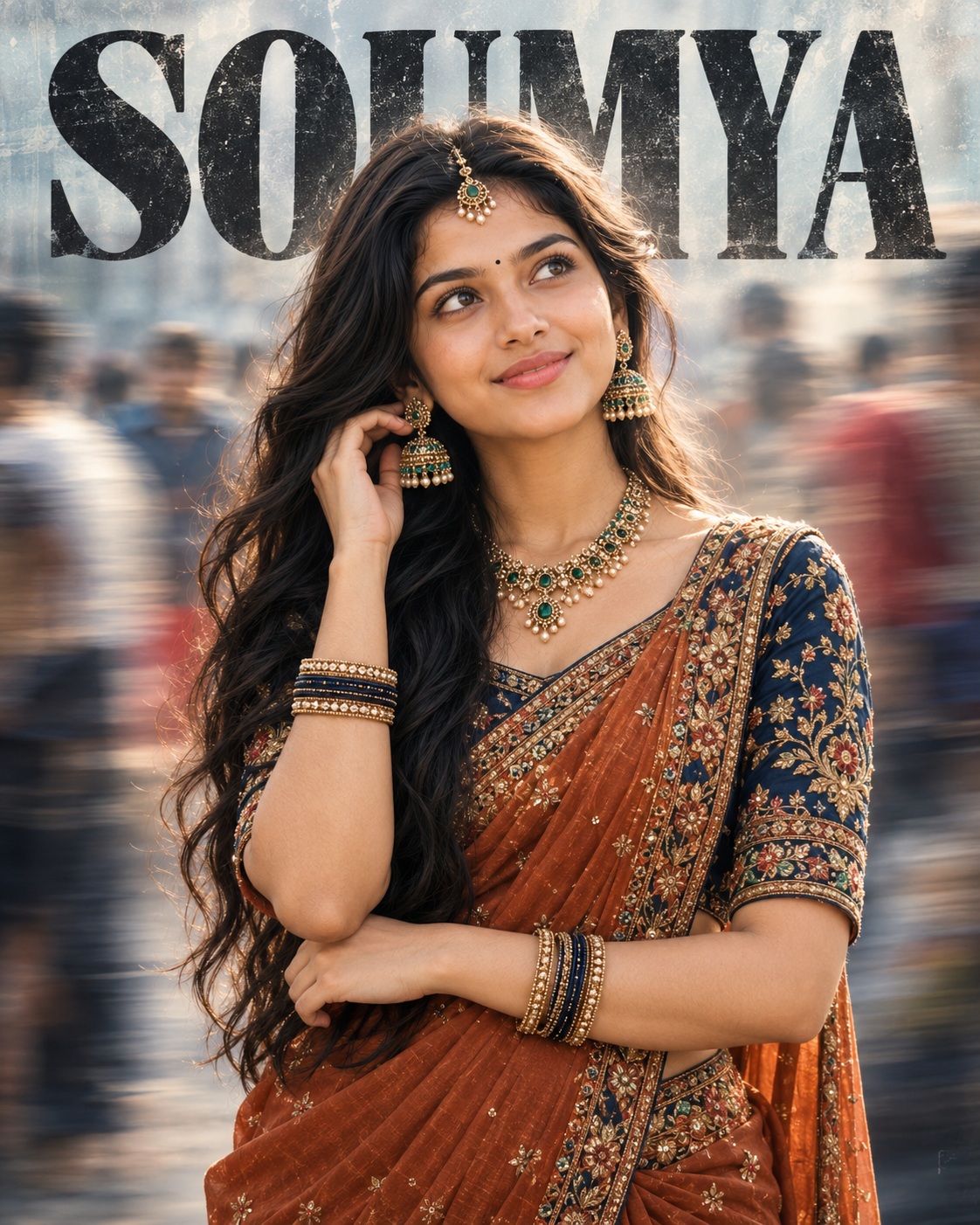
Cinematic Sari Portrait
This concept presents a single female subject in a highly polished cinematic Indian fashion-poster composition. The visual direction combines traditional clothing, expressive portrait photography, atmospheric movement, large editorial typography, and the graceful visual language associated with an Indian film poster. The woman remains the clear focal point throughout the composition, while the surrounding background becomes softer, more dynamic, and intentionally less recognizable. The overall design feels joyful, elegant, warm, nostalgic, and visually sophisticated.
The main subject is one woman positioned centrally and occupying most of the vertical frame. The portrait is tightly framed from the upper torso toward the bottom edge, and the original amount of visible body is an important part of the composition. The framing should not become wider or tighter because the reference relies on a very specific relationship between the woman’s body and the edges of the poster. Her scale remains dominant, giving the face, sari, jewelry, and expressive pose enough visual presence to carry the entire artwork.
The woman’s identity is the primary personal element. The supplied user’s recognizable facial characteristics are preserved while the visual styling follows the reference. Facial structure, eyes, nose, lips, jawline, cheeks, natural asymmetry, and other distinctive traits remain important for recognition. The identity is integrated into the cinematic portrait rather than appearing as a separate realistic face placed over another character. This creates a more natural connection between the user’s appearance and the established visual language of the poster.
Her expression is bright and genuinely joyful. The face is turned upward toward the upper-left portion of the composition, and the head is gently tilted. The upward gaze gives the portrait an open, optimistic quality, while the smile adds warmth and approachability. The expression is not exaggerated or theatrical. Its appeal comes from the combination of natural happiness, graceful posture, and soft cinematic lighting.
The pose has a particularly important role in the visual storytelling. One hand is raised beside the ear and delicately touches or adjusts the earring. The other arm crosses naturally across the waist. The shoulders, elbows, wrists, and hands create a graceful arrangement that complements the sari and jewelry. Because the hand near the ear connects directly with the earring, the gesture also draws attention toward the face and traditional styling. The exact arm geometry should remain consistent with the reference rather than being simplified.
The hairstyle is long, dark, and softly wavy. Loose strands frame the face, while the overall hair retains natural volume around the head. The hair is not treated as an overly polished salon hairstyle. Its softness and movement contribute to the atmospheric quality of the portrait. A small black bindi and central maang tikka provide important traditional forehead details, giving the styling a distinctly Indian character.
The sari is one of the strongest visual components. The drape uses warm rust, copper, and brown tones, creating a rich contrast against the cooler background. The sari crosses naturally over the torso and extends toward the lower portion of the frame. Fabric folds, borders, embroidery, and ornamental details contribute depth. The sari should retain a luxurious traditional appearance rather than becoming a simplified modern fashion garment.
The blouse provides a strong secondary color and texture. It is deep navy or dark blue and heavily embroidered. Dense gold, copper, muted red, and jewel-toned ornamentation covers the visible sleeves and fabric. This embroidery gives the clothing a premium handcrafted quality. The combination of dark blue with rust and antique gold makes the outfit visually rich without requiring excessive color saturation.
Jewelry completes the traditional styling. Large chandelier earrings frame the face and connect directly with the raised hand gesture. An elaborate layered necklace with green gemstone accents adds detail across the upper torso, while the central maang tikka reinforces the forehead styling. The jewelry should appear substantial and ornate but remain consistent with the soft cinematic rendering. Metallic highlights provide small points of visual sparkle without turning the portrait into a glossy commercial product photograph.
The background is intentionally atmospheric. It uses a pale cool gray-blue environment that contrasts with the warm sari and skin tones. Several indistinct people appear behind the main woman, but they remain blurred and visually secondary. Their purpose is to suggest movement and a populated cinematic setting without competing with the subject. The background should not become a collection of recognizable secondary portraits.
Motion blur is a defining creative feature. The people behind the woman are strongly blurred with radial or vertical movement, creating the impression that the surrounding environment is moving while the central character remains composed and sharply rendered. This contrast gives the poster energy. The woman’s face, jewelry, sari texture, and main body remain clear, while the background appears to flow around her.
Typography provides another important layer. The word “ANUPAMA” is placed prominently across the upper background behind the woman’s head. It is large, uppercase, bold, dark charcoal or black, and slightly distressed. The woman’s hair and head partially obscure the lettering, allowing the text to feel physically integrated into the poster instead of appearing as a separate title placed on top. The typography contributes an editorial and cinematic identity to the composition.
The lighting is soft rather than harsh. Diffused frontal or upper illumination creates gentle highlights across the face, while a subtle glow surrounds portions of the hair and head. Shadows remain moderate and controlled. The lighting should preserve natural skin texture and avoid the extremely bright, high-contrast appearance associated with heavy studio retouching. The atmosphere should feel luminous without becoming overexposed.
Color balance is carefully controlled. The cool gray-blue background creates a calm foundation, while warm skin, rust and copper sari tones, deep navy fabric, and antique gold jewelry introduce warmth. The green gemstone details provide a restrained accent. Saturation remains moderate, allowing the image to feel cinematic and sophisticated rather than digitally intense.
The artistic style combines fashion photography, Indian film-poster design, and subtle painterly softness. The face and clothing retain photographic realism, but atmospheric diffusion and textured edges give the image a slightly softened editorial quality. The result should not look like a clean commercial photograph, a 3D render, an anime illustration, or a heavily painted artwork. Its strength comes from maintaining realistic structure while adding cinematic atmosphere.
Depth of field is another important part of the concept. The main woman remains clearly defined while the background loses detail through blur, motion, and atmospheric diffusion. This separation makes the subject immediately readable. The effect also reinforces the idea that the woman is the still center of a moving environment.
The poster’s emotional tone is warm, graceful, joyful, and nostalgic. Traditional clothing and jewelry provide cultural richness, while the smile and upward gaze keep the portrait lively. The moving background creates a sense of a larger story beyond the frame. Together, these elements create the feeling of a memorable film-poster moment rather than a static studio portrait.
Compositionally, the central placement is essential. The woman’s body occupies most of the poster, while the typography and blurred figures support her rather than compete with her. The crop remains tight enough to emphasize her face and styling but broad enough to show the sari, necklace, crossed arm, and important fabric details. This balance makes the image feel like a fashion editorial while preserving the cinematic poster character.
The concept also demonstrates how traditional styling can be presented in a contemporary visual format. The sari, bindi, maang tikka, chandelier earrings, necklace, embroidery, and expressive pose establish a traditional foundation. The typography, motion blur, atmospheric background, and fashion-poster composition provide a modern editorial framework. Neither side overwhelms the other, allowing the result to feel culturally recognizable while remaining visually polished.
From a creative design perspective, this style can be useful for personal portraits, social-media artwork, fashion posts, cultural celebrations, editorial campaigns, festive portraits, profile artwork, promotional posters, and cinematic personal branding. It is especially suitable when the goal is to combine traditional Indian elegance with a modern photographic presentation.
The reference-driven approach is important because the concept depends on preserving the established visual structure. The user’s identity becomes the personal center, while the pose, crop, clothing arrangement, jewelry placement, background motion, typography, lighting, and color relationships remain connected to the original reference. This keeps the artwork cohesive instead of turning it into a completely new fashion composition.
The negative details reinforce this consistency. Unwanted changes include a different face, incorrect expression, downward gaze, altered hand position, changed body visibility, missing jewelry, simplified embroidery, western clothing, sharp background figures, missing motion blur, incorrect typography, harsh studio light, HDR, oversaturation, excessive skin smoothing, anime styling, 3D rendering, or a redesigned poster. These exclusions protect the visual identity of the reference.
Overall, the concept is a sophisticated celebration of feminine Indian fashion presented through a cinematic editorial lens. The smiling woman, upward gaze, graceful hand gesture, ornate jewelry, rust sari, embroidered blue blouse, cool atmospheric background, moving figures, and bold “ANUPAMA” typography work together as one unified visual composition. The result is designed to feel elegant, joyful, nostalgic, culturally rich, and polished while keeping the user’s identity at the center of the artwork.
[[[
REFERENCE ANALYSIS
- Composition: Vertical cinematic fashion-poster portrait, tightly framed from the upper torso to the bottom edge. The woman is centered and occupies most of the frame. Do not alter the portrait scale or crop.
- Main subject: One female character, looking upward toward the upper-left with a bright, natural smile. Her head is slightly tilted.
- Pose: Right hand raised beside the ear, touching/adjusting the earring. Other arm crosses naturally across the waist. Preserve the exact arm geometry and hand positions.
- Hair & face: Long dark wavy hair, loosely styled with soft strands around the face. Small black bindi and traditional forehead jewelry. Preserve the user’s identity while reproducing these details in the reference style.
- Clothing: Rich traditional sari with a warm rust/copper-brown drape and heavily embroidered dark blue blouse. Dense gold, copper and multicolor ornamental embroidery covers the sleeves and fabric.
- Jewelry: Large traditional chandelier earrings, ornate layered necklace with green stones, and central maang tikka. Preserve placement and visual scale.
- Background: Pale cool gray/blue atmospheric background with multiple blurred people moving behind the subject.
- Motion: Strong radial/vertical motion blur on background figures, creating a sense of movement while the main woman remains sharply rendered.
- Typography: Large bold uppercase “ANUPAMA” behind the woman’s head across the upper portion. The text is dark charcoal/black with a slightly distressed texture and remains partially integrated behind the subject.
- Lighting: Soft diffused frontal/upper light with a gentle glow around the hair and face. Moderate contrast, soft skin highlights and muted shadows.
- Style: Cinematic Indian film-poster / editorial portrait photography with subtle painterly softness, atmospheric diffusion, controlled depth of field and textured edges.
- Mood: Warm, joyful, graceful, elegant and nostalgic.
MASTER PROMPT
Use the supplied reference image as the master visual blueprint. Replace only the reference character with the supplied user identity. Maintain the exact subject scale, screen-space proportion, cropping, and visibility of the reference character; do not normalize, enlarge, or reframe. Preserve all other visual information, composition, environment, lighting, color, depth, atmosphere, objects, background and artistic rendering as faithfully as possible.
Reconstruct the reference as a vertical cinematic Indian fashion/film-poster portrait. Preserve the exact framing and subject scale: one female character occupies the central majority of the frame, shown from approximately the upper torso downward to the bottom crop, with the same amount of body visible and the same relationship to every frame edge. Do not expand the crop, reveal additional legs or feet, zoom in, zoom out, or change the camera distance.
Replace the reference woman’s identity with [USER IDENTITY]. Preserve the user’s recognizable facial structure, eyes, nose, lips, jawline, cheeks, natural asymmetry and distinctive features. Integrate the identity naturally into the reference’s photographic/cinematic rendering rather than pasting a realistic face onto a different person. The user’s identity must remain recognizable while the pose, expression, clothing, lighting and styling follow the reference.
Preserve the exact pose: the head is gently tilted and turned upward toward the upper-left portion of the frame, with a bright natural smile and an expressive upward gaze. One hand is raised beside the ear, delicately touching the earring, while the opposite arm crosses naturally in front of the waist. Maintain the exact shoulder angle, elbow positions, wrist orientation, hand placement and visible amount of each arm.
Preserve the hairstyle as a long, dark, softly wavy hairstyle, with loose strands framing the face and natural volume around the head. Preserve the traditional forehead styling: small black bindi and delicate central maang tikka/forehead ornament. Do not replace the styling with modern Western accessories.
Preserve the exact traditional outfit: a richly detailed sari with a warm rust/copper-brown drape crossing the torso and falling toward the lower frame, paired with a deep navy/blue heavily embroidered blouse. Maintain the dense ornamental embroidery across the sleeves and visible fabric, including gold, copper, muted red and jewel-toned decorative motifs. Preserve fabric folds, drape direction, border detailing, stitching and ornamental texture.
Preserve the traditional jewelry exactly in its visual role and placement: large ornate chandelier earrings, elaborate layered necklace with green gemstone accents, and central maang tikka. Jewelry should have realistic metallic highlights while remaining consistent with the reference’s soft cinematic rendering.
Keep the background as the same pale cool gray-blue atmospheric environment with several indistinct people positioned around and behind the main character. These background figures must remain heavily motion-blurred and partially smeared, suggesting movement through the scene. The central woman remains sharply defined relative to the moving background. Do not add recognizable secondary characters or redesign the environment.
Preserve the large typography “ANUPAMA” across the upper background, behind the subject’s head. Keep the letters very large, uppercase, bold, dark charcoal/black, slightly distressed/textured, and partially obscured by the woman’s head and hair exactly as in the reference. [TEXT] should only replace or modify this if explicitly requested.
Match the reference lighting: soft, diffused, slightly cool ambient illumination with gentle warm skin highlights, subtle glow around the hair and face, moderate contrast and softly controlled shadows. Preserve the atmospheric haze and delicate bloom around bright regions. Do not dramatically brighten the face or introduce hard studio lighting.
Preserve the muted cinematic palette: cool gray-blue background, natural warm skin tones, deep navy fabric, rust/copper sari tones, antique gold jewelry and restrained saturation. Avoid excessive HDR, oversaturation or modern orange-teal grading.
Preserve the subtle cinematic photographic softness, shallow depth of field, atmospheric diffusion, realistic fabric texture, detailed embroidery, natural skin texture and controlled background blur. The finished image should resemble the same reference poster with only the original woman replaced by [USER IDENTITY], with all composition, pose, styling, typography, background movement and visual atmosphere retained.
EDITABLE VARIABLES
- [USER IDENTITY]: Supplied user’s identity; preserve recognizable facial structure, proportions and natural features.
- [OUTFIT]: Reference sari, embroidered blue blouse and traditional jewelry.
- [TEXT]: “ANUPAMA” — preserve exactly unless the user specifies replacement text.
- [OBJECT CHANGE]: None.
- [POSE CHANGE]: Reference pose — upward gaze, smile, hand touching earring, opposite arm across waist.
- [ADDITIONAL EDIT]: None unless explicitly specified.
NEGATIVE PROMPT
identity loss, different face, generic face, original character remaining, added person, extra main subject, face swap, pasted face, artificial face, wrong facial proportions, wrong expression, closed eyes, downward gaze, wrong head angle, wrong pose, wrong hand position, altered arm geometry, extra fingers, malformed hands, altered body visibility, full body, legs revealed, feet revealed, changed crop, changed framing, zoomed in, zoomed out, enlarged subject, reduced subject, recentered composition, changed camera distance,
altered screen-space proportion, changed background, clean empty background, sharp background people, recognizable secondary people, missing motion blur, missing typography, incorrect text, misspelled ANUPAMA, text in front of subject, altered text scale, modern font, missing sari, wrong sari color, western clothing, missing embroidery, simplified clothing, missing jewelry, modern jewelry, excessive jewelry, missing bindi,
missing maang tikka, harsh studio lighting, overexposed face, brighter face, lifted shadows, HDR, oversaturation, orange-teal grading, plastic skin, excessive skin smoothing, excessive sharpening, anime, illustration, 3D render, cartoon, unwanted painterly conversion, altered atmosphere, lost depth of field, lost motion blur, redesigned poster, unnecessary modifications. ]]]