
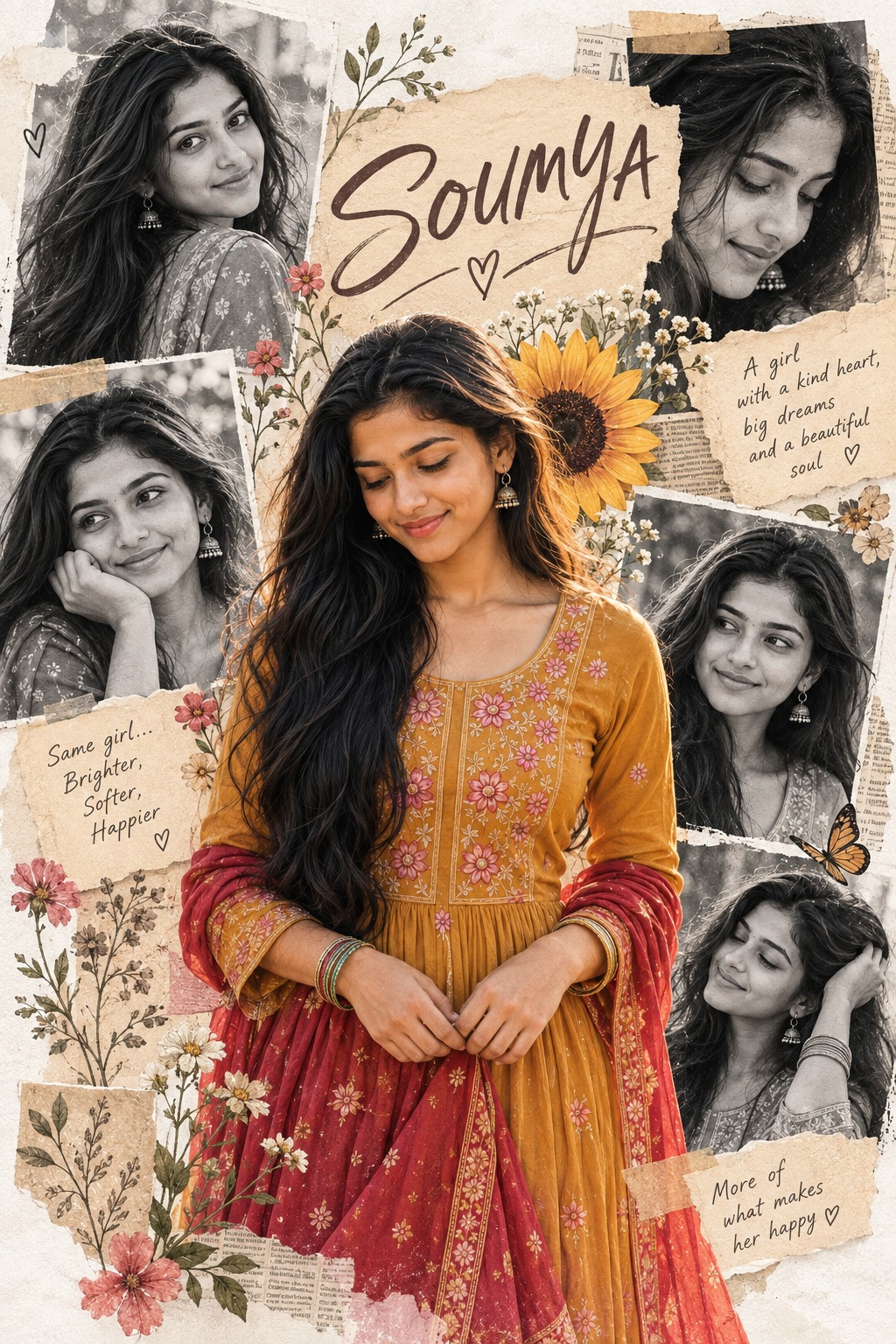
Mixed Media Portrait Collage
This concept is designed as a sophisticated mixed-media editorial scrapbook collage centered around one female identity. The main visual idea is to combine one large color portrait with five smaller monochrome portraits of the same woman. This creates a strong contrast between the warm central image and the surrounding black-and-white photographic treatments, giving the composition a refined magazine-editorial character.
The overall artwork is vertical and arranged as a layered collage rather than a conventional single portrait. The central woman is the dominant figure, while the five smaller portraits surround her at different sizes and positions. Each secondary portrait has its own crop, pose, clothing visibility and facial direction. The variety between these six appearances creates visual movement while maintaining the continuity of one recognizable person.
The central portrait is the primary focal point. She is shown from the head down toward the lower body, giving the viewer considerably more information than the surrounding portraits. Her gaze is directed downward or slightly sideways, accompanied by a soft smile. Her hands are held together near the waist, producing a calm and elegant body posture.
The central figure remains in natural color, which immediately separates her from the monochrome portraits. This color treatment is one of the most important visual decisions in the composition. Warm skin tones, colorful traditional clothing and red or orange fabric create a lively focal point against the neutral grayscale surrounding images.
The user’s identity is intended to remain consistent throughout all six appearances. Facial structure, eyes, eyebrows, nose, lips, cheeks, jawline, hair characteristics and natural asymmetry are important identity markers. The concept is not about creating six separate interpretations of a person; it is about presenting one identity through six different editorial photographs.
The five surrounding portraits are treated in black and white. Their grayscale appearance gives the composition a vintage photographic quality and creates strong contrast with the central color image. Each monochrome portrait retains its own reference pose and crop, ensuring that the surrounding images feel like individual photographs rather than duplicated versions of the main portrait.
The monochrome portraits also create a visual frame around the central subject. Because they vary in size and placement, they produce a layered editorial rhythm. Some portraits may emphasize the face, while others reveal more clothing or body position. This variation makes the collage feel collected from different moments.
The clothing of the central woman provides another important visual anchor. She wears a colorful traditional Indian outfit with a patterned blouse or skirt and a red or orange drape. Jewelry and fabric details contribute to the warmth of the central portrait. The surrounding portraits retain their own reference clothing rather than being forced into identical styling.
The background uses white textured paper rather than a conventional photographic environment. Fine paper fibers, subtle grain and faint gray imperfections give the surface a tactile quality. This paper foundation allows the photographs, botanical elements and torn-paper layers to appear as physical objects assembled into a scrapbook.
The paper texture is deliberately understated. It should not overpower the portraits. Instead, it creates small variations across the white background that make the artwork feel handmade and editorial. The slightly imperfect surface helps connect the photographic elements with the physical-paper aesthetic.
Botanical details are distributed around the composition. Hand-drawn stems, flowers and other plant forms introduce delicate organic shapes. These elements provide visual transitions between the photographic portraits and the empty paper areas.
A sunflower near the central woman’s hair provides a stronger botanical accent. Its warm color reinforces the central portrait’s natural color treatment and creates a recognizable focal detail. The flower also connects the woman visually with the surrounding hand-drawn botanical elements.
Torn-paper pieces contribute another layer of texture. Their irregular edges and subtle shadows make the collage feel physically assembled rather than digitally arranged. The paper fragments can support text, photographs or decorative elements while preserving the overall vintage editorial character.
A newspaper clipping behind the upper-right portrait adds an additional archival reference. Its presence suggests that the collage is built from collected paper materials, old photographs and editorial fragments. This newspaper element also creates a contrast between photographic imagery and printed media.
The combination of photography, paper, botanical drawings and newspaper texture produces a mixed-media language that feels sophisticated and nostalgic. The composition does not depend on a single visual effect. Instead, it gains character from the interaction between multiple material textures.
Personalization is a major functional feature of the concept. Users can provide a name, date, occasion, title, message, quote, location or additional details. These values are intended to be integrated into the collage itself rather than added as a modern text layer.
The name or title can appear as elegant editorial typography or a handwritten paper label. This allows short information to become part of the physical scrapbook language. A date can function like a small handwritten annotation, newspaper-style caption or vintage paper note.
Longer messages or quotes can appear on torn-paper elements or newspaper-inspired fragments. This gives the text a natural physical context within the artwork. Instead of appearing as a large modern caption, the information becomes another piece of the collage.
An occasion can be treated as a small editorial heading, while short additional information can appear as subtle scrapbook annotations. The visual treatment should adapt to the type and amount of supplied information while remaining faithful to the vintage paper aesthetic.
The typography therefore has a supporting role. The portraits remain the primary visual focus, while personalized information is integrated into the surrounding paper layers. This keeps the design elegant and prevents text from dominating the composition.
Accuracy of personalized text is particularly important in this concept. Names, dates, punctuation, capitalization and special characters should retain the supplied form. The personalized information is part of the user’s identity and should visually belong to the collage without being altered.
The design also maintains an important distinction between central color photography and secondary monochrome photography. The central image provides warmth, personality and immediate attention. The five surrounding grayscale images create a documentary or editorial frame around it.
This mixed treatment can make the composition feel like a combination of a fashion editorial, personal scrapbook and vintage photo archive. The central image feels contemporary and alive, while the monochrome photographs provide a timeless supporting layer.
The emotional mood is elegant, artistic, nostalgic and personal. It is not overly dramatic. Instead, the soft smile, traditional styling, botanical elements and paper textures create a quiet editorial atmosphere that feels curated and meaningful.
The composition is particularly suitable for personalized portraits, fashion editorials, cultural artwork, social media graphics, memory collages, anniversary concepts, lifestyle presentations and personal branding. The mixed-media format gives the subject more storytelling space than a conventional single portrait.
The central color portrait also creates a clear hierarchy. Because it is larger and more colorful, the viewer naturally looks there first. The grayscale portraits then guide the eye around the composition, while flowers, torn paper and newspaper fragments provide smaller visual discoveries.
The white paper background is important because it creates negative space between the elements. Without this breathing room, the six portraits and decorative objects could become visually crowded. The white surface allows each component to retain its own identity while still belonging to the same collage.
The botanical drawings soften the harder edges of the photographic portraits and paper fragments. Their thin organic lines introduce a hand-drawn quality that contrasts nicely with the grayscale photography.
The newspaper clipping adds historical and editorial character. It can appear partially hidden behind a portrait, allowing the printed texture to function as a background layer rather than a dominant graphic.
The overall design demonstrates how different visual materials can work together when they share a restrained color and texture language. White paper, grayscale photography, warm central color, botanical lines and muted paper fragments create a cohesive visual environment.
Another important characteristic is the absence of excessive digital polish. The collage benefits from subtle imperfections such as paper grain, irregular torn edges, faint shadows and handmade botanical marks. These details make the artwork feel tangible.
The concept also supports a wide range of personalized information without changing the main composition. Whether the user provides only a name or a combination of name, date, quote and occasion, the information can be placed within the existing scrapbook structure.
This flexibility makes the concept useful for different creative purposes. A name and date can create a personal memory card, while an occasion and title can turn the collage into an editorial celebration. A longer quote can provide an emotional statement without disrupting the portrait hierarchy.
The surrounding monochrome portraits also allow the user’s identity to be explored through different poses. Instead of repeating the central pose, each secondary photograph maintains its own reference character. This gives the collage visual variety while keeping the person consistent.
The central traditional outfit adds cultural richness. Patterned fabric, colorful draping and jewelry provide visual detail that stands out strongly against the white paper and grayscale images. The red and orange tones also connect naturally with botanical accents.
The overall aesthetic can be described as vintage editorial scrapbook photography with contemporary portrait identity. It combines fashion, photography, paper craft and botanical decoration in one unified composition.
The strongest creative feature is the contrast between color and monochrome. One large warm portrait communicates the present and personality, while the five grayscale images create an archival feeling. This contrast makes the composition immediately recognizable and visually sophisticated.
The design is especially effective for users who want a portrait concept that feels personal rather than generic. The repeated identity, handwritten-style information and physical scrapbook textures make the artwork feel like a curated collection created specifically around one person.
The final impression is elegant, nostalgic and editorial. The central color portrait remains dominant, the monochrome portraits provide supporting rhythm, and the paper, flowers and newspaper elements create a handcrafted visual world around them.
[[[
REFERENCE ANALYSIS
- Composition: Vertical collage poster with one large central color portrait surrounded by five smaller monochrome portraits of the same woman.
- Main subject: Central woman is the dominant figure, shown nearly full-length from head to lower body. She is looking downward/sideways with a soft smile, hands held together near the waist.
- Secondary portraits: Five grayscale versions of the same identity surround the central figure at different scales, poses and crops. Preserve their exact individual poses and placements.
- Style: Mixed-media editorial collage — central portrait in warm natural color, surrounding portraits in black-and-white photographic treatment.
- Background: White textured paper with faint grain and collage-paper appearance.
- Graphic elements: Hand-drawn botanical stems, pressed/painted flowers, a sunflower near the central woman’s hair, torn-paper elements and a newspaper clipping behind the upper-right portrait.
- Clothing: Central subject wears a colorful traditional Indian outfit with patterned blouse/skirt and red/orange dupatta. Secondary portraits retain their own reference clothing.
- Important personalization: User can provide name, date, quote, message, occasion, title or other details. These must be dynamically inserted into the final collage without changing the reference composition.
- Text style: User-provided information should look like it was originally designed into this scrapbook/editorial collage—e.g. handwritten notes, newspaper clipping, paper strips, small editorial captions or elegant typography—depending on the amount/type of information supplied.
MASTER PROMPT
Use the supplied reference image as the master visual blueprint. Replace only the reference character with the supplied user identity. Maintain the exact subject scale, screen-space proportion, cropping, and visibility of the reference character; do not normalize, enlarge, or reframe. Preserve all other visual information, composition, environment, lighting, color, depth, atmosphere, objects, background and artistic rendering as faithfully as possible.
Reconstruct the reference as a vertical mixed-media editorial scrapbook portrait collage.
Preserve the exact composition: one large central color portrait surrounded by five smaller monochrome portrait appearances of the same person. Preserve the exact number of portraits, their individual sizes, positions, crops, poses, overlaps and spacing.
Replace the reference woman’s identity with [USER IDENTITY] consistently across all six appearances. The central portrait and all five surrounding portraits must clearly represent the same user. Preserve the user’s recognizable facial structure, eyes, eyebrows, nose, lips, jawline, cheeks, hair characteristics and natural asymmetry. Do not make the six portraits look like six different people.
The central portrait must remain the dominant color element. Preserve its exact pose, downward/sideways gaze, soft smile, hand placement, body position, clothing silhouette and visible body amount. Keep the same colorful traditional outfit, patterned fabric, red/orange drape and jewelry treatment from the reference unless [OUTFIT] is explicitly changed.
Preserve the five surrounding portraits as black-and-white photographic/collage portraits. Each must retain its own reference pose, crop, facial direction, clothing silhouette and placement. Do not turn them into identical copies of the central portrait.
Preserve the background as white textured paper, including subtle paper fibers, grain, faint gray imperfections and handmade collage character.
Preserve all decorative visual elements: hand-drawn botanical stems, flowers, sunflower, torn paper pieces, newspaper clipping, grayscale portrait layers and subtle collage shadows. Maintain their original locations and relationships to the subjects.
LIVE USER TEXT / DETAILS
The user may provide any combination of:
- [USER NAME]
- [DATE]
- [OCCASION]
- [TITLE]
- [CUSTOM MESSAGE]
- [QUOTE]
- [LOCATION]
- [ADDITIONAL DETAILS]
These are live variables. At generation time, replace the variables with the exact information supplied by the user.
Never show the variable names, brackets or placeholder text in the final artwork.
The supplied information must be integrated inside the collage in the same visual language as the reference, rather than appearing as a modern text box pasted on top.
For example:
- A name/title can appear as elegant editorial typography or a handwritten paper label.
- A date can appear as a small handwritten date, newspaper-style caption or vintage paper annotation.
- A long message/quote can appear naturally on a torn-paper note or newspaper-paper element.
- An occasion can appear as a small editorial heading.
- Short additional details can be distributed as subtle scrapbook annotations.
Choose the text treatment according to the amount and type of information provided while keeping it visually consistent with the reference: cream/white paper, black or dark-gray ink, handwritten lettering, serif editorial typography, newspaper texture, torn-paper edges and subtle collage integration.
Do not create a large modern text box, neon typography, clean digital UI text or unrelated decorative typography. The user’s information should look as though it was physically part of the original vintage collage.
If the user supplies no text/details, do not invent any. Preserve the reference’s original visual elements instead.
If the user supplies text, spell it exactly as provided, including names, dates, punctuation, capitalization and special characters. Do not paraphrase, shorten or “correct” user-provided text.
The personalized text must never cover important facial features, hands or major clothing details unless the reference itself has an overlapping graphic element there.
Preserve the reference’s mixed color treatment: warm, naturally colored central portrait contrasted against surrounding monochrome portraits. Keep realistic skin texture, photographic detail and subtle tonal transitions.
Maintain the overall artistic collage aesthetic: editorial photography, vintage paper texture, monochrome portrait cutouts, botanical line drawings, torn-paper layers, newspaper fragments and subtle handmade imperfections.
The final result should look like the original reference collage was created specifically for [USER IDENTITY] and the user’s supplied details, rather than having text added afterward.
EDITABLE VARIABLES
- [USER IDENTITY]: Supplied user’s identity; same person across all six portrait appearances.
- [USER NAME]: User-provided name.
- [DATE]: User-provided date.
- [OCCASION]: User-provided occasion.
- [TITLE]: User-provided title/headline.
- [CUSTOM MESSAGE]: User-provided message.
- [QUOTE]: User-provided quote.
- [LOCATION]: User-provided location, if any.
- [ADDITIONAL DETAILS]: Any other user-provided information.
- [OUTFIT]: Preserve reference outfit unless explicitly changed.
- [TEXT STYLE]: Automatically match the reference collage style; do not use modern UI typography.
- [OBJECT CHANGE]: None unless explicitly requested.
- [POSE CHANGE]: None; preserve every reference pose.
NEGATIVE PROMPT
identity loss, inconsistent identity, different person in different portraits, generic face, original character remaining, added people, missing portrait, extra portrait, wrong number of portraits, duplicated pose, identical portraits, changed portrait placement, changed subject scale, enlarged central subject, reduced central subject, altered crop, recentered composition, changed camera distance, altered screen-space proportion, redesigned collage, modern poster design, clean digital collage, plain background, missing paper texture, missing newspaper clipping, missing botanical drawings, missing flowers, missing sunflower, missing torn paper,
missing monochrome portraits, colorizing all portraits, making all portraits black and white, photorealistic face pasted onto illustration, anime, cartoon, 3D render, plastic skin, excessive smoothing, excessive saturation, neon colors, modern UI text, text box, banner, large digital caption, random typography, invented text, missing user text, altered user text, misspelled name, altered date, incorrect punctuation, placeholder text, visible [USER NAME], visible [DATE], visible [CUSTOM TEXT], visible variable names, creator watermark, signature, username, unnecessary modifications. ]]]